Connecting the Future of Central Asia Through Korean Language and Korean Culture 2026 Central Asia KSI Workshop Held
글쓴이홍보협력팀
태그
작성일 2026-09-18
조회수76

Connecting the Future of
Central Asia Through Korean Language and Korean Culture
2026 Central Asia KSI Workshop Held
Central Asia Through Korean Language and Korean Culture
2026 Central Asia KSI Workshop Held
> Operating experiences of Central Asian KSIs were shared in Almaty, Kazakhstan, from August 5 to 7
> Around 170 representatives from 37 KSIs in nine countries participated, strengthening the professional capacity of teachers and operations staff
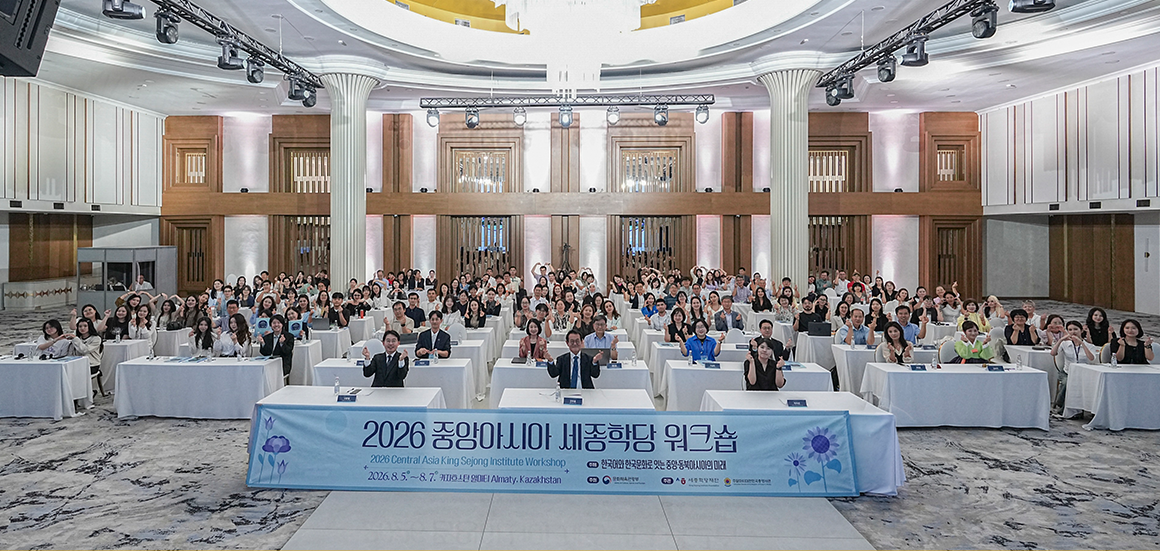
The King Sejong Institute Foundation (KSIF) held the 2026 Central Asia KSI Workshop in Almaty, Kazakhstan, from August 5 to 7. Held under the theme “Connecting the Future of Central Asia Through Korean Language and Korean Culture,” the workshop brought together around 170 participants, including teachers and operations staff from 37 KSIs in nine countries - including Kazakhstan, Uzbekistan, Mongolia, China, and Japan - as well as local Korean language education professionals.
◇ A Workshop Filled with Education, Culture, and Field Experiences
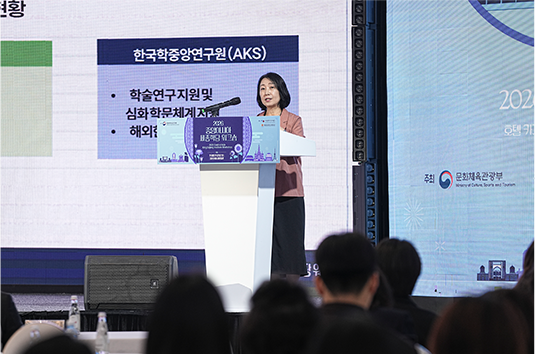
Professor Son Yu-jeong of Al-Farabi Kazakh National University delivering a special lecture
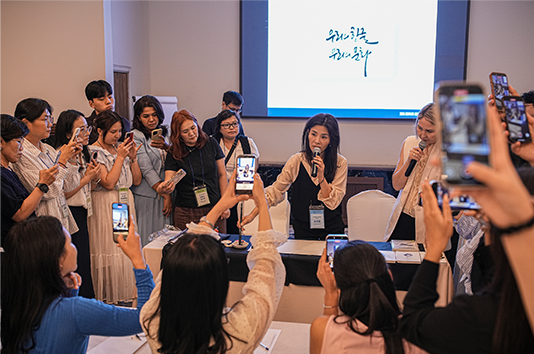
Expert Choi Jeong-mun leading Korean calligraphy training
Over three days and two nights, participants shared the operational experiences of their respective KSIs and took part in special lectures and training sessions designed to strengthen the professional capacity of teachers and operations staff. On the first day, Professor Son Yu-jeong of Al-Farabi Kazakh National University delivered a special lecture on “The Present and Future of Korean Language Education in Central and Northeast Asia,” while Professor Chae Soo-hong of Seoul National University spoke on “Korean Studies from the Perspective of Area Studies.” Participants then had the opportunity to experience Korean culture firsthand and strengthen their cultural education capacity by learning pansori and Korean calligraphy.
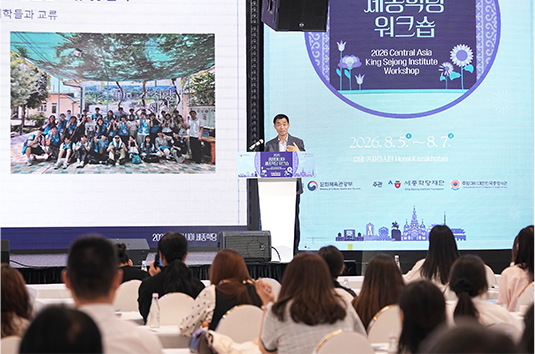
KSI Tashkent 1, Uzbekistan, presenting a case study on institute operations
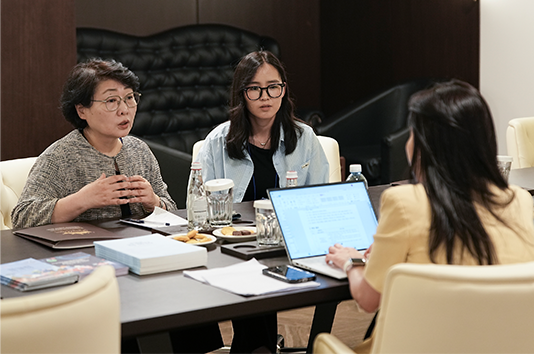
One-on-one operational consulting session
for operations staff
for operations staff
On the second day, practical training continued with content that participants could apply directly in the field at their KSIs. KSI Korean Cultural Center in Kazakhstan and KSI Tashkent 1, Uzbekistan, presented case studies on institute operations, while Professor Kim Jeong-hoon of Hanyang University introduced “Korean Language Teaching Methods Using Artificial Intelligence (AI).” Kim Eun-ji, head of the Sejong Korean Language Assessment Team at the KSIF, delivered a special lecture on “Ways to Use the Sejong Korean Language Assessment (SKA).” In in-depth group training sessions, operations staff received one-on-one consultations, while teachers were introduced to teaching methods using the new textbook Sejong Korean for Study Abroad. Participants also exchanged insights on each institute’s operating methods and classroom cases.
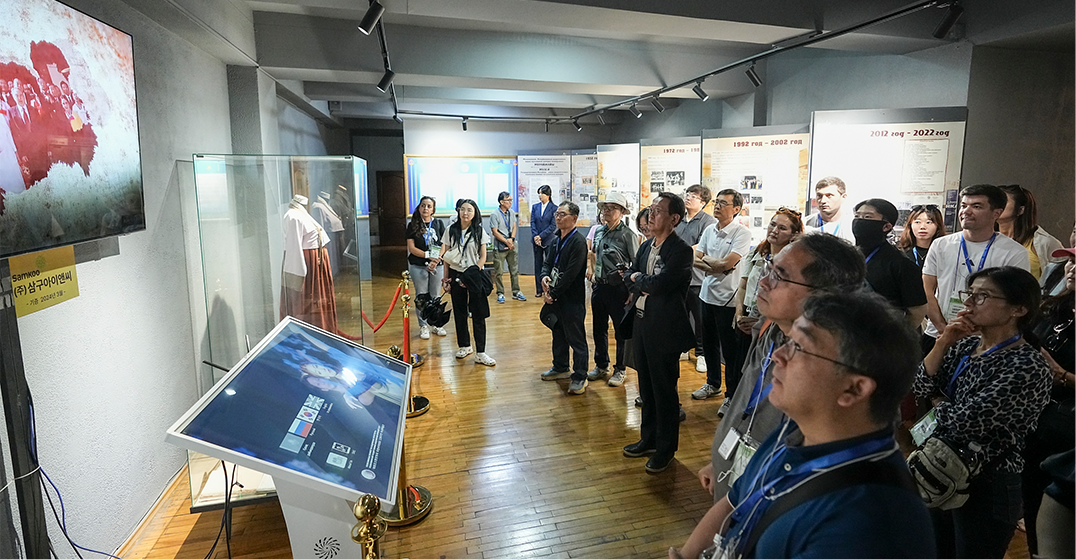
Participants of the Central Asia KSI Workshop visiting the Koryo Theater
On the final day, participants visited cultural landmarks in Almaty and sites connected to the local Korean community, including Panfilov Park, Zenkov Cathedral, and the Koryo Theater. By exploring local history and the Korean diaspora community, participants deepened their understanding and brought the three-day program to a close. The KSIF has worked to respond to the strong interest in Korean language and Korean culture across Central Asia and to support the continued expansion of Korean language education and cultural exchange in the region. It will continue building a foundation for broader people-to-people and cultural exchange between Korea and the countries of Central Asia.
◇ Stories Learned and Shared in Central Asia
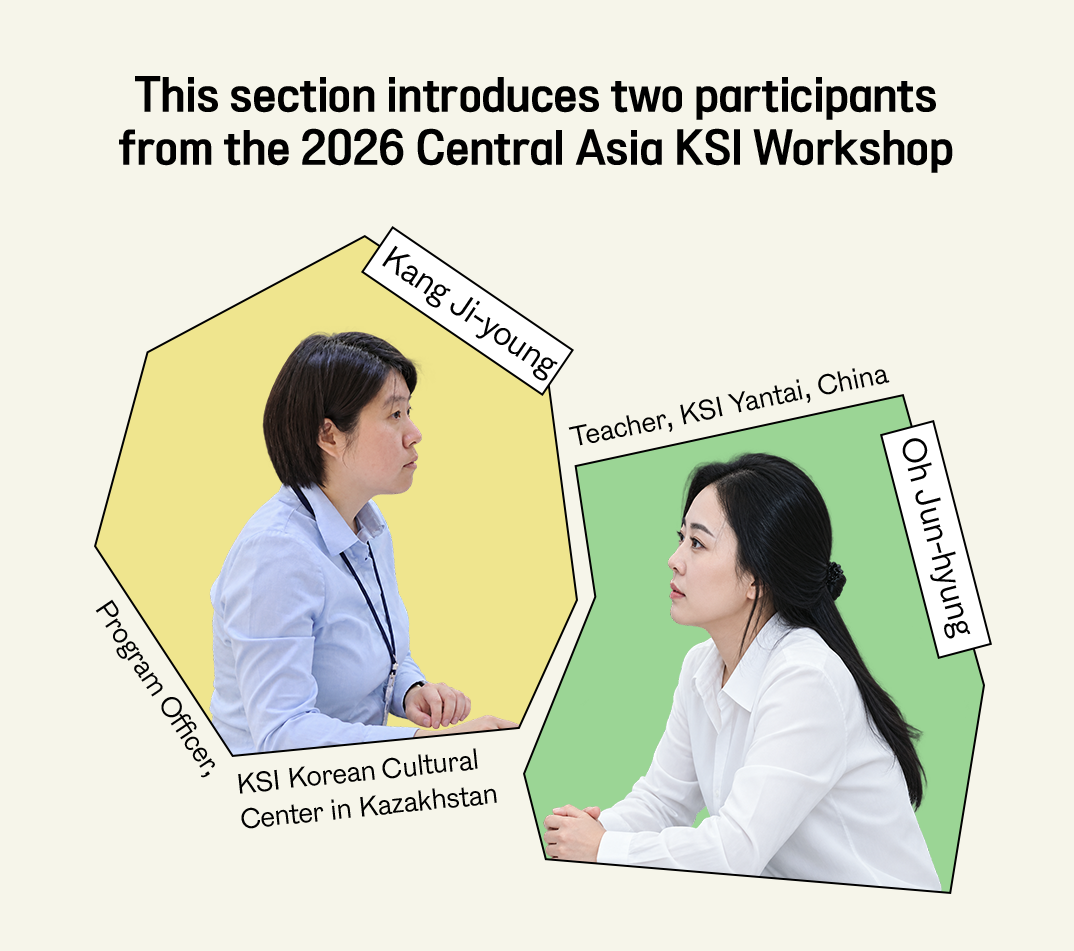
We spoke with Program Officer Kang Ji-young of the KSI Korean Cultural Center in Kazakhstan and Teacher Oh Jun-hyung of KSI Yantai, China, who participated in the workshop, about the enthusiasm for Korean language education in their regions, what they learned through the workshop, and their goals for the future.
Q. Hello. Please introduce the KSI where you currently work and the area you are responsible for. What kinds of people usually come to your KSI locally?
A. Program Officer Kang Ji-young I currently work as a program officer on the Education and Press Team at the Korean Cultural Center in Kazakhstan, where I am responsible for KSI operations and Korean language education. The Korean Cultural Center in Kazakhstan, located in Astana, the capital of Kazakhstan, is the only Korean Cultural Center in Central Asia, and it introduces Korea locally through Korean language courses and cultural events.
Many people come to KSI after becoming interested in Korean culture through Hallyu, including K-pop and K-dramas. We have around 900 learners each year, ranging in age from teenagers to people in their 60s. Female learners in their teens and 20s make up a particularly large share, and recently, as interest in studying and working in Korea has grown, the number of male learners has also been increasing. Kazakhstan is home to around 120,000 Koryo-saram, or ethnic Koreans, and some people learn Korean to preserve their identity as Koreans and understand their roots.
Many people come to KSI after becoming interested in Korean culture through Hallyu, including K-pop and K-dramas. We have around 900 learners each year, ranging in age from teenagers to people in their 60s. Female learners in their teens and 20s make up a particularly large share, and recently, as interest in studying and working in Korea has grown, the number of male learners has also been increasing. Kazakhstan is home to around 120,000 Koryo-saram, or ethnic Koreans, and some people learn Korean to preserve their identity as Koreans and understand their roots.
A. Teacher Oh Jun-hyung At KSI Yantai, China, I teach Korean to learners of various ages and levels through both online and offline classes. In addition to learners who became interested in Korean through Korean popular culture such as K-dramas and K-pop, more and more learners are now studying Korean with specific goals, such as studying or working in Korea. An increasing number of learners also want to go beyond studying the language itself and communicate directly with Korean people and experience Korean culture.
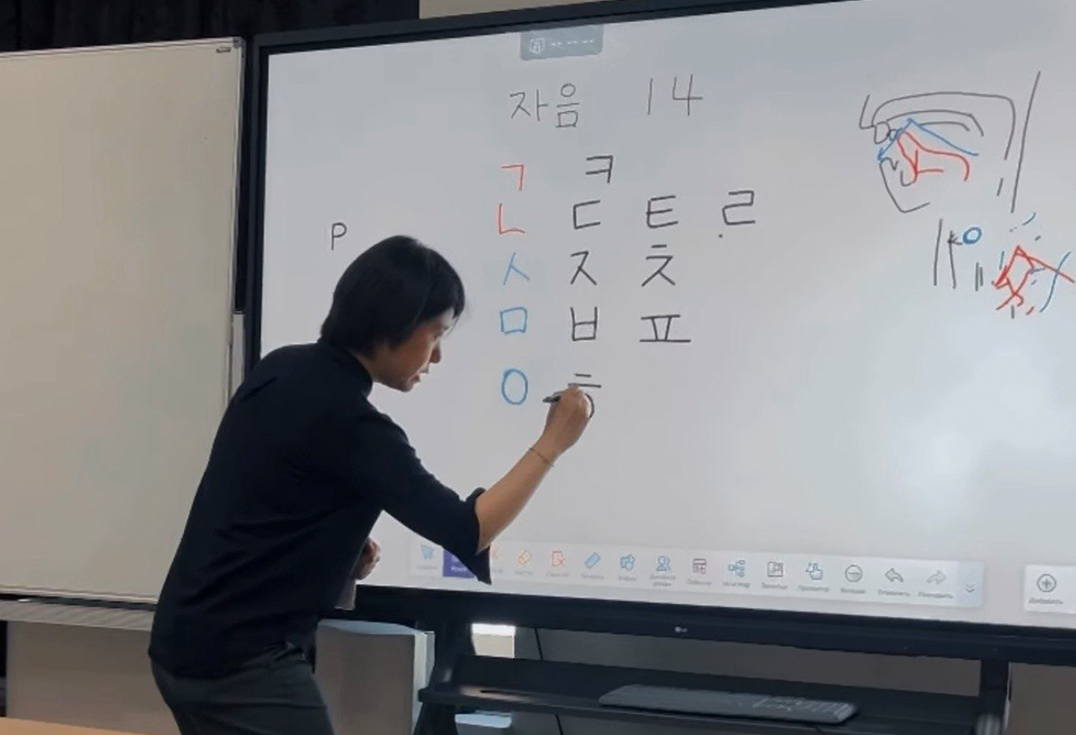
Program Officer Kang Ji-young teaching a class at KSI Korean Cultural Center in Kazakhstan
Q. What led you to work at a local KSI, and what was the process like? Please also share a moment when you felt the greatest sense of fulfillment in your work.
A. Program Officer Kang Ji-young After double-majoring in Korean literature at university, I became naturally interested in Korean language education when I started working at the Korean Cultural Center. I first became connected with KSI while moving from cultural event-related work into education-related work. About nine years ago, I took over a Sejong Korean 1A class for two months in place of a teacher who suddenly became unable to teach, and that was the beginning. The learners who studied Hangeul with me back then are now adults living their own lives. Whenever I meet them again at cultural center events and exchange greetings, I feel very happy.
The moments when I feel most fulfilled are when I can see learners’ growth. It is deeply rewarding to see a learner who did not know Hangeul at all naturally carry on a basic conversation in Korean after completing one semester. I am especially moved when learners I have watched for a long time complete the regular Sejong Korean course through 4B and graduate.
The moments when I feel most fulfilled are when I can see learners’ growth. It is deeply rewarding to see a learner who did not know Hangeul at all naturally carry on a basic conversation in Korean after completing one semester. I am especially moved when learners I have watched for a long time complete the regular Sejong Korean course through 4B and graduate.
A. Teacher Oh Jun-hyung When I was attending university in China, I began teaching Korean for free to friends who were interested in the language because I wanted to share what I knew. Teaching my native language to foreign friends was a special and rewarding experience. As I explained the Korean I had always used naturally to others, I also came to see the language in a new way, and my interest in Korean language education grew.
That experience led me to remain in China after graduating from university and continue teaching Korean, and later I came to work at a KSI. Sometimes, learners tell me that they first spoke to a Korean person they met on the street and became friends. In those moments, I feel especially proud, because the Korean I taught has led to real communication outside the classroom.
That experience led me to remain in China after graduating from university and continue teaching Korean, and later I came to work at a KSI. Sometimes, learners tell me that they first spoke to a Korean person they met on the street and became friends. In those moments, I feel especially proud, because the Korean I taught has led to real communication outside the classroom.
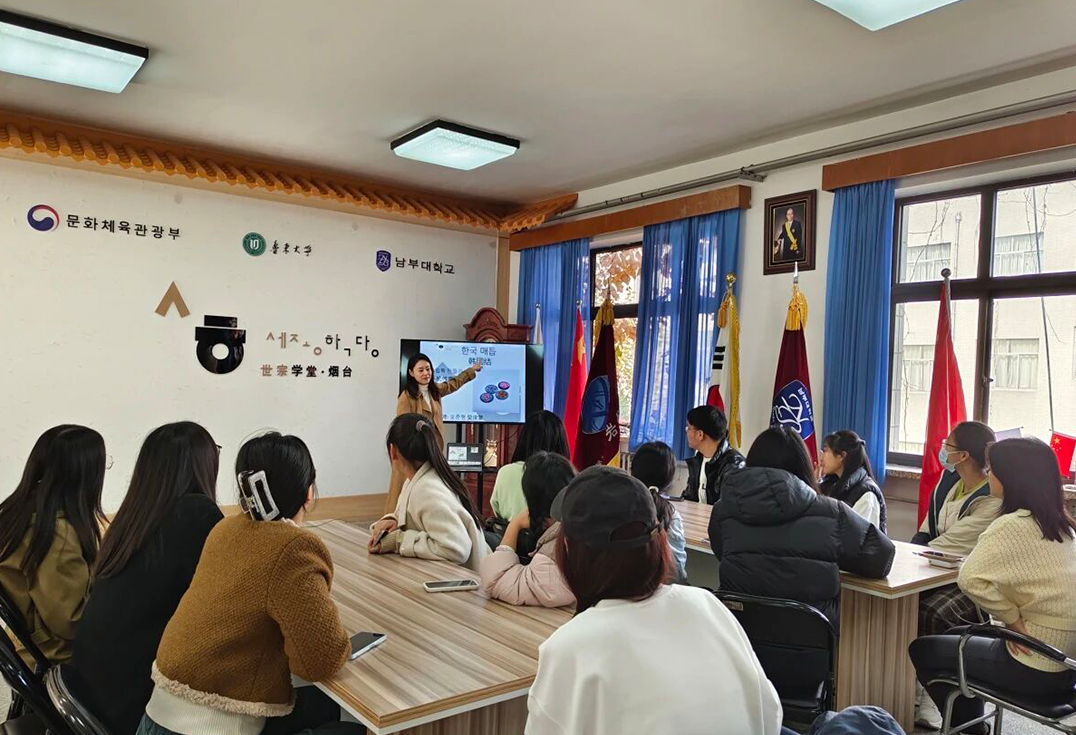
Teacher Oh Jun-hyung teaching a class at KSI Yantai, China
Q. You participated in the 2026 Central Asia KSI Workshop from August 5 to 7. Which program left the strongest impression on you, and why?
A. Program Officer Kang Ji-young Two programs were especially memorable. The first was the presentation on the operations of KSI Tashkent 1, Uzbekistan. Since our KSI is affiliated with the Korean Cultural Center, we have not had many opportunities to observe how other KSIs carry out their work and plan their annual projects. It was very helpful to examine their actual operating process in detail.
The training on teaching methods using Sejong Korean for Study Abroad was also useful. As we discussed ways to use a textbook that reflects the demand for studying in Korea, I was also able to think about whether the content could be planned as a special lecture at our KSI.
The training on teaching methods using Sejong Korean for Study Abroad was also useful. As we discussed ways to use a textbook that reflects the demand for studying in Korea, I was also able to think about whether the content could be planned as a special lecture at our KSI.
A. Teacher Oh Jun-hyung The most impressive part for me was the time when teachers shared actual classroom cases. In my own teaching, I constantly think about questions such as, “How can I help learners study Korean in a more fun and accessible way?” “How can I create classes that are both enjoyable and educationally strong?” and “How can my teaching help introduce Korea more widely?”
Listening to other teachers talk about the environments in which they teach and how they address the difficulties learners face gave me new ideas. I had the impression that every program had been carefully prepared for teachers and operations staff working in the field.
Listening to other teachers talk about the environments in which they teach and how they address the difficulties learners face gave me new ideas. I had the impression that every program had been carefully prepared for teachers and operations staff working in the field.
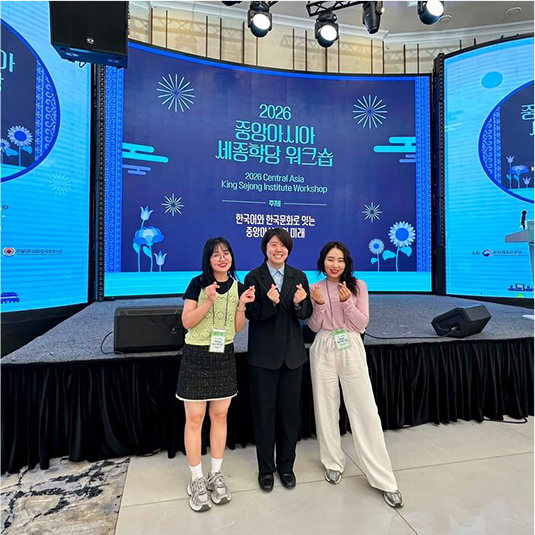
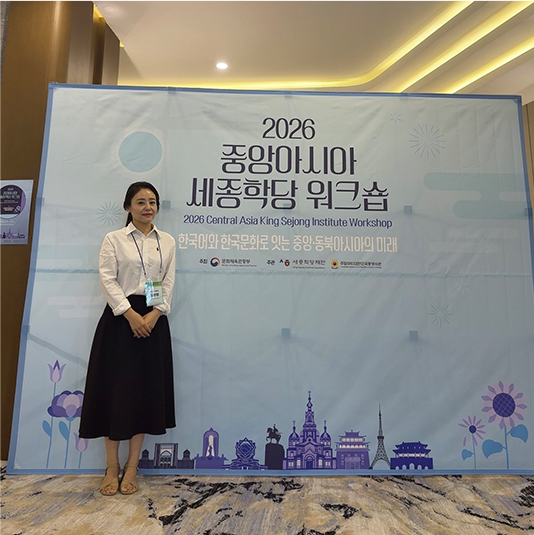
Program Officer Kang Ji-young (center from left) and Teacher Oh Jun-hyung (right) posing for
commemorative photos at the Central Asia KSI Workshop
commemorative photos at the Central Asia KSI Workshop
Q. This workshop brought together KSI representatives from several countries across Central and Northeast Asia. As you shared experiences and concerns with representatives from other countries, was there anything new you learned or found relatable? What kinds of exchange would you like to continue in the future?
A. Program Officer Kang Ji-young This workshop was a large-scale event that brought together not only Central Asian KSIs but also KSIs in Northeast Asia, including China and Japan. I was surprised to learn that, even though our regions differ, the rewards and difficulties we feel while operating KSIs are similar. I was impressed to see even teachers who have worked for many years continuing to learn in order to use new tools such as interactive whiteboards and artificial intelligence in their classes, and continually developing themselves for their learners.
Still, the topic we talked about most was, of course, our learners. Registration methods, completion criteria, and ways of delivering announcements may differ from country to country, but we all share the same desire to help more learners study conveniently and efficiently. I would like to continue participating in various workshops, share concrete operational experiences, and exchange ideas with teachers who are implementing teaching methods that use new tools.
Still, the topic we talked about most was, of course, our learners. Registration methods, completion criteria, and ways of delivering announcements may differ from country to country, but we all share the same desire to help more learners study conveniently and efficiently. I would like to continue participating in various workshops, share concrete operational experiences, and exchange ideas with teachers who are implementing teaching methods that use new tools.
A. Teacher Oh Jun-hyung Although we work in different environments, I felt that we all share the same desire to teach our learners better. We had similar concerns about how to increase learner participation and how to convey Korean language and Korean culture in engaging ways.
A method I had taken for granted sometimes became a new idea for another teacher, while another teacher’s experience sometimes showed me a new solution. I hope we can continue exchanging classroom cases and materials and thinking together. I believe that this kind of learning ultimately benefits the learners.
A method I had taken for granted sometimes became a new idea for another teacher, while another teacher’s experience sometimes showed me a new solution. I hope we can continue exchanging classroom cases and materials and thinking together. I believe that this kind of learning ultimately benefits the learners.
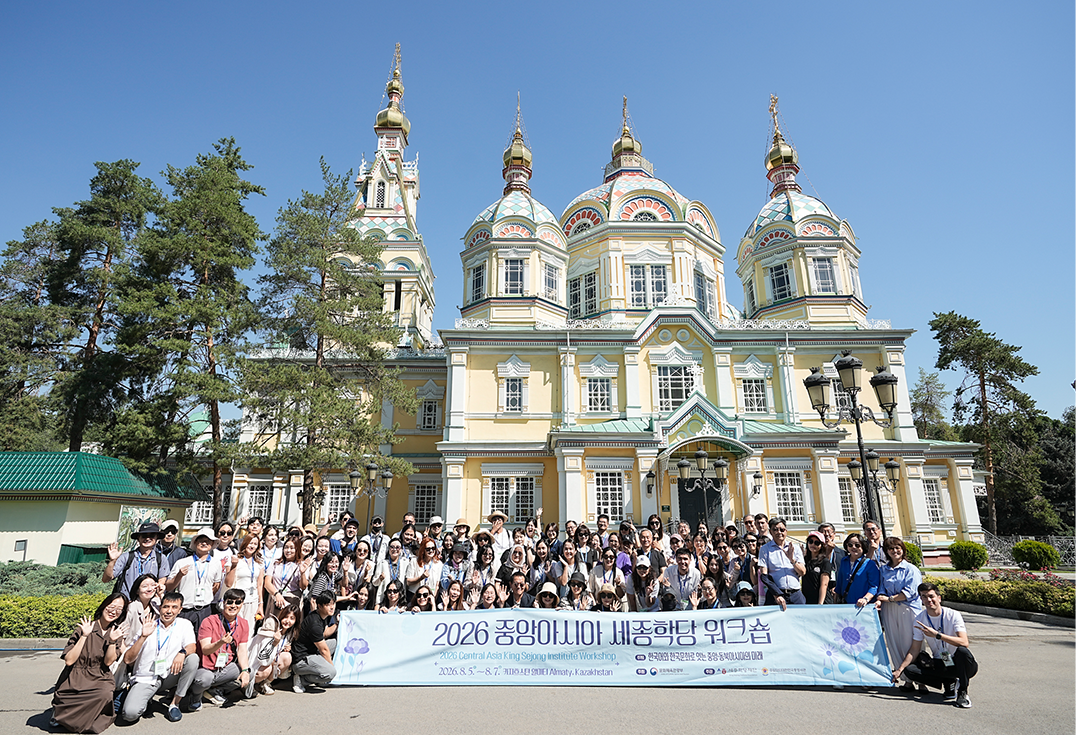
Participants taking a commemorative group photo on the final day of the Central Asia KSI Workshop
Q. Finally, what kind of teacher would you like to be remembered as? Please also share the goals you hope to achieve going forward.
A. Program Officer Kang Ji-young Rather than being remembered myself, I hope the content I teach remains with learners for a long time. Recently, I taught an introductory Korean course, and I was concerned that learners still seemed to find Hangeul difficult. I tend to joke around with learners and nag them quite a bit, but I hope that every word and action toward them, from beginning to end, is truly for their benefit.
I would like to develop the ability to teach Korean in Kazakh as well, but more than that, I want to become a teacher who can help learners understand easily and accurately even when teaching only in Korean. As an operations staff member, my goal is to continue supporting learners and teachers so that they can learn and teach a little more happily each year. I cheer for everyone who represents Korea in their own place and shares the Korean language and Korean culture with the world.
I would like to develop the ability to teach Korean in Kazakh as well, but more than that, I want to become a teacher who can help learners understand easily and accurately even when teaching only in Korean. As an operations staff member, my goal is to continue supporting learners and teachers so that they can learn and teach a little more happily each year. I cheer for everyone who represents Korea in their own place and shares the Korean language and Korean culture with the world.
A. Teacher Oh Jun-hyung I hope learners remember me not simply as someone who taught them Korean, but as someone who helped them form a positive impression of Korea and Korean people. For many learners studying Korean in China, I may be the first Korean person they meet. Since meeting me can become their first memory of experiencing Korea, I believe the way I present myself in class is important.
I hope the Korean I teach does not remain with learners merely as one foreign language. I hope they meet new people, understand new cultures, and expand their world through Korean. If, after time has passed, learners look back on the time they spent studying Korean and remember, “That was such an enjoyable time, and I was glad to meet a Korean person,” I would be happy. If one Korean expression I taught and one story I shared can remain as a good memory of Korea for learners, that would be the teacher I most hope to become.
I hope the Korean I teach does not remain with learners merely as one foreign language. I hope they meet new people, understand new cultures, and expand their world through Korean. If, after time has passed, learners look back on the time they spent studying Korean and remember, “That was such an enjoyable time, and I was glad to meet a Korean person,” I would be happy. If one Korean expression I taught and one story I shared can remain as a good memory of Korea for learners, that would be the teacher I most hope to become.