13th Sejong Korean Language Assessment (SKA) to Be Held on September 19 at 14 Test Centers Nationwide
글쓴이홍보협력팀
태그
작성일 2026-09-18
조회수87

13th Sejong Korean Language Assessment (SKA)
to Be Held on September 19 at 14 Test Centers Nationwide
to Be Held on September 19 at 14 Test Centers Nationwide
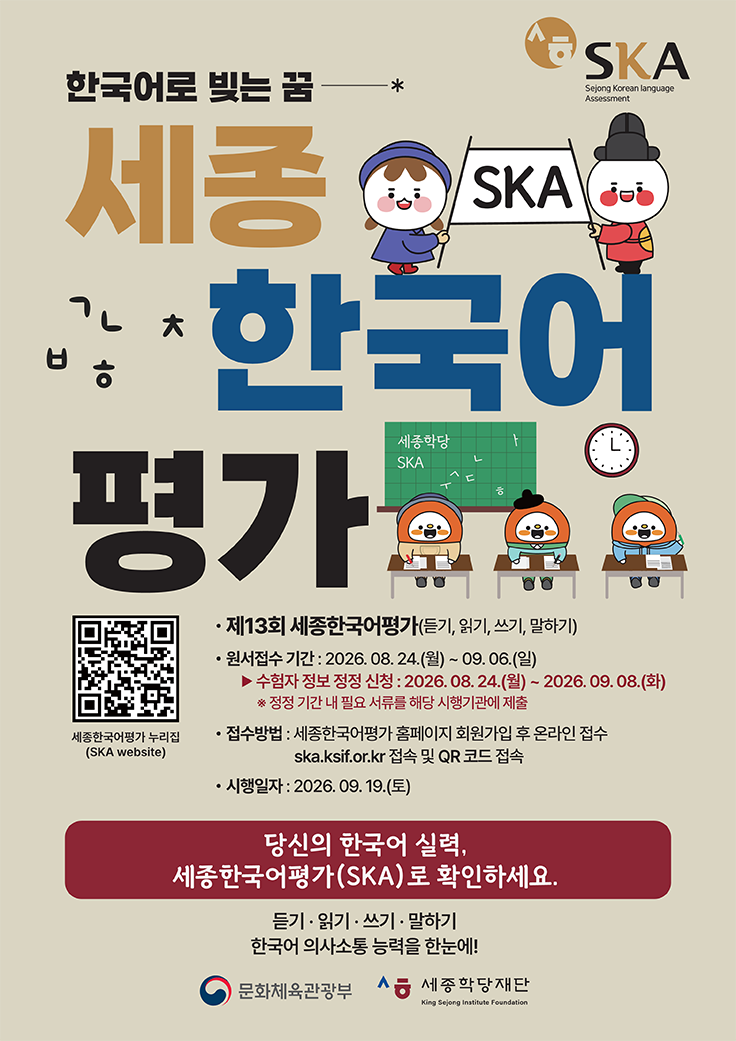
> Applications will be accepted from August 24, followed by the assessment on September 19 at 14 test centers in seven cities and provinces nationwide
> As the second domestic administration of the assessment, the number of test centers has expanded from 5 to 14, improving access for foreign learners
The King Sejong Institute Foundation (KSIF) will conduct the 13th Sejong Korean Language Assessment (SKA) on September 19 at 14 test centers in seven cities and provinces across Korea. Applications will be accepted through the Sejong Korean Language Assessment website (ska.ksif.or.kr) from 9:00 a.m. on August 24 to 11:59 p.m. on September 6.
The SKA is an assessment that comprehensively measures the communication ability of learners studying Korean as a foreign language. Through four areas - listening, reading, writing, and speaking - it evaluates how effectively learners can use Korean in real-life situations.
The SKA is an assessment that comprehensively measures the communication ability of learners studying Korean as a foreign language. Through four areas - listening, reading, writing, and speaking - it evaluates how effectively learners can use Korean in real-life situations.
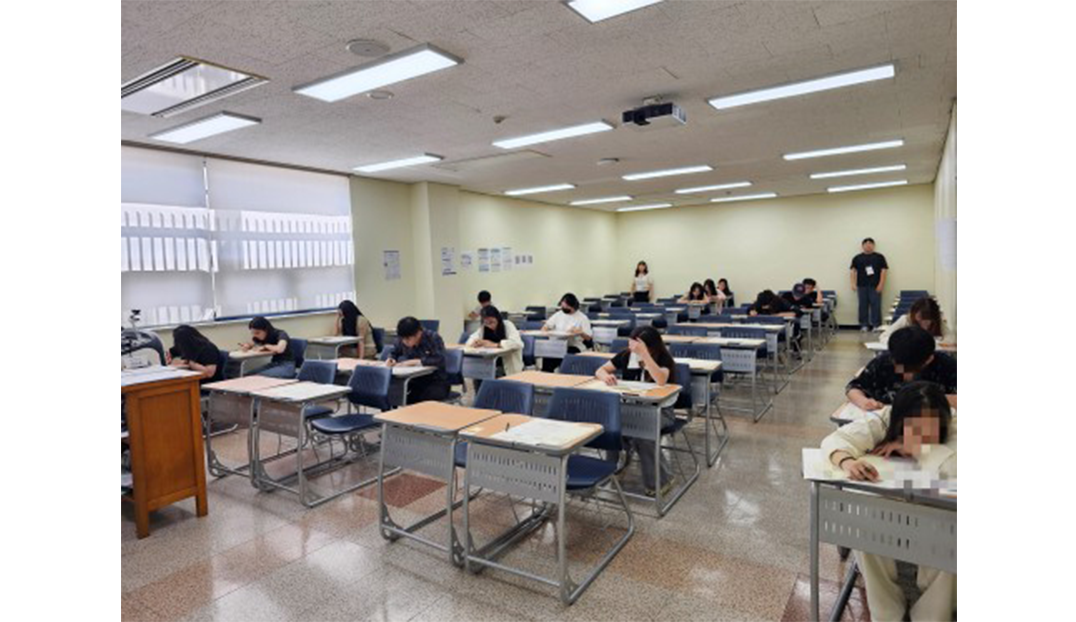
Test site scene from the 12th Sejong Korean Language Assessment (SKA) held at Daegu Haany University
To respond to growing domestic demand for Korean language proficiency assessment, KSIF introduced the SKA in Korea this year after having administered it overseas. This will be the second domestic assessment, following the 12th SKA held in June. In particular, to expand opportunities for foreign learners in Korea to take the assessment, KSIF increased the number of test centers from the previous 5 to 14, improving test accessibility.
Test centers for this assessment will be set up in seven cities and provinces nationwide, including Seoul, Gyeonggi, Daegu, Gyeongbuk, Chungbuk, Gyeongnam, and Jeonnam. The assessment will be conducted at a total of 14 locations: Shinyeon Middle School in Seoul, Konkuk University, Tech University of Korea, Shinhan University, Kyungdong University, Dongyang University, Daegu Haany University, Handong Global University, Yeungnam University College, Chungcheong University, Jungwon University, Gimhae College, Dongwon Institute of Science and Technology, and Chodang University.
Test centers for this assessment will be set up in seven cities and provinces nationwide, including Seoul, Gyeonggi, Daegu, Gyeongbuk, Chungbuk, Gyeongnam, and Jeonnam. The assessment will be conducted at a total of 14 locations: Shinyeon Middle School in Seoul, Konkuk University, Tech University of Korea, Shinhan University, Kyungdong University, Dongyang University, Daegu Haany University, Handong Global University, Yeungnam University College, Chungcheong University, Jungwon University, Gimhae College, Dongwon Institute of Science and Technology, and Chodang University.
◇ Applications Accepted on the Website Until September 6
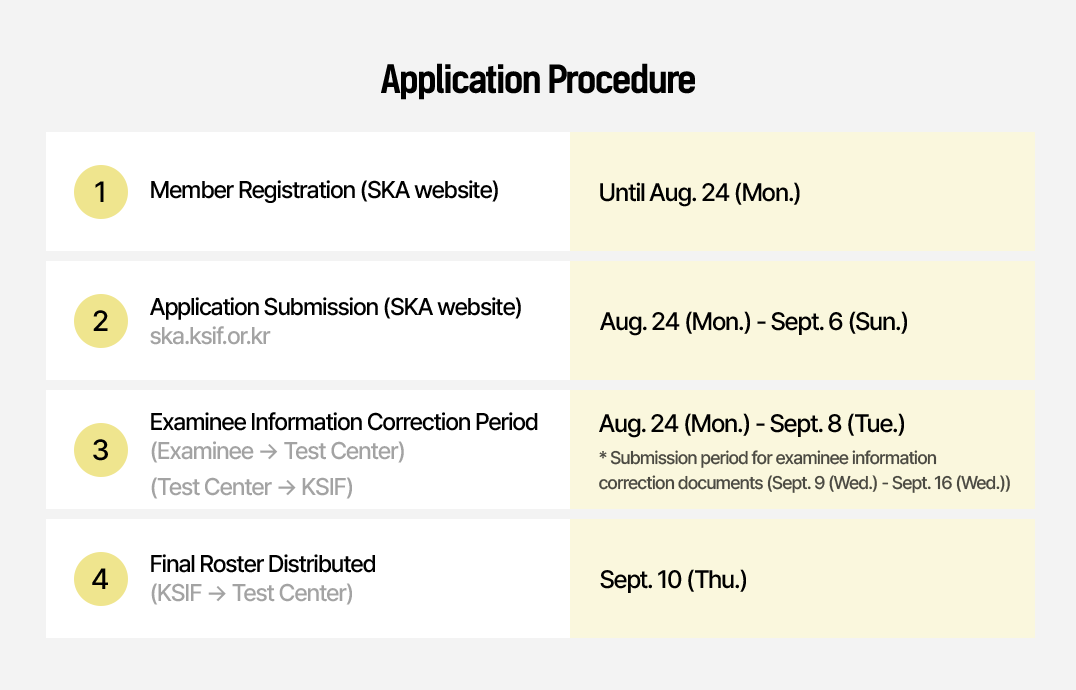
The 13th SKA is open to learners aged 14 or older who are studying Korean as a foreign language. Applicants can create an account on the SKA website and submit their applications directly online. To receive a score certificate, test takers must take all four sections: listening, reading, writing, and speaking.
When submitting an application, applicants must enter their English name exactly as it appears on their passport or identification card and upload a photo taken within the past six months that meets the required specifications. On the day of the assessment, test takers must bring identification for identity verification.
When submitting an application, applicants must enter their English name exactly as it appears on their passport or identification card and upload a photo taken within the past six months that meets the required specifications. On the day of the assessment, test takers must bring identification for identity verification.
◇ Expanding Use from Universities to Companies and Visa Screening
The range of uses for the SKA continues to expand. As of August 2026, institutions such as Korea University, Yonsei University, and Ewha Womans University use the assessment as a requirement for international students in areas such as admission, graduation, and entry into majors. In the United States, Vanderbilt University and the University of Missouri use it as an academic requirement. Organizations, including the Korea Trade-Investment Promotion Agency (KOTRA) and Daekyo, use SKA scores to select outstanding talent, while the Embassy of the Republic of Korea in Uzbekistan uses SKA scores as proof of Korean-language proficiency in visa-issuance screening.
In particular, amendments to the Framework Act on the National Language that underpin the operation and administration of the SKA took effect on July 29, establishing a legal foundation for its recognition as an official assessment. Going forward, KSIF will continue discussions with companies, universities, and relevant organizations so that the SKA can be widely used in various areas, including employment, stay in Korea, and scholarships for international students.
In particular, amendments to the Framework Act on the National Language that underpin the operation and administration of the SKA took effect on July 29, establishing a legal foundation for its recognition as an official assessment. Going forward, KSIF will continue discussions with companies, universities, and relevant organizations so that the SKA can be widely used in various areas, including employment, stay in Korea, and scholarships for international students.