[KSI People] A Special Connection with Korea: From the Memories of Korean War Veterans to Encounters with KSIs
글쓴이홍보협력팀
태그
작성일 2026-07-24
조회수74

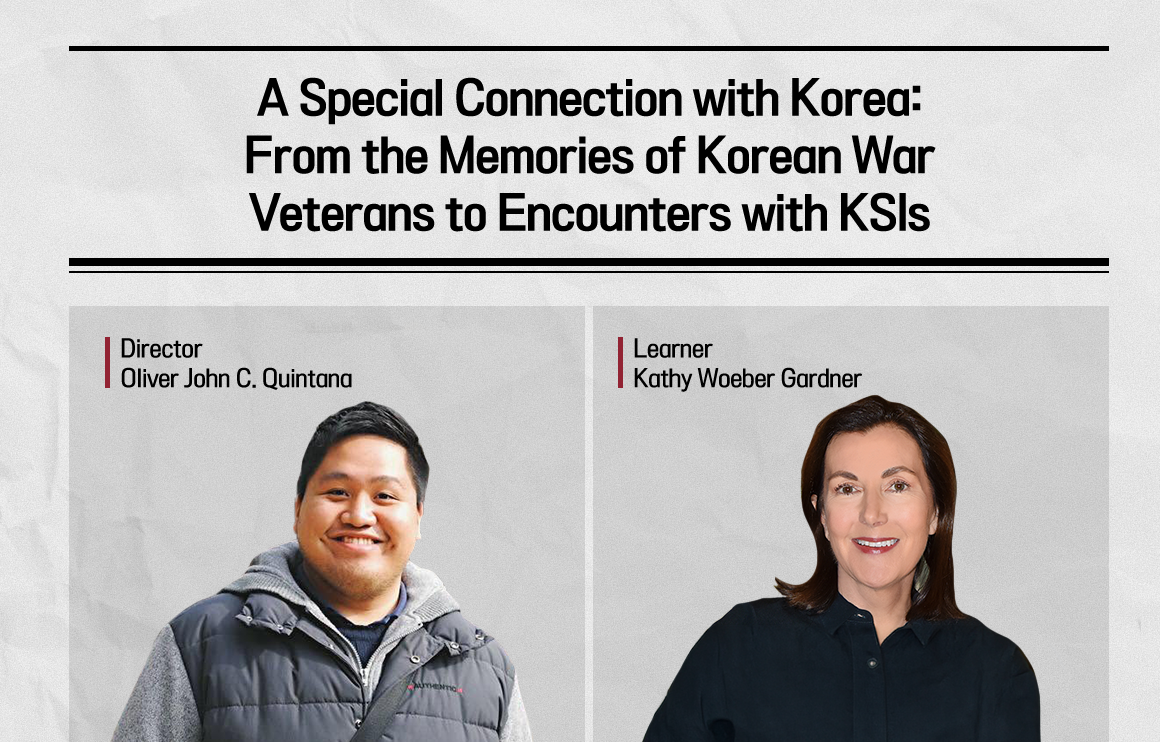
“Our Family Members Were Heroes of Korea”
A Special Connection with Korea:
From the Memories of Korean War
Veterans to Encounters with KSIs
From the Memories of Korean War
Veterans to Encounters with KSIs
The connection that began with the Korean War in 1950 has endured for generations. The sacrifice and courage of veterans who devoted themselves to Korea have left indelible memories for their families and descendants, opening the door to new connections. Today, that connection continues through another journey at the King Sejong Institutes (KSIs): learning Korean and understanding Korean culture.
To mark June, the Month of Patriots and Veterans in Korea, Monthly Knock-Knock met Oliver John C. Quintana, Director of KSI Quezon City 2, Philippines, and Kathy Woeber Gardner, a learner at KSI San Francisco, USA. As descendants of Korean War veterans, they share the memories their families have carried, their special ties with Korea, and the stories that continue to resonate across generations.
To mark June, the Month of Patriots and Veterans in Korea, Monthly Knock-Knock met Oliver John C. Quintana, Director of KSI Quezon City 2, Philippines, and Kathy Woeber Gardner, a learner at KSI San Francisco, USA. As descendants of Korean War veterans, they share the memories their families have carried, their special ties with Korea, and the stories that continue to resonate across generations.
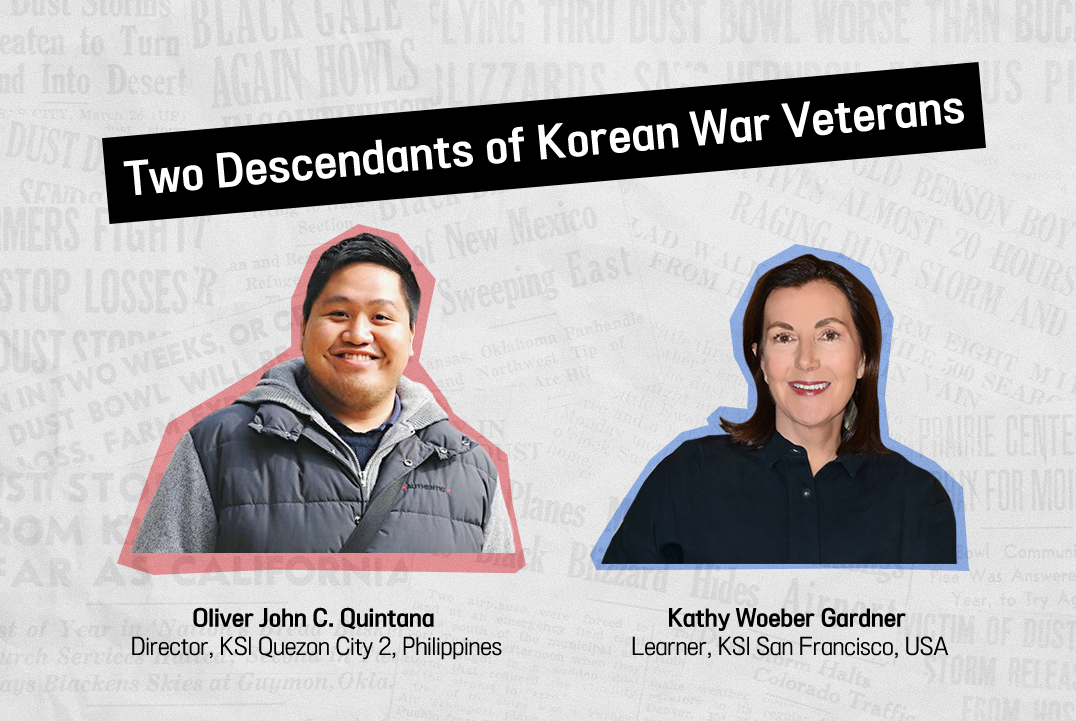
◇ Gratitude and Memories Shared by Descendants During
the Month of Patriots and Veterans
the Month of Patriots and Veterans
Q. To begin, please introduce yourself and tell us about your family member who served in the Korean War.
A.
Oliver John C. Quintana Hello. I am Oliver John C. Quintana, an Assistant Professor in the Department of Political Science at Ateneo de Manila University in Quezon City, Philippines. I also serve as the Director of KSI Quezon City 2 at the same university.
I am the grandson of the late Colonel (Ret.) Melecio S. Quintana, a Korean War veteran. My grandfather served with the 14th Battalion Combat Team (BCT), also famously known as “The Avengers,” of the Philippine Expeditionary Forces to Korea (PEFTOK).
I am the grandson of the late Colonel (Ret.) Melecio S. Quintana, a Korean War veteran. My grandfather served with the 14th Battalion Combat Team (BCT), also famously known as “The Avengers,” of the Philippine Expeditionary Forces to Korea (PEFTOK).
A.
Kathy Woeber Gardner Hello. My name is Kathy Woeber Gardner. I am the co-founder and partner of Montgomery Pacific LLP, a corporate boutique law firm in San Francisco, specializing in cross-border venture capital investments and mergers and acquisitions (M&A). Since September 2023, I’ve also been serving on the Board of Directors of the San Francisco Korean Center Inc. It is especially meaningful to me that I am currently the only non-Korean member on the board.
My father, Thomas J. Woeber, Jr., served in Korea from June 1952 to October 1953 as a First Lieutenant in the U.S. Army Intelligence Corps.
My father, Thomas J. Woeber, Jr., served in Korea from June 1952 to October 1953 as a First Lieutenant in the U.S. Army Intelligence Corps.
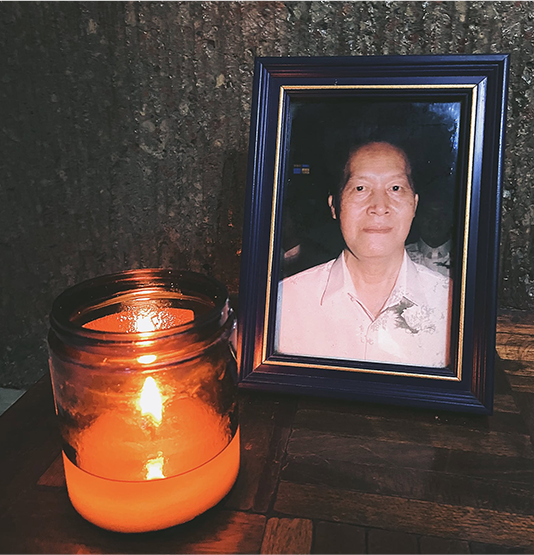
The late Colonel (Ret.) Melecio S. Quintana,
Oliver’s grandfather
Oliver’s grandfather
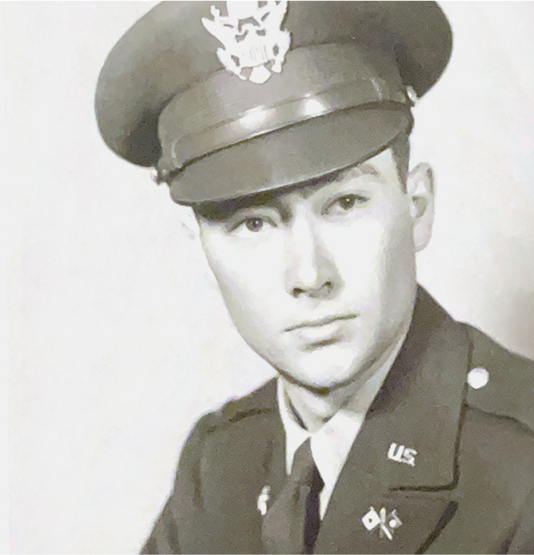
Kathy’s father, Thomas J. Woeber, Jr.,
during his service as a First Lieutenant
during his service as a First Lieutenant
Q. How is the veteran remembered within your family? Did you hear stories about Korea from him while growing up, or were there memories that were passed down through your family?
A.
Oliver I had always known that my grandfather served in the Korean War, but I did not truly grasp the significance of that fact until much later in my life. The turning point for me was the PEFTOK Scholarship Program.* I was selected as a PEFTOK scholar throughout high school and university, receiving academic support every semester. Naturally, I became curious about the origins of the program, and researching its background helped me gain a deeper understanding of my grandfather’s service and the sacrifices made by Filipino veterans during the Korean War.
* The PEFTOK Scholarship Program is a scholarship initiative supported by the Korean government and the Embassy of the Republic of Korea in the Philippines to honor the historic courage and dedication of the PEFTOK and support their descendants.
Unfortunately, my grandfather passed away when I was in high school, so I did not have the opportunity to hear many stories directly from him. Much of what I know comes from stories he shared with family members and from the testimonies of other veterans I later met through the PEFTOK Veterans Association (PVAI). What left the deepest impression on me was his recollection of Korea in the early 1950s. My grandfather often spoke of villages reduced to ruins by war and the struggle of people to survive. He also frequently described the harrowing Korean winters, a climate nearly unimaginable for soldiers from the tropical Philippines. He often remarked that enduring the biting cold was as difficult as fighting the enemy. During the Battle of Christmas Hill, one of the 14th BCT’s fiercest battles, many Filipino soldiers displayed remarkable courage despite the extreme cold. But he also shared warmer memories of Filipino actors and performance groups visiting the troops, recalling how much they lifted their spirits and reminded them of home.
* The PEFTOK Scholarship Program is a scholarship initiative supported by the Korean government and the Embassy of the Republic of Korea in the Philippines to honor the historic courage and dedication of the PEFTOK and support their descendants.
Unfortunately, my grandfather passed away when I was in high school, so I did not have the opportunity to hear many stories directly from him. Much of what I know comes from stories he shared with family members and from the testimonies of other veterans I later met through the PEFTOK Veterans Association (PVAI). What left the deepest impression on me was his recollection of Korea in the early 1950s. My grandfather often spoke of villages reduced to ruins by war and the struggle of people to survive. He also frequently described the harrowing Korean winters, a climate nearly unimaginable for soldiers from the tropical Philippines. He often remarked that enduring the biting cold was as difficult as fighting the enemy. During the Battle of Christmas Hill, one of the 14th BCT’s fiercest battles, many Filipino soldiers displayed remarkable courage despite the extreme cold. But he also shared warmer memories of Filipino actors and performance groups visiting the troops, recalling how much they lifted their spirits and reminded them of home.
A.
Kathy My siblings and I were born long after our father’s service in the Korean War, but we grew up knowing how proud he was to have contributed to defending today’s Republic of Korea. When we were young, he often showed us photographs and newspaper clippings from his time in Korea. As a result, what he experienced in the Korean War became an important part of our family story.
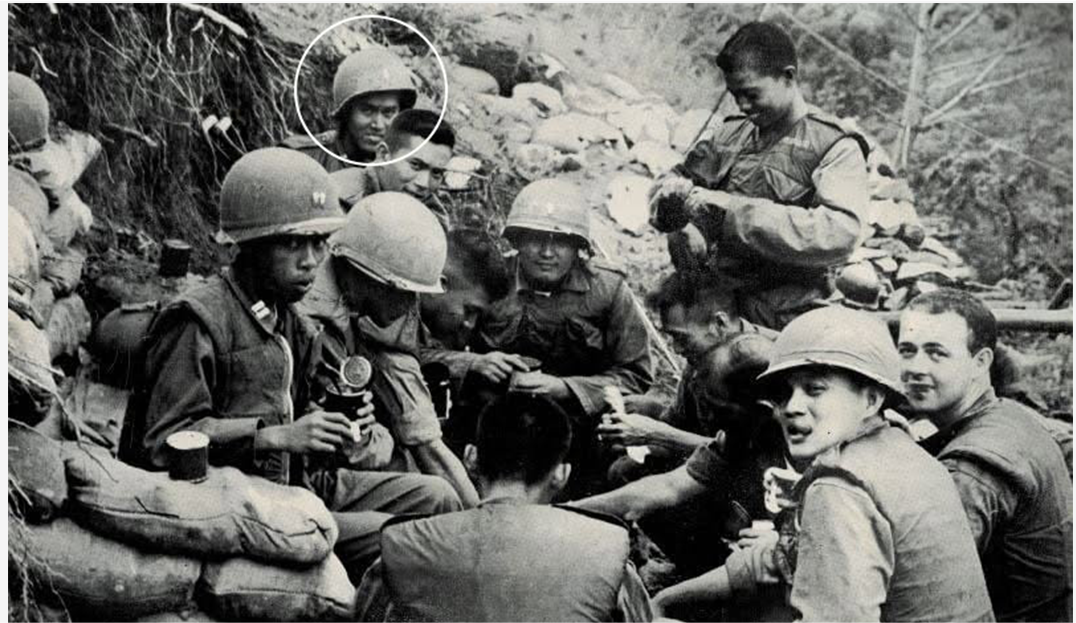
The late Colonel (Ret.) Melecio S. Quintana during the Korean War
Q. In Korea, June is observed as the “Month of Patriots and Veterans,” a time to remember and express gratitude to those who dedicated themselves to the nation. Have you heard of this observance? As a descendant of a veteran, what does this period mean to you?
A.
Oliver For me, Korea’s Month of Patriots and Veterans is more than an annual commemorative period. It is a time to remember that the friendship between the Philippines and the Republic of Korea was not forged simply by diplomacy or economic cooperation, but through shared sacrifice, courage, and comradeship.
The bond between the two countries rests on the selfless sacrifices of young Filipinos who stepped forward to defend freedom and peace in a country that was not their own. They did not take up arms in expectation of recognition or reward. They fought because they believed that freedom and peace were values worth protecting at a time when both were under threat around the world.
Every June, I remember not only my grandfather but also the countless Filipino veterans who willingly risked their lives for future generations of Koreans, whose courage and sacrifice have become the very foundation of today’s Republic of Korea. At the same time, June reminds me of the gratitude Korea has consistently shown. Thanks to my grandfather’s service, I could be selected as a PEFTOK scholar, which allowed me to live in Korea, learn the language, and experience Korean culture firsthand. Through that journey, I felt how deeply Korea remembers and respects those who fought alongside them.
In particular, the moment I laid flowers in tribute to the fallen at the UN Memorial Cemetery in Korea in Busan remains deeply meaningful to me. There, I realized that remembrance is not simply an act of looking back; it is a way of carrying the values of courage, sacrifice, gratitude, and peace into the present and the future.
The bond between the two countries rests on the selfless sacrifices of young Filipinos who stepped forward to defend freedom and peace in a country that was not their own. They did not take up arms in expectation of recognition or reward. They fought because they believed that freedom and peace were values worth protecting at a time when both were under threat around the world.
Every June, I remember not only my grandfather but also the countless Filipino veterans who willingly risked their lives for future generations of Koreans, whose courage and sacrifice have become the very foundation of today’s Republic of Korea. At the same time, June reminds me of the gratitude Korea has consistently shown. Thanks to my grandfather’s service, I could be selected as a PEFTOK scholar, which allowed me to live in Korea, learn the language, and experience Korean culture firsthand. Through that journey, I felt how deeply Korea remembers and respects those who fought alongside them.
In particular, the moment I laid flowers in tribute to the fallen at the UN Memorial Cemetery in Korea in Busan remains deeply meaningful to me. There, I realized that remembrance is not simply an act of looking back; it is a way of carrying the values of courage, sacrifice, gratitude, and peace into the present and the future.
A.
Kathy Our family makes every effort to learn as much as we can about Korean history and culture. To be honest, however, this is the first time I have learned that June is observed as the Month of Patriots and Veterans in Korea. Until now, we have honored my father and other American veterans of the Korean War mainly in November, around Veterans Day in the United States. I am very grateful for this opportunity to learn what June means to Korean War veterans in Korea.
◇ Oliver’s Story
Q. What inspired you to become a KSI director, and what has that experience meant to you?
A.
Looking back, I believe that becoming a KSI director was not a career path I had planned from the beginning. Rather, it was the natural continuation of a journey that began with my grandfather’s service during the Korean War. After completing my master’s degree in Seoul and returning to the Philippines, one of the first things I did was to join the newly established Korean Studies Program (KSP) at Ateneo de Manila University. The decision was driven by a desire to contribute to a deeper understanding of Korea, not simply through its language or Hallyu culture, but through its history and the special relationship that binds our two nations together.
In 2016, I helped organize the Third Ateneo Korean Studies Conference, held under the theme, “Revisiting the Korean War: History, Memory, and Its Implications on Contemporary Nation Building.” It was a deeply meaningful experience to invite PEFTOK veterans to the university and provide a platform to hear their testimonies firsthand.
That experience reaffirmed my belief in the power of stories. History truly comes alive when told through the voices of those who lived it. For many students there, it was their first encounter with Korean War veterans. Through their accounts, history—which had existed only in textbooks—became vibrant stories of human lives, courage, and sacrifice.
Subsequently, I was appointed as the Director of the Ateneo Korean Studies Program and continued a range of activities to preserve the memory of the Korean War and strengthen ties between the Philippines and Korea. Even during the pandemic, we held an online seminar commemorating the 70th anniversary of the outbreak of the Korean War. For the event, we invited Major General Masimo P. Young, the then-President of the PVAI, to share his historical testimony with students and the public. I also developed and continue to teach one of the first elective courses at Ateneo to examine relations between Korea, the Philippines, and ASEAN. The course covers Korea’s economic development, diplomacy, and contemporary issues, as well as the historical foundations of relations between our countries. Most importantly, I emphasize to my students that Filipino soldiers stood firm beside Korea during one of its most difficult times, long before the emergence of K-pop, K-dramas, and Hallyu.
I was then given the meaningful opportunity to serve as the Director of KSI Quezon City 2. To me, the KSI is far more than a language education institution. Language is a key to a new world, and learning Korean is also a journey toward understanding Korea’s history, culture, values, and the profound bond between our two nations. I constantly remind my students that relations between the Philippines and Korea did not begin with tourism or Hallyu; they were forged through the courage and sacrifice Filipinos demonstrated during the Korean War. Through Korean language education and a range of cultural and academic programs, KSIs will share that story for generations to come.
In 2016, I helped organize the Third Ateneo Korean Studies Conference, held under the theme, “Revisiting the Korean War: History, Memory, and Its Implications on Contemporary Nation Building.” It was a deeply meaningful experience to invite PEFTOK veterans to the university and provide a platform to hear their testimonies firsthand.
That experience reaffirmed my belief in the power of stories. History truly comes alive when told through the voices of those who lived it. For many students there, it was their first encounter with Korean War veterans. Through their accounts, history—which had existed only in textbooks—became vibrant stories of human lives, courage, and sacrifice.
Subsequently, I was appointed as the Director of the Ateneo Korean Studies Program and continued a range of activities to preserve the memory of the Korean War and strengthen ties between the Philippines and Korea. Even during the pandemic, we held an online seminar commemorating the 70th anniversary of the outbreak of the Korean War. For the event, we invited Major General Masimo P. Young, the then-President of the PVAI, to share his historical testimony with students and the public. I also developed and continue to teach one of the first elective courses at Ateneo to examine relations between Korea, the Philippines, and ASEAN. The course covers Korea’s economic development, diplomacy, and contemporary issues, as well as the historical foundations of relations between our countries. Most importantly, I emphasize to my students that Filipino soldiers stood firm beside Korea during one of its most difficult times, long before the emergence of K-pop, K-dramas, and Hallyu.
I was then given the meaningful opportunity to serve as the Director of KSI Quezon City 2. To me, the KSI is far more than a language education institution. Language is a key to a new world, and learning Korean is also a journey toward understanding Korea’s history, culture, values, and the profound bond between our two nations. I constantly remind my students that relations between the Philippines and Korea did not begin with tourism or Hallyu; they were forged through the courage and sacrifice Filipinos demonstrated during the Korean War. Through Korean language education and a range of cultural and academic programs, KSIs will share that story for generations to come.
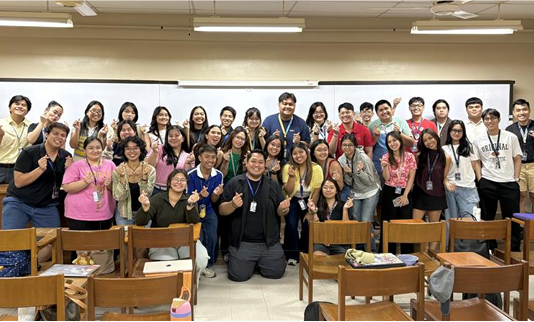
Oliver and his students from the course “Korea
-ASEAN Relations” at Ateneo de Manila University
-ASEAN Relations” at Ateneo de Manila University
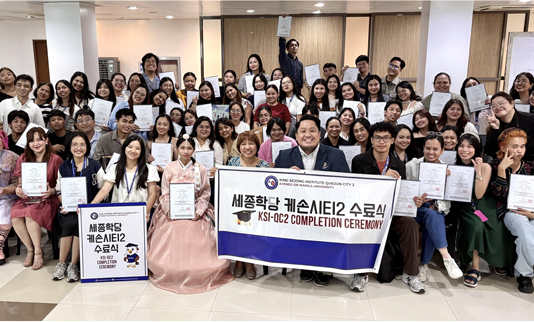
The 4th Completion Ceremony of
KSI Quezon City 2, Philippine
KSI Quezon City 2, Philippine
Q. Through your academic research and fieldwork related to PEFTOK veterans, you have met many veterans and their families. Is there a story that has remained especially memorable, or an example that shows how the Korean War changed a person’s life?
A.
Having encountered countless stories over the years, I feel most impressed when I witness firsthand how the sacrifice of one generation can transform the lives of the next.
My close friend, Kenn Gutierrez, is the grandson of Eleuterio Gutierrez Sr., who served in the 2nd Battalion Combat Team (BCT), known as the Black Lion, of the PEFTOK at the age of 18. Like me, Kenn was selected for the UN Korean War Memorial Scholarship Program, jointly supported by the Ministry of Patriots and Veterans Affairs of the Republic of Korea, the Korean War Memorial Foundation, and Hankuk University of Foreign Studies. He studied at Hankuk University of Foreign Studies and Seoul National University. After living and working in Korea for over a decade, he now serves as a diplomat in the Northeast Asia Division of the Office of Asian and Pacific Affairs at the Department of Foreign Affairs of the Philippines.
Another friend, Jenna Dizon, is the granddaughter of Captain Juan Joaquin Dizon, who served with the 19th Battalion Combat Team, known as the Bloodhounds, during the Korean War. Jenna also studied in Korea through the same scholarship program; she earned her master’s degree from Hankuk University of Foreign Studies and now works in the field of international development, including Mekong region development projects.
Whenever I reflect on the journeys of Kenn, Jenna, and myself, I am struck by one profound realization: the sacrifice of our grandfathers’ generation did not just end with victory in the war; it opened new opportunities for the next generation. The grandchildren of those young soldiers who headed to the battlefield are now returning to Korea, carrying books instead of rifles, to learn, build friendships, and foster a spirit of cooperation that bridges our two nations. To me, that is the true legacy of the Korean War.
I believe that legacy is not simply about commemorating the past. Rather, it is about carrying forward the values of peace, freedom, friendship, and international cooperation that our grandfathers sought to protect. Kenn is doing so as a diplomat, Jenna as an international development professional, and I as an educator, researcher, and KSI director.
I have also witnessed veterans return to Korea after 50 or 60 years through the Korean government’s Revisit Korea Program. I still remember them looking out their hotel windows and asking, “Is this really the Korea we remember?” Korea, once devastated by war, had transformed into a country of high-rise buildings, advanced technology, and democracy. Yet, what truly moved them was not merely Korea’s remarkable development, but the warmth and gratitude of the Korean people. As they saw young people, soldiers, and citizens alike remember the war and express their thanks, the veterans felt once again that Korea had not forgotten them. In that moment, I realized that remembrance is not simply about looking back on the past; it is about sustaining relationships between people.
My close friend, Kenn Gutierrez, is the grandson of Eleuterio Gutierrez Sr., who served in the 2nd Battalion Combat Team (BCT), known as the Black Lion, of the PEFTOK at the age of 18. Like me, Kenn was selected for the UN Korean War Memorial Scholarship Program, jointly supported by the Ministry of Patriots and Veterans Affairs of the Republic of Korea, the Korean War Memorial Foundation, and Hankuk University of Foreign Studies. He studied at Hankuk University of Foreign Studies and Seoul National University. After living and working in Korea for over a decade, he now serves as a diplomat in the Northeast Asia Division of the Office of Asian and Pacific Affairs at the Department of Foreign Affairs of the Philippines.
Another friend, Jenna Dizon, is the granddaughter of Captain Juan Joaquin Dizon, who served with the 19th Battalion Combat Team, known as the Bloodhounds, during the Korean War. Jenna also studied in Korea through the same scholarship program; she earned her master’s degree from Hankuk University of Foreign Studies and now works in the field of international development, including Mekong region development projects.
Whenever I reflect on the journeys of Kenn, Jenna, and myself, I am struck by one profound realization: the sacrifice of our grandfathers’ generation did not just end with victory in the war; it opened new opportunities for the next generation. The grandchildren of those young soldiers who headed to the battlefield are now returning to Korea, carrying books instead of rifles, to learn, build friendships, and foster a spirit of cooperation that bridges our two nations. To me, that is the true legacy of the Korean War.
I believe that legacy is not simply about commemorating the past. Rather, it is about carrying forward the values of peace, freedom, friendship, and international cooperation that our grandfathers sought to protect. Kenn is doing so as a diplomat, Jenna as an international development professional, and I as an educator, researcher, and KSI director.
I have also witnessed veterans return to Korea after 50 or 60 years through the Korean government’s Revisit Korea Program. I still remember them looking out their hotel windows and asking, “Is this really the Korea we remember?” Korea, once devastated by war, had transformed into a country of high-rise buildings, advanced technology, and democracy. Yet, what truly moved them was not merely Korea’s remarkable development, but the warmth and gratitude of the Korean people. As they saw young people, soldiers, and citizens alike remember the war and express their thanks, the veterans felt once again that Korea had not forgotten them. In that moment, I realized that remembrance is not simply about looking back on the past; it is about sustaining relationships between people.
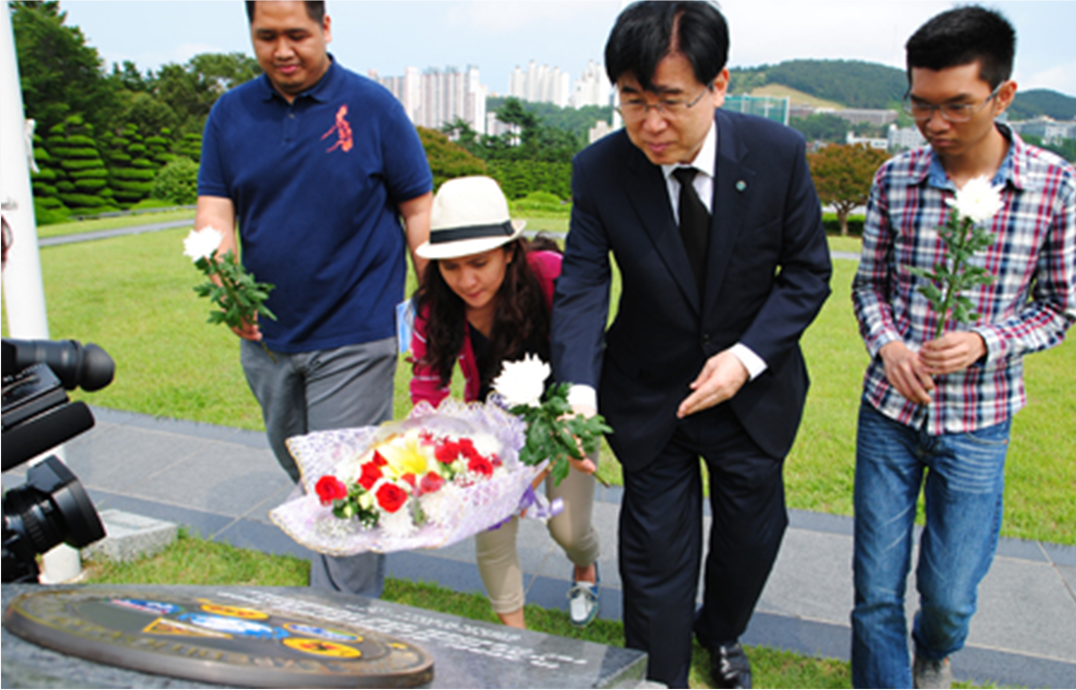
In June 2012, Oliver and his friends, Jenna and Kenn, lay flowers at the Philippine Soldiers Memorial at the UN
Memorial Cemetery in Busan, Korea, with the President of Hankuk University of Foreign Studies
Memorial Cemetery in Busan, Korea, with the President of Hankuk University of Foreign Studies
Q. As a descendant carrying your family’s story forward, and as a researcher who has studied the history and memory of the Korean War and its veterans, what have these experiences left with you most deeply?
A.
When I reflect upon my life as my grandfather’s grandson, from my scholarship and studies in Korea to my encounters with other veterans’ descendants, as well as my current role as an educator and KSI director sharing the legacy of the PEFTOK, three things stand out as the most significant.
First is a profound sense of pride. I am immensely proud of my grandfather and the PEFTOK veterans, not merely because they served in a war, but because they willingly stepped forward for people they had never met and for a country they had never visited. At the time, the Philippines was still grappling with the wounds of World War II, yet they crossed borders to serve because they believed in freedom, peace, and human dignity. That is the greatest legacy they have left me.
Second is the enduring value of friendship, diplomacy, and international cooperation. The Korean War shows us that relationships between countries are ultimately built through people. The friendship between the Philippines and Korea did not begin in conference rooms or diplomatic negotiations; it was formed through shared sacrifice and mutual trust. Today, that friendship continues through education and cultural exchange, academic cooperation, diplomacy, and people-to-people relationships. Having experienced this bond firsthand as a student, researcher, and KSI director, I view the cooperation we are building today as a continuation of the friendship the veterans began more than 70 years ago.
Third is the responsibility of remembrance. As an educator at Ateneo de Manila University, my awareness of this duty has only deepened as I nurture the next generation. Memory does not continue on its own. Unless we consciously recount these stories, teach them, record them, and pass them on, they will eventually fade into oblivion. As more veterans pass away, that responsibility now rests upon descendants, educators, researchers, institutions, and indeed, all of us.
I believe that remembering is not simply an act of looking back; it is the practice of responsibility. Remembrance must not be confined to monuments or memorial events, but must remain vibrant in our classrooms, research, and dialogue with the next generation, as well as the values and actions we choose. Every time I teach students about the history of the PEFTOK and help carry forward the friendship between the Philippines and Korea, that legacy lives on.
Above all, I carry a constant sense of gratitude: gratitude for my grandfather’s courage; gratitude to Korea for remembering the sacrifices of Filipino veterans through scholarships, commemorative programs, and enduring friendship; and gratitude that I, too, can contribute in my own small way to carrying this shared history forward.
First is a profound sense of pride. I am immensely proud of my grandfather and the PEFTOK veterans, not merely because they served in a war, but because they willingly stepped forward for people they had never met and for a country they had never visited. At the time, the Philippines was still grappling with the wounds of World War II, yet they crossed borders to serve because they believed in freedom, peace, and human dignity. That is the greatest legacy they have left me.
Second is the enduring value of friendship, diplomacy, and international cooperation. The Korean War shows us that relationships between countries are ultimately built through people. The friendship between the Philippines and Korea did not begin in conference rooms or diplomatic negotiations; it was formed through shared sacrifice and mutual trust. Today, that friendship continues through education and cultural exchange, academic cooperation, diplomacy, and people-to-people relationships. Having experienced this bond firsthand as a student, researcher, and KSI director, I view the cooperation we are building today as a continuation of the friendship the veterans began more than 70 years ago.
Third is the responsibility of remembrance. As an educator at Ateneo de Manila University, my awareness of this duty has only deepened as I nurture the next generation. Memory does not continue on its own. Unless we consciously recount these stories, teach them, record them, and pass them on, they will eventually fade into oblivion. As more veterans pass away, that responsibility now rests upon descendants, educators, researchers, institutions, and indeed, all of us.
I believe that remembering is not simply an act of looking back; it is the practice of responsibility. Remembrance must not be confined to monuments or memorial events, but must remain vibrant in our classrooms, research, and dialogue with the next generation, as well as the values and actions we choose. Every time I teach students about the history of the PEFTOK and help carry forward the friendship between the Philippines and Korea, that legacy lives on.
Above all, I carry a constant sense of gratitude: gratitude for my grandfather’s courage; gratitude to Korea for remembering the sacrifices of Filipino veterans through scholarships, commemorative programs, and enduring friendship; and gratitude that I, too, can contribute in my own small way to carrying this shared history forward.
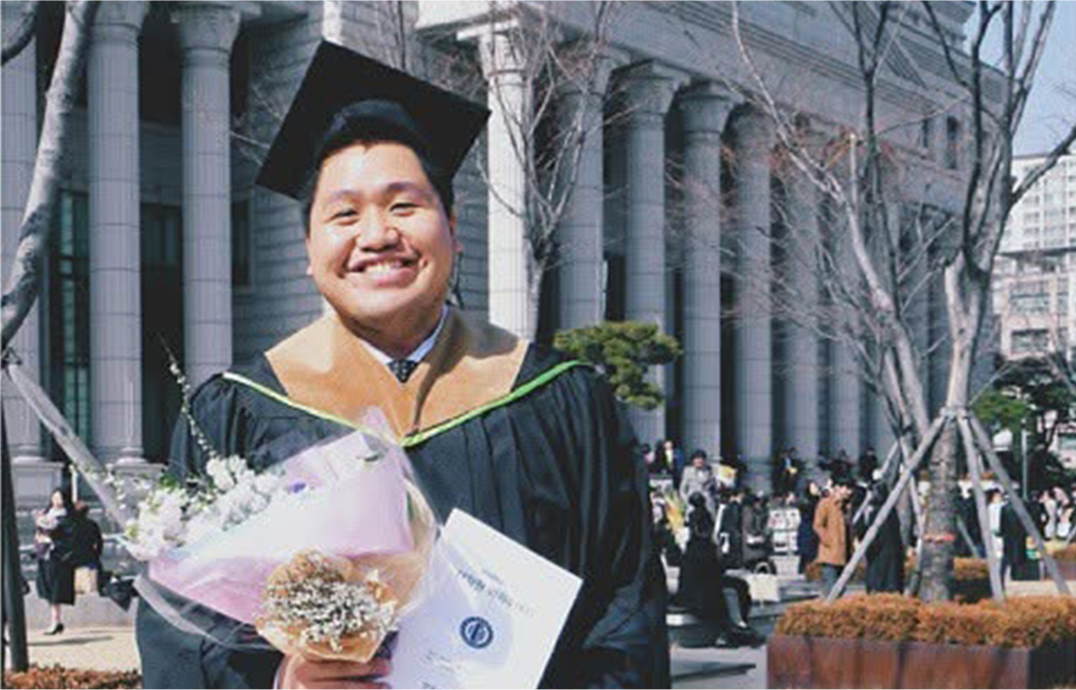
Oliver at his graduation ceremony at Hankuk University of Foreign Studies in 2015
◇ Kathy’s Story
Q. What motivated you to start learning the Korean language, and could you share any memorable experiences or insights you’ve gained while studying at the KSI?
A.
I had long wanted to learn Korean, ever since adopting my Korean son, Theo. However, caring for my family while also running a law firm made it difficult to pursue this goal for many years.
In 2023, I finally began studying Korean at KSI San Francisco, USA. The teachers there have always guided me with kindness and unwavering support, allowing me to learn Korean at my own pace. There are also many learners at KSI San Francisco with Korean spouses, so connecting with them always makes my studies more enjoyable.
In 2023, I finally began studying Korean at KSI San Francisco, USA. The teachers there have always guided me with kindness and unwavering support, allowing me to learn Korean at my own pace. There are also many learners at KSI San Francisco with Korean spouses, so connecting with them always makes my studies more enjoyable.
Q. How did your connection with your father, a Korean War veteran, influence your decision to adopt? Also, what has this special tie to Korea come to mean in your family’s life?
A.
When my husband and I were planning to adopt our second child, our thoughts naturally turned to our connection with Korea, which began with my father’s service in the Korean War. And this historical tie had a profound influence on our decision to adopt a child from Korea.
Shortly before we left for Seoul to meet our son, Theo, my mother passed away, so I asked my father to join us on this important journey. As our entire family stayed in Seoul, we met with the Korean Social Welfare Society and Theo’s foster family, as well as our friends living there. During that time, many Koreans expressed their gratitude for my father’s service, and their warm words remain a cherished memory for our family to this day.
Shortly before we left for Seoul to meet our son, Theo, my mother passed away, so I asked my father to join us on this important journey. As our entire family stayed in Seoul, we met with the Korean Social Welfare Society and Theo’s foster family, as well as our friends living there. During that time, many Koreans expressed their gratitude for my father’s service, and their warm words remain a cherished memory for our family to this day.
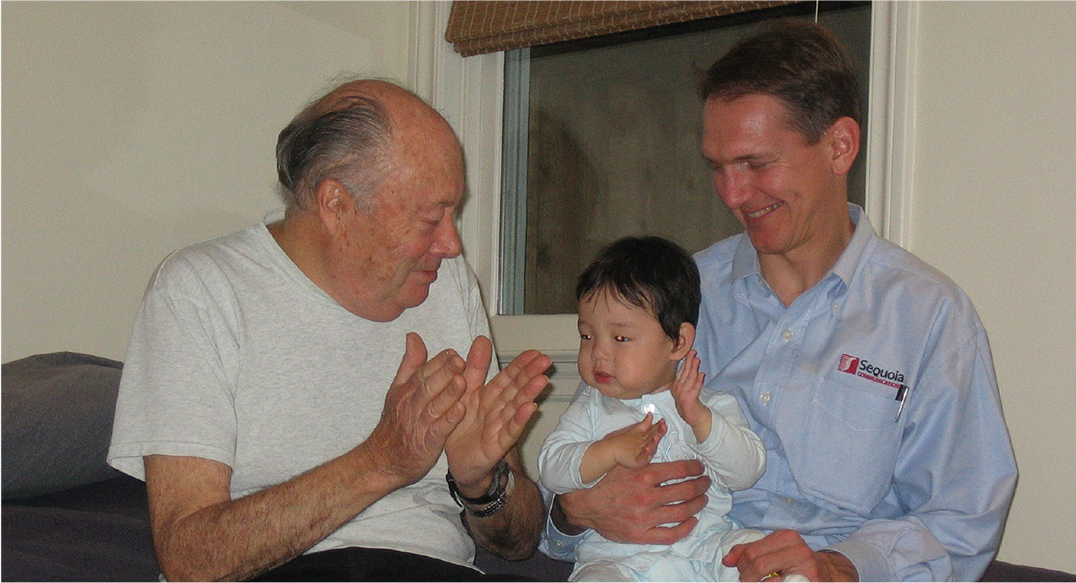
Kathy’s father meeting Theo for the first time in Seoul in 2006
Q. We understand that you made consistent efforts to help your son, who was born in Korea, stay connected to Korean culture and language while growing up. As a parent, what was the most important aspect of that process for you?
A.
Theo joined our family in San Francisco when he was one year old. Since we wanted our children to grow up with a natural understanding of Korean language and culture, we asked Korean students studying in San Francisco to help care for them and those relationships continued until Theo was in middle school.
I also joined a Korean mothers’ community to learn more about Korean culture and help Theo make Korean friends his own age. Many of the people I met there remain dear friends to this day. Our children regularly attended Saturday Korean language classes and culture camps. In high school, Theo also attended a Korean immersion camp at Concordia Language Villages in Minnesota. He now studies at the University of Oregon, where he plans to take courses in Korean language and Korean history. He looks forward to spending a semester as an exchange student at a university in Seoul as well.
Our family has visited Korea several times since the adoption. On each visit, we visited the Korean Social Welfare Society to express our gratitude for helping Theo become part of our family. We hope that when Theo studies in Seoul, he will have the opportunity to volunteer there and give back in some small way for what they have done for us.
I also joined a Korean mothers’ community to learn more about Korean culture and help Theo make Korean friends his own age. Many of the people I met there remain dear friends to this day. Our children regularly attended Saturday Korean language classes and culture camps. In high school, Theo also attended a Korean immersion camp at Concordia Language Villages in Minnesota. He now studies at the University of Oregon, where he plans to take courses in Korean language and Korean history. He looks forward to spending a semester as an exchange student at a university in Seoul as well.
Our family has visited Korea several times since the adoption. On each visit, we visited the Korean Social Welfare Society to express our gratitude for helping Theo become part of our family. We hope that when Theo studies in Seoul, he will have the opportunity to volunteer there and give back in some small way for what they have done for us.
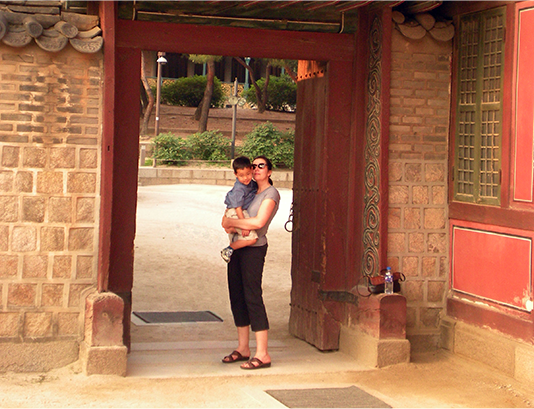
Kathy’s first visit to Seoul with
Theo after his adoption in 2011
Theo after his adoption in 2011
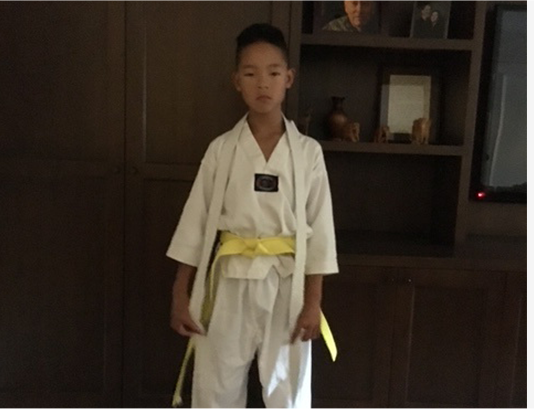
Theo wearing a taekwondo uniform in 2013
◇ The Legacy of Service, in Light of Today’s Korea
Q. As a descendant of a Korean War veteran, how do you view the Republic of Korea today? Looking at the country now, what meaning do you find in the sacrifice and dedication of the veterans?
A.
Oliver The Republic of Korea I see today is far more than an economic powerhouse representing Asia or a global leader in technology, culture, and innovation. I see it as a living testament to the fact that no country is forever defined by its darkest moments.
The Korea my grandfather remembered was a country devastated by war, with destroyed cities, displaced people, and suffering beyond words. By contrast, as a graduate student, a Korean studies researcher, and someone who has lived in Korea, I experienced a country marked by recovery, growth, and connection with the world. These two memories, spanning generations, come together to form one remarkable story of recovery and reconstruction.
I also believe that the relationship between the Philippines and Korea has developed in such meaningful ways. During the Korean War, the Philippines sent young soldiers across the sea to help defend Korea. Today, Korea has become a country that provides the Philippines with many forms of support and opportunity. This can be seen in Korea being among the first to provide humanitarian assistance following Typhoon Haiyan (Yolanda), its ongoing development and education cooperation, and the many Filipino workers, students, and professionals now living in Korea.
The Korea to which Filipino soldiers once headed for the battlefield has become a country where many Filipinos build their lives and futures. I am also deeply impressed by Korea’s democratic journey, a process driven not only by economic growth, but by the participation and courage of its citizens. As someone who studies international relations, I find it especially meaningful that our two nations continue to learn from each other’s experiences based on shared values of democracy, freedom, and civic participation. In this sense, the sacrifice of the veterans goes beyond protecting a country during a war. Their courage and devotion laid the foundation for the friendship and cooperation that have sustained the Philippines and Korea for over 70 years.
The Korea my grandfather remembered was a country devastated by war, with destroyed cities, displaced people, and suffering beyond words. By contrast, as a graduate student, a Korean studies researcher, and someone who has lived in Korea, I experienced a country marked by recovery, growth, and connection with the world. These two memories, spanning generations, come together to form one remarkable story of recovery and reconstruction.
I also believe that the relationship between the Philippines and Korea has developed in such meaningful ways. During the Korean War, the Philippines sent young soldiers across the sea to help defend Korea. Today, Korea has become a country that provides the Philippines with many forms of support and opportunity. This can be seen in Korea being among the first to provide humanitarian assistance following Typhoon Haiyan (Yolanda), its ongoing development and education cooperation, and the many Filipino workers, students, and professionals now living in Korea.
The Korea to which Filipino soldiers once headed for the battlefield has become a country where many Filipinos build their lives and futures. I am also deeply impressed by Korea’s democratic journey, a process driven not only by economic growth, but by the participation and courage of its citizens. As someone who studies international relations, I find it especially meaningful that our two nations continue to learn from each other’s experiences based on shared values of democracy, freedom, and civic participation. In this sense, the sacrifice of the veterans goes beyond protecting a country during a war. Their courage and devotion laid the foundation for the friendship and cooperation that have sustained the Philippines and Korea for over 70 years.
A.
Kathy When we visited Seoul to adopt Theo, we went to several places my father remembered from the war. We also visited the Demilitarized Zone (DMZ), which was a very emotional experience for him. My father and husband toured Korea’s cutting-edge industries as well, and my father was deeply impressed by the remarkable development the country has achieved since the war.
I believe that the Republic of Korea’s progress and standing in the world today reflect the sacrifice and dedication of all Korean War veterans. Our family holds the deepest respect for the Korean people. Their pride, diligence, resilience, and belief that any hardship can be overcome never fail to inspire us. Theo, too, is growing up proud that he was born in a country that continues to make a positive impact on the world.
I believe that the Republic of Korea’s progress and standing in the world today reflect the sacrifice and dedication of all Korean War veterans. Our family holds the deepest respect for the Korean people. Their pride, diligence, resilience, and belief that any hardship can be overcome never fail to inspire us. Theo, too, is growing up proud that he was born in a country that continues to make a positive impact on the world.
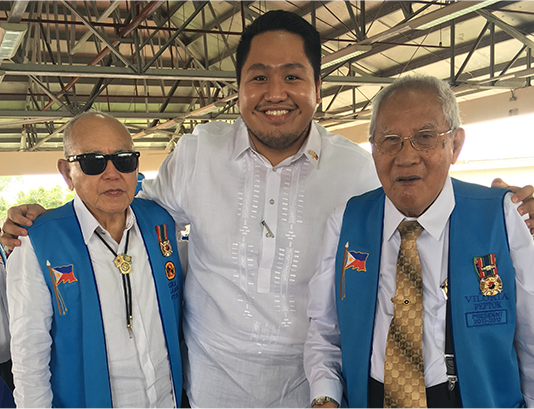
Oliver with members of the PEFTOK
Veterans Association (PVAI)
Veterans Association (PVAI)
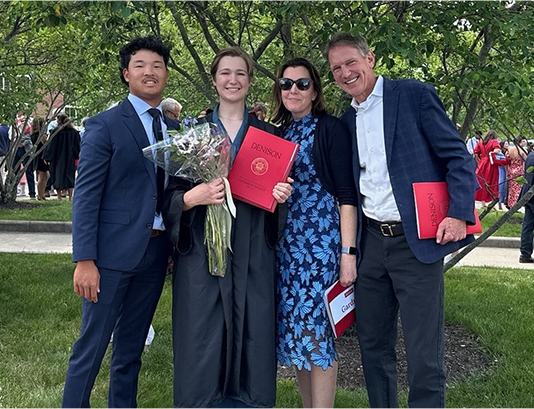
Kathy’s family at the university graduation ceremony
of her daughter, Mariana
of her daughter, Mariana
Q. Finally, the Korean War is remembered by many as history, but for descendants, it is also a family story. How do you hope the stories of Korean War veterans and their families will be remembered and passed on?
A.
Oliver I hope the stories of Korean War veterans will not remain merely as military events in history books, but will endure as living history, as part of the Filipino identity. To make this possible, the roles of governments, educational institutions, and organizations such as the PVAI are especially important. We must preserve these veterans’ stories through museums, memorial halls, and archival projects, ensuring that younger generations can fully understand their significance through education. Furthermore, cooperation with the Embassy of the Republic of Korea, cultural centers, and the KSIF is essential for learners to explore not only Korean language and culture, but also the values of democracy, peace, and international solidarity.
For many young Filipinos, the Korean War may seem like distant history from more than 70 years ago. Yet, considering how wars and conflict continue to plague many parts of the world, the values of courage, peace, democracy, and international solidarity that emerged from the Korean War remain just as relevant. That is why I believe these stories must continue to be shared, not to glorify war, but to remember the value of peace and the sacrifices made for it.
As the number of surviving veterans steadily declines, it is more urgent than ever to record their testimonies, photographs, diaries, letters, and personal experiences. Once their voices are gone, they cannot be recovered. This is not simply a way of commemorating the past; it is an investment in the future. As an educator and KSI director, I am committed to carrying this legacy forward by teaching students about Korea and the history of the PEFTOK, and by connecting the Philippines and Korea through a range of programs.
To me, remembering is not a task reserved for a particular anniversary, but a way of life practiced every day through education, scholarship, friendship, and service. I hope future generations will remember our veterans not simply as people who fought in a distant war, but as people who willingly devoted themselves to others.
Our veterans fulfilled the responsibility of their time. The responsibility left to us is no longer to fight a war, but to continue the “fight against oblivion.” As long as we continue to share their stories, uphold the values they left behind, and carry forward the friendship between the Philippines and Korea, their sacrifice will no longer remain in the past. Instead, it will continue to bridge the present and the future. I believe that is the most dignified way for us to honor the veterans.
For many young Filipinos, the Korean War may seem like distant history from more than 70 years ago. Yet, considering how wars and conflict continue to plague many parts of the world, the values of courage, peace, democracy, and international solidarity that emerged from the Korean War remain just as relevant. That is why I believe these stories must continue to be shared, not to glorify war, but to remember the value of peace and the sacrifices made for it.
As the number of surviving veterans steadily declines, it is more urgent than ever to record their testimonies, photographs, diaries, letters, and personal experiences. Once their voices are gone, they cannot be recovered. This is not simply a way of commemorating the past; it is an investment in the future. As an educator and KSI director, I am committed to carrying this legacy forward by teaching students about Korea and the history of the PEFTOK, and by connecting the Philippines and Korea through a range of programs.
To me, remembering is not a task reserved for a particular anniversary, but a way of life practiced every day through education, scholarship, friendship, and service. I hope future generations will remember our veterans not simply as people who fought in a distant war, but as people who willingly devoted themselves to others.
Our veterans fulfilled the responsibility of their time. The responsibility left to us is no longer to fight a war, but to continue the “fight against oblivion.” As long as we continue to share their stories, uphold the values they left behind, and carry forward the friendship between the Philippines and Korea, their sacrifice will no longer remain in the past. Instead, it will continue to bridge the present and the future. I believe that is the most dignified way for us to honor the veterans.
A.
Kathy I hope my children will remember their grandfather’s story as one of the countless stories of the veterans who defended the Republic of Korea. I will continue to encourage them to learn more about the Korean War, Korea’s history, and the sacrifice and dedication behind the nation’s growth.
Above all, our family is deeply grateful to the Republic of Korea for making it possible to welcome Theo into our family. I will continue to do everything I can to ensure that Theo views his heritage as a great blessing and lives with pride in his roots.
Above all, our family is deeply grateful to the Republic of Korea for making it possible to welcome Theo into our family. I will continue to do everything I can to ensure that Theo views his heritage as a great blessing and lives with pride in his roots.