“A New Model of Korean Language Education for Military and Security Settings” KSI Auburn, Launches Advanced Korean Course for U.S. Air Force
글쓴이홍보협력팀
태그
작성일 2026-07-24
조회수63

“A New Model of Korean Language Education for
Military and Security Settings”
Military and Security Settings”
KSI Auburn, Launches Advanced
Korean Course for U.S. Air Force
Korean Course for U.S. Air Force
> Three-week, 90-hour intensive Korean course provided for advanced learners in the U.S. Air Force
> Advanced Korean language and culture courses to be launched for military, diplomatic, and security personnel
◇ Launching Practical and Professional Korean Language Courses for Advanced Learners with Specific Needs
For three weeks from June 8 to 25, KSI Auburn, USA, conducted a summer intensive Korean program for five U.S. Air Force personnel. The program is part of a strategic language education initiative supported by the U.S. Department of Defense’s Defense Language and National Security Education Office (DLNSEO), specifically designed to provide advanced, intensive language training (LITE U) for the U.S. Air Force. The high-intensity course was structured to help the learners rapidly maximize their language proficiency in preparation for upcoming missions, serving as a key language education program to achieve higher ratings on the Interagency Language Roundtable (ILR) scale.
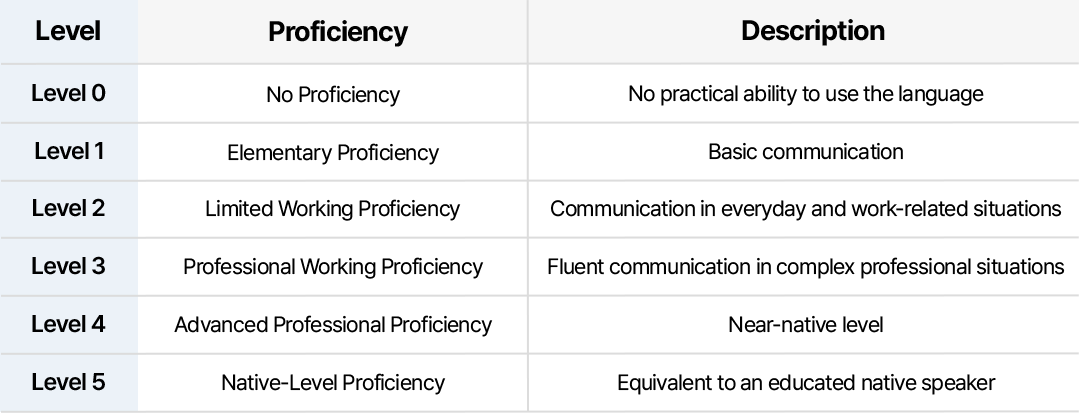
[Reference] The Interagency Language Roundtable (ILR) Scale
The ILR scale is a set of language proficiency assessment standards developed by the Interagency Language Roundtable (ILR) under the U.S. federal government. It consists of six levels, from Level 0 to Level 5.
[Reference] The Interagency Language Roundtable (ILR) Scale
The ILR scale is a set of language proficiency assessment standards developed by the Interagency Language Roundtable (ILR) under the U.S. federal government. It consists of six levels, from Level 0 to Level 5.
◇ Practice and Context at the Core: 90 Hours of Immersion and Curriculum Tailored to Advanced Learners
The 90-hour program, held at Auburn University, combined intensive Korean language training with specialized lectures on Korean Studies. Designed for advanced learners working in the military, diplomatic, security, and policy sectors, the program focused on practical and professional Korean, rather than simple conversational skills. Its core objective lay in strengthening both the literacy skills required for military and intelligence analysis and a contextual understanding of Korean society.
To this end, the curriculum was organized around three core pillars: practical communication training, internalizing language etiquette, and analyzing contemporary Korean society. In practical communication training, learners performed role-plays that compared Korean communication styles—rooted in Confucian values and concepts such as nunchi and face—with the U.S. military rank system. Language etiquette training focused on the intensive practice of using honorifics based on position and age, as well as language etiquette for various situations. Furthermore, by analyzing modern Korean history and generational values, the program enabled learners to build emotional rapport with Korean partners in real-world settings.
The curriculum also fosters the ability to conduct in-depth research on topics related to learners’ interests or real-world missions through a capstone project. To this end, advanced Korean language instruction was provided across diverse fields, including current affairs, economics, society, culture, politics, health, and technology. Learners were required to select a topic from these fields, conduct research over a 15-day period, write a paper, and deliver a final oral presentation. This process held particular significance as the final assessment that marked the conclusion of the intensive Korean language program.
To this end, the curriculum was organized around three core pillars: practical communication training, internalizing language etiquette, and analyzing contemporary Korean society. In practical communication training, learners performed role-plays that compared Korean communication styles—rooted in Confucian values and concepts such as nunchi and face—with the U.S. military rank system. Language etiquette training focused on the intensive practice of using honorifics based on position and age, as well as language etiquette for various situations. Furthermore, by analyzing modern Korean history and generational values, the program enabled learners to build emotional rapport with Korean partners in real-world settings.
The curriculum also fosters the ability to conduct in-depth research on topics related to learners’ interests or real-world missions through a capstone project. To this end, advanced Korean language instruction was provided across diverse fields, including current affairs, economics, society, culture, politics, health, and technology. Learners were required to select a topic from these fields, conduct research over a 15-day period, write a paper, and deliver a final oral presentation. This process held particular significance as the final assessment that marked the conclusion of the intensive Korean language program.
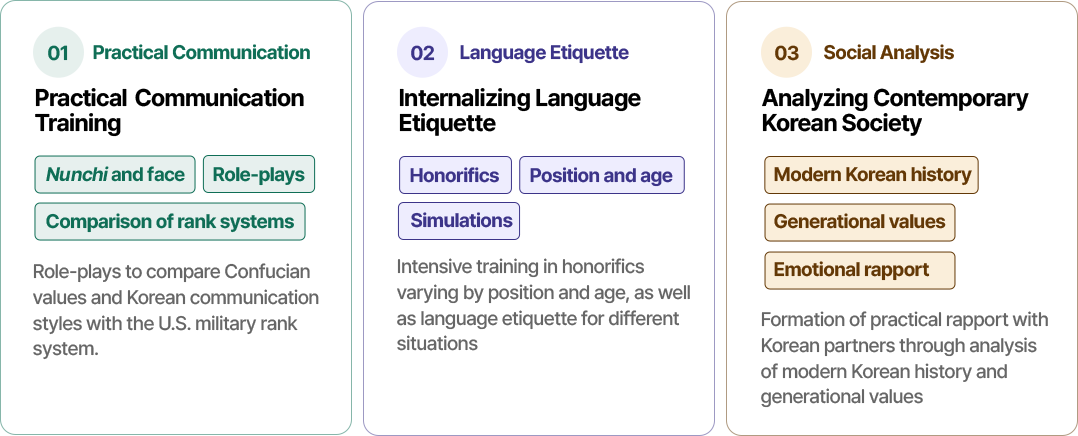
Curriculum Guidelines for the Summer Intensive Korean Language Education Program for U.S. Air Force Learners
◇ A New Expansion: Establishing a Korean Language Education Model for Advanced Learners with Specific Needs
“This change marks a meaningful leap for KSIs, as it is our first program designed for advanced learners. Furthermore, it holds profound significance in that it can provide customized teaching methods and advanced educational content in line with learners’ professional expertise and backgrounds, going beyond conventional language education.” _Lee Seung-heui, Director of the Auburn Korea Center, USA
“I hope this program serves as a catalyst for enhancing learners’ communication skills and their understanding of Korea by integrating language education with insights into Korean society and culture, as well as their respective fields of expertise. I look forward to seeing it evolve into a benchmark for specialized, advanced-level Korean language education.” _Kim Ju-yeon, Program Coordinator at KSI Auburn, USA
“I hope this program serves as a catalyst for enhancing learners’ communication skills and their understanding of Korea by integrating language education with insights into Korean society and culture, as well as their respective fields of expertise. I look forward to seeing it evolve into a benchmark for specialized, advanced-level Korean language education.” _Kim Ju-yeon, Program Coordinator at KSI Auburn, USA
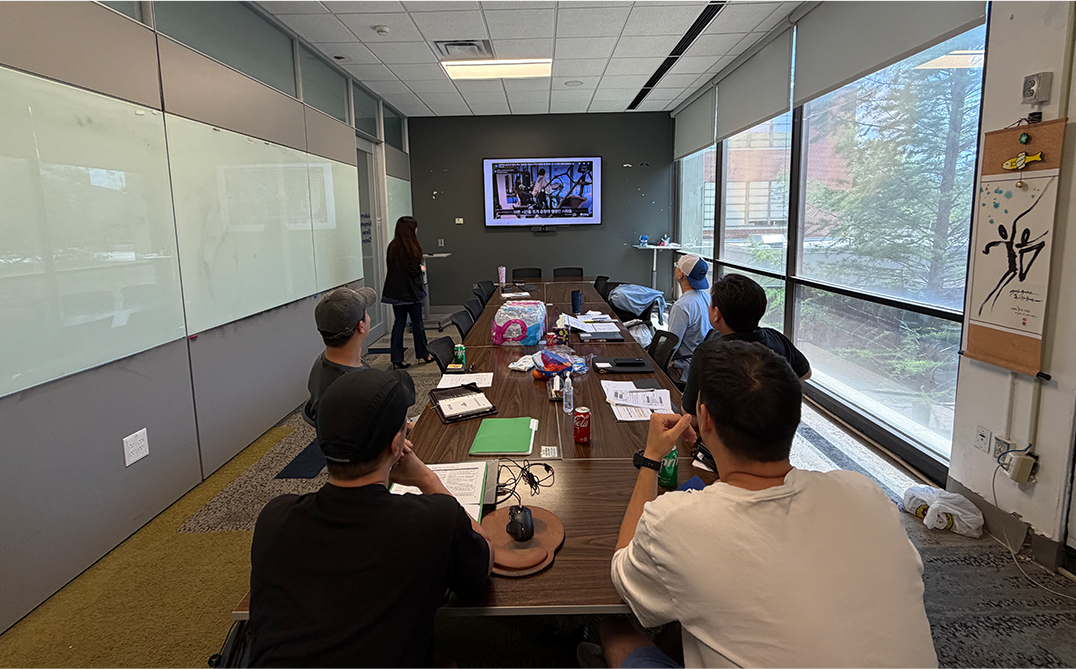
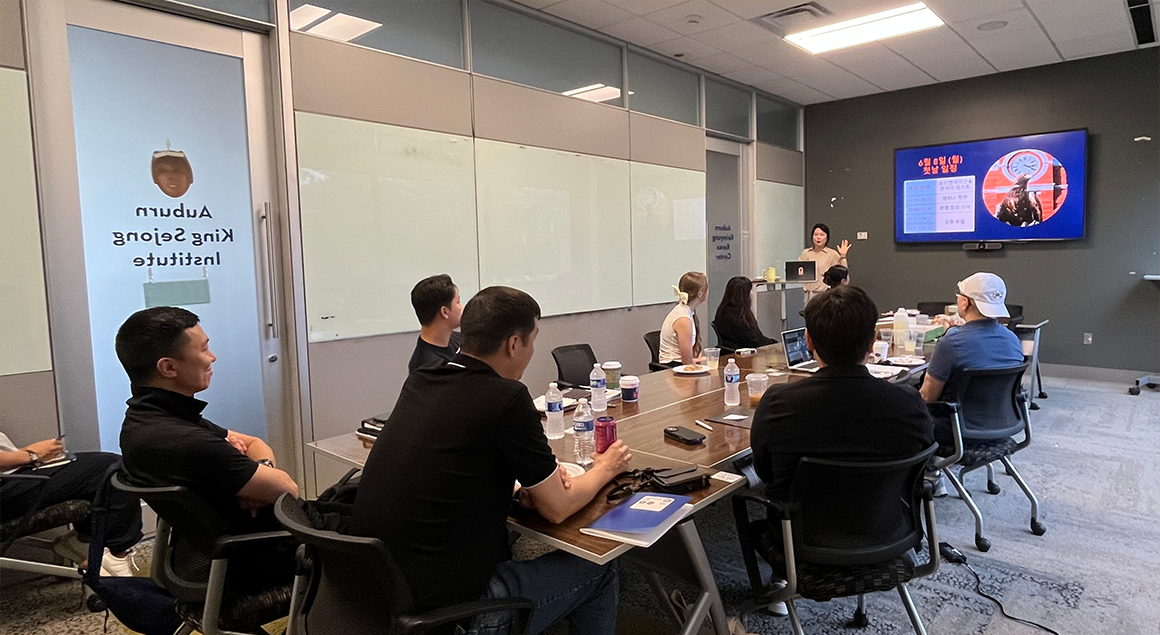
U.S. Air Force personnel during the intensive Korean language program
Building on the success of this program, KSI Auburn plans to develop Korean language education content tailored to U.S. military personnel, professionals, and advanced learners, while expanding its curriculum to include expert lectures and various other programs. Representatives from Keimyung University and KSI Auburn will also visit the KSIF headquarters to share the program’s detailed operational plans and discuss foundation-level cooperation strategies for internal and external promotion.
This program is highly significant, as it demonstrates how KSIs contribute not only to Korean language and culture education but also to the development of national security professionals. In particular, it marks a meaningful milestone in advancing practical, professional-level Korean language training for advanced learners, further solidifying the role of KSIs in the field of national strategic language education.
This program is highly significant, as it demonstrates how KSIs contribute not only to Korean language and culture education but also to the development of national security professionals. In particular, it marks a meaningful milestone in advancing practical, professional-level Korean language training for advanced learners, further solidifying the role of KSIs in the field of national strategic language education.
Article by Lee Mi-young, Correspondent at the KSI Auburn