“The Words That Shaped Me, the Lessons That Awakened Me” From Teacher and Students to Colleagues
글쓴이홍보협력팀
태그
작성일 2026-06-29
조회수51

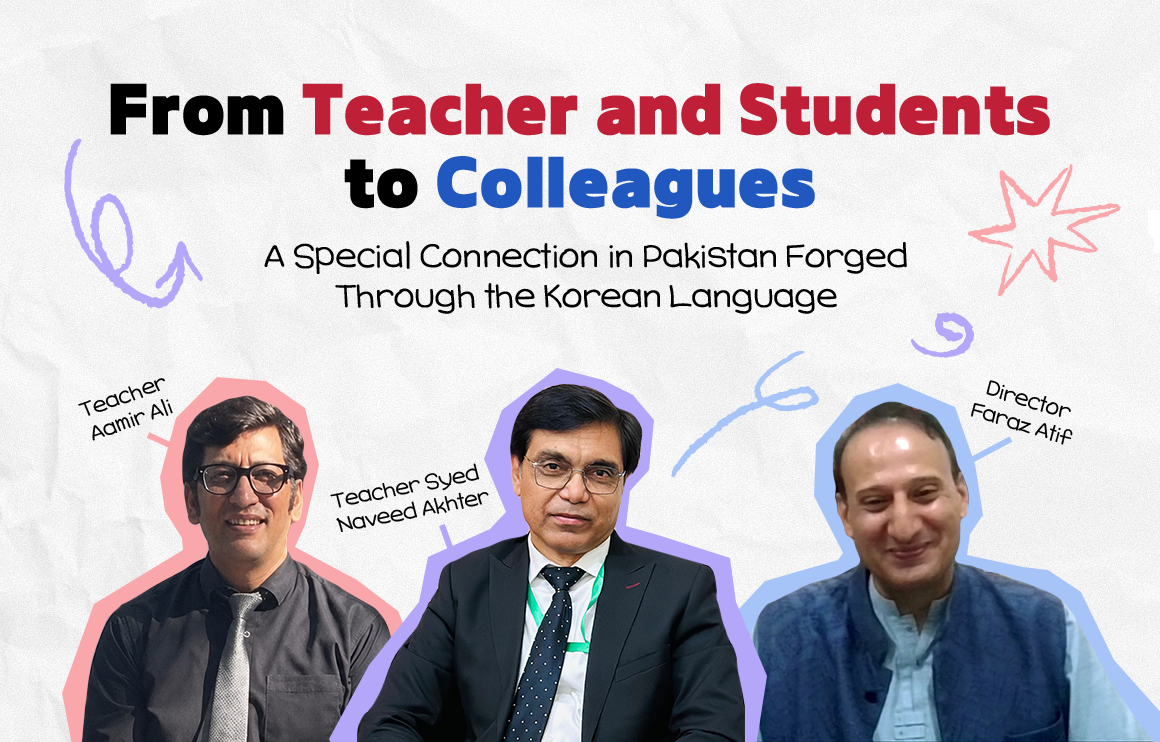
“The Words That Shaped Me, the Lessons That Awakened Me”
From Teacher and Students to Colleagues
The stories that unfold inside King Sejong Institute (KSI) classrooms cross more than just language barriers. They are journeys of human connection, where people build meaningful relationships, deepen their understanding of one another’s cultures, and discover new dreams and possibilities. For many, Korean is more than just a foreign language; it’s a door to new opportunities in life.
At KSI Islamabad, Pakistan, three people share one such remarkable journey. They first met as teacher and students, but today they work side by side as colleagues teaching Korean together at the same institute. They are Director Faraz Atif and his former students turned teachers Aamir Ali and Syed Naveed Akhter.
In celebration of Teachers’ Day and King Sejong the Great’s Birthday on May 15, 2026, we sat down with the three of them to hear about their paths from students to educators, the enduring impact of their teacher’s guidance, and their inspiring dreams and growth, all connected through the Korean language.
At KSI Islamabad, Pakistan, three people share one such remarkable journey. They first met as teacher and students, but today they work side by side as colleagues teaching Korean together at the same institute. They are Director Faraz Atif and his former students turned teachers Aamir Ali and Syed Naveed Akhter.
In celebration of Teachers’ Day and King Sejong the Great’s Birthday on May 15, 2026, we sat down with the three of them to hear about their paths from students to educators, the enduring impact of their teacher’s guidance, and their inspiring dreams and growth, all connected through the Korean language.
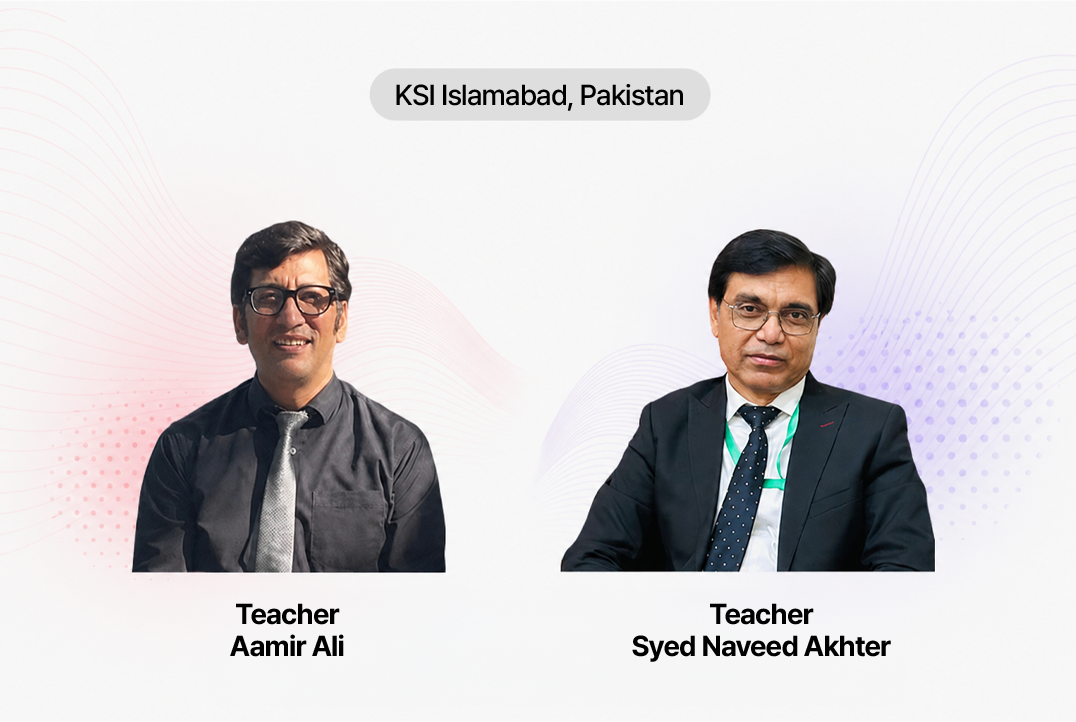
◇ From Learners to Teachers: The Stories of Two Local Teachers in Pakistan
Q. Hello! To start, could you introduce yourselves to the readers of Monthly Knock-Knock?
A. Aamir Ali Hello, my name is Aamir Ali. I studied Korean for two years at the National University of Modern Languages in Pakistan, and I currently work as a Korean language teacher at KSI Islamabad, Pakistan.
A. Syed Naveed Akhter Hello, my name is Syed Naveed Akhter. I lived in South Korea for five years, during which I learned Korean and naturally developed a deep passion for Korean language education. After returning to Pakistan, I began teaching Korean in 2007 to people seeking employment in Korea through the Ministry of Labor. Since 2014, I have been a teacher at KSI Islamabad, where I teach both Korean language and culture courses.
Q. You have both been with KSI Islamabad for over a decade. Was there any particular reason you decided to become a Korean language teacher at the KSI?
A. Aamir Honestly, I never imagined I would develop such close ties with the King Sejong Institute, as I initially started learning Korean out of practical necessity rather than as an academic or educational pursuit. Before studying the language, I worked as a tour guide at a time when growing numbers of Korean expedition teams and mountaineers were visiting Pakistan. Travel agencies needed someone who could communicate with Korean visitors and provide interpretation and guidance, and that was the starting point of my journey with the language.
It was around that time that I met my teacher and mentor, Director Faraz Atif. This encounter completely changed the trajectory of my life. What began as language study for professional purposes gradually morphed into a deep passion for the Korean language and Korean culture, and I eventually made the transition from student to teacher at the institute. It was an unexpected path, but it has been an incredibly meaningful and rewarding journey.
I believe that learning a foreign language involves more than simply acquiring new vocabulary; it’s a process that allows you to better understand your own native language, culture, and way of thinking. What struck me most about Korean was the consideration and respect woven into the fabric of the language, as well as the subtle shifts in nuance that reflect relationships and social context. The more I learned, the more fascinated I became. When I later had the opportunity to teach, I found immense fulfillment in learning and communicating alongside my students. Beyond just teaching a language, being able to share the culture and values woven into it holds a special meaning for me. Over time, teaching Korean has become more than just a job; it’s now one of the greatest sources of joy in my life.
It was around that time that I met my teacher and mentor, Director Faraz Atif. This encounter completely changed the trajectory of my life. What began as language study for professional purposes gradually morphed into a deep passion for the Korean language and Korean culture, and I eventually made the transition from student to teacher at the institute. It was an unexpected path, but it has been an incredibly meaningful and rewarding journey.
I believe that learning a foreign language involves more than simply acquiring new vocabulary; it’s a process that allows you to better understand your own native language, culture, and way of thinking. What struck me most about Korean was the consideration and respect woven into the fabric of the language, as well as the subtle shifts in nuance that reflect relationships and social context. The more I learned, the more fascinated I became. When I later had the opportunity to teach, I found immense fulfillment in learning and communicating alongside my students. Beyond just teaching a language, being able to share the culture and values woven into it holds a special meaning for me. Over time, teaching Korean has become more than just a job; it’s now one of the greatest sources of joy in my life.
A. Naveed I believe my connection with the King Sejong Institute grew out of the time I spent living in Korea. My teachers were wonderful and had a huge influence on me, and I experienced firsthand how vital it is to learn the language and the culture together. I became a KSI teacher because I wanted to share that same experience with learners in Pakistan.
What left the biggest impression on me during my time in Korea was the politeness and cultural values of the Korean people. Beyond learning the language, it was an opportunity to encounter a different way of life. When I returned to Pakistan, I wanted to share that inspiration with others, not keep it to myself. Working alongside Director Atif and the other exceptional educators at the King Sejong Institute truly inspired me and made me realize that I wanted to be just like them, passing on the Korean language and Korean culture to students.
What left the biggest impression on me during my time in Korea was the politeness and cultural values of the Korean people. Beyond learning the language, it was an opportunity to encounter a different way of life. When I returned to Pakistan, I wanted to share that inspiration with others, not keep it to myself. Working alongside Director Atif and the other exceptional educators at the King Sejong Institute truly inspired me and made me realize that I wanted to be just like them, passing on the Korean language and Korean culture to students.
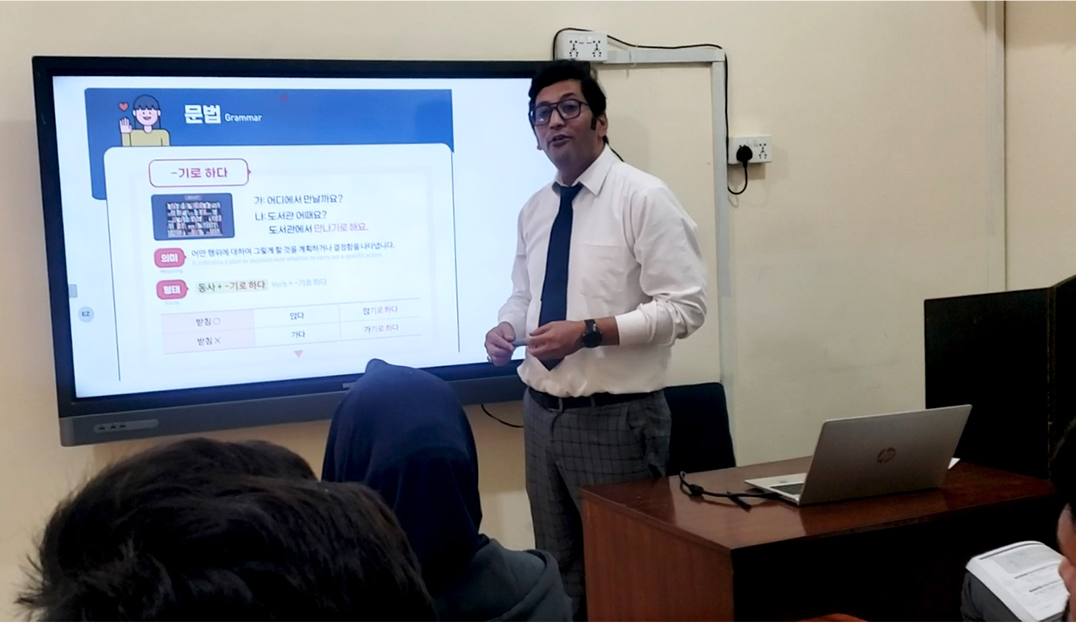
Aamir Ali teaching a Korean language class at KSI Islamabad, Pakistan
Q. What does teaching Korean in Pakistan mean to you? When do you feel the greatest sense of fulfillment as a teacher at KSI Islamabad, Pakistan?
A. Aamir For me, teaching Korean in Pakistan is more than simply teaching a foreign language. Korean is still perceived as a unique and unfamiliar language here, so I believe it provides students with new opportunities and a wider perspective on the world. I find it very fulfilling when I see students engage with the culture through the language, broaden their horizons, and even change the direction of their lives. What brings me the greatest pride and happiness is watching my students turn their dreams into reality after years of hard work by achieving a high TOPIK score, earning a scholarship, or seizing an opportunity to study or work in Korea. But for a teacher, the ultimate joy is witnessing students develop a genuine love for the Korean language and Korean culture, rather than studying purely to pass an exam or advance in their career.
A. Naveed I view Korean language education not merely as linguistic instruction, but as a cultural bridge connecting Korea and Pakistan. It gives me a great sense of fulfillment to watch students who could not speak a single word of Korean gradually learn to communicate in the language and pursue their dreams through it. To support them, I always keep my door open after class so that they can reach stop by with questions anytime. When they ask about their homework, I make sure to reply with a voice message, even if it’s the weekend. I also make an effort to spend time with students outside the classroom by sharing meals and participating in various activities with them. I can see that this kind of bonding helps them develop a deeper interest in the language and culture, which makes me genuinely proud.
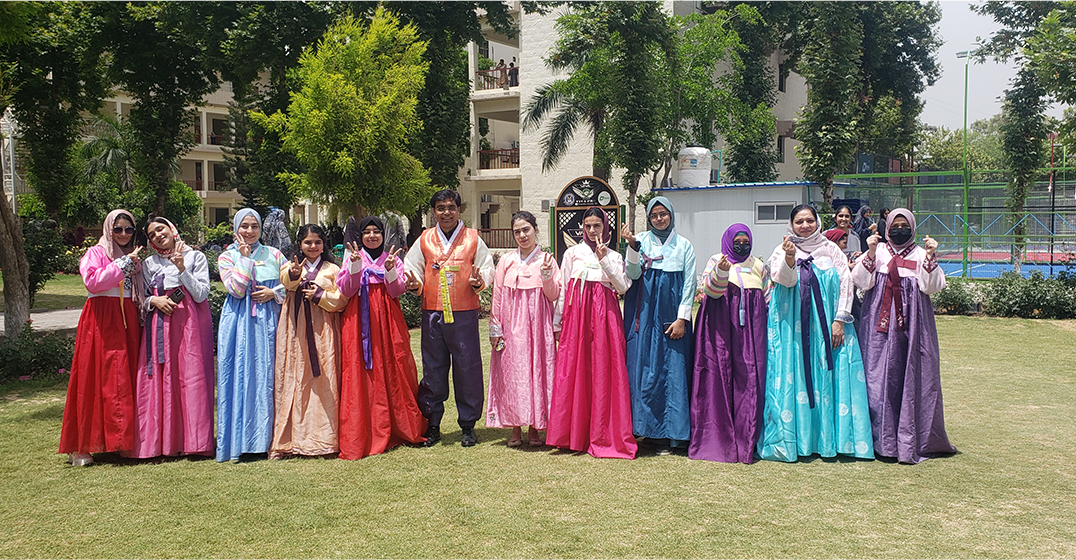
Syed Naveed Akhter (sixth from left) posing for a commemorative photo
with learners from KSI Islamabad, Pakistan, following a hanbok experience program
with learners from KSI Islamabad, Pakistan, following a hanbok experience program
Q. Director Faraz Atif is your former teacher. Is there any particular piece of advice or lesson from him that has stuck with you?
A. Aamir I have the utmost respect for Director Faraz Atif, both as a teacher and a mentor. I learned a great deal from him while studying Korean, and I continue to draw inspiration from both his words and his attitude. The piece of advice that left the deepest impression on me is: “Well begun is half done.” At first, it sounded like a common proverb, but over time I came to understand its true depth. Many people never take the first step because of fear or hesitation, yet the moment you begin, you have already overcome the greatest obstacle. That lesson changed the way I approach life, learning, and education.
He also once told me, “Teaching is about more than transferring knowledge; it’s also about understanding the fears and concerns of students and guiding them in the right direction.” This entirely reshaped my perspective on the role of an educator, and it’s something I think about whenever I prepare lessons or meet with students.
Another lesson that has stuck with me over the years is: “Even if someone wrongs you a hundred times, if they do something good for you even once, remember that one good deed.” To me, these words carry a profound message of consideration, forgiveness, and warmth toward others. It’s something that I strive to put into practice in my relationships with both students and colleagues.
He also once told me, “Teaching is about more than transferring knowledge; it’s also about understanding the fears and concerns of students and guiding them in the right direction.” This entirely reshaped my perspective on the role of an educator, and it’s something I think about whenever I prepare lessons or meet with students.
Another lesson that has stuck with me over the years is: “Even if someone wrongs you a hundred times, if they do something good for you even once, remember that one good deed.” To me, these words carry a profound message of consideration, forgiveness, and warmth toward others. It’s something that I strive to put into practice in my relationships with both students and colleagues.
A. Naveed Thinking of Director Atif always makes me feel warm inside, because he has always treated people with kindness and sincerity. Among the many insights he shared, the one that resonates with me most deeply is: “A good teacher is someone who instills dreams and confidence in students.” I think of those words every time I step into the classroom. They taught me that the true role of a teacher is not merely to impart knowledge, but to help each student believe in their own potential.
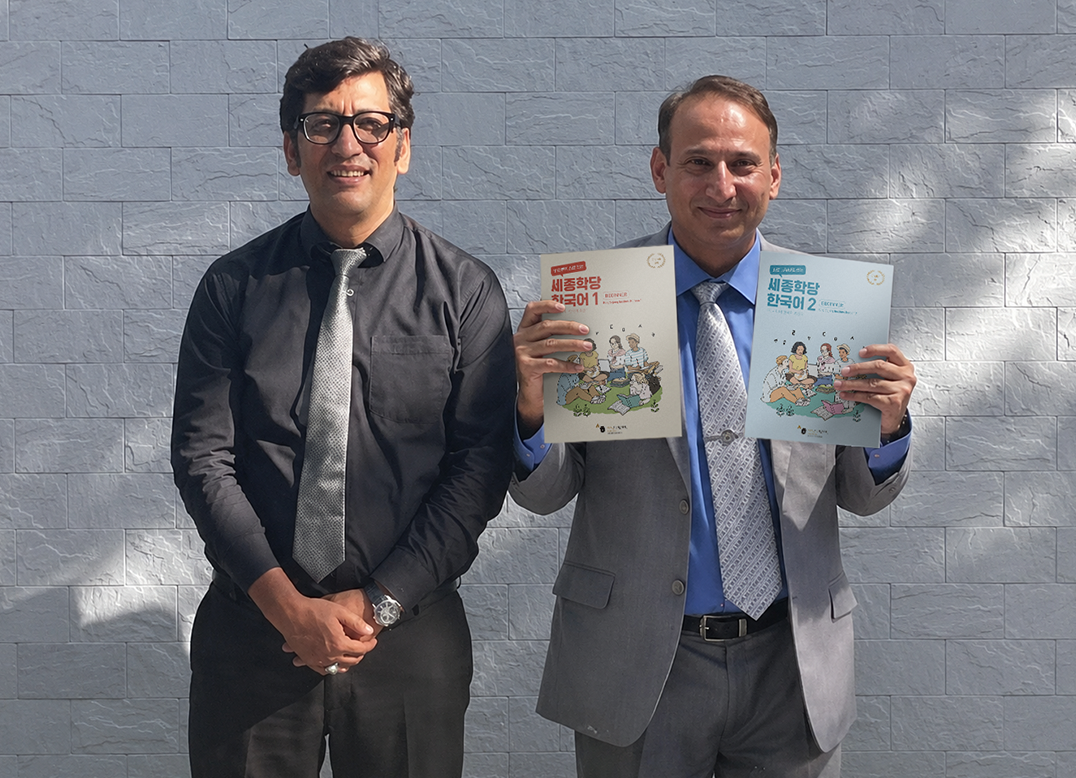
(From left) Teacher Aamir Ali and Director Faraz Atif
Q. Are there any lessons or attitudes you learned from Director Atif that you still bring to your classroom today?
A. Aamir I place the greatest importance on integrity, and I always strive to put the valuable lessons I learned from Director Atif into practice.
A. Naveed The most important lesson I learned from Director Atif is the importance of respecting students and instilling confidence in them. In my own classes, I make a conscious effort to encourage students so they don’t lose confidence when they make mistakes. I try to create a supportive environment where we can figure out a solution together when they encounter something they don’t know.
Q. What message of gratitude would you like to share with Director Faraz Atif for Teachers’ Day?
A. Aamir The time I have spent with you, Director Atif, has been an extraordinary journey in my life. You now serve as the leader of our institution, but you began as my teacher and will always remain so in my heart. You didn’t just teach me the Korean language; you always guided me with warmth and encouragement so that I could overcome my fears and limitations. Whenever I lost my way, you helped me find my direction again, and your teachings became the great strength that shaped who I am today. I now want to pass that same guidance on to my own students.
A. Naveed I can be quite forgetful at times and I still have much to learn, but throughout my journey of becoming an educator, you have always guided me with patience and warmth, never once raising your voice. I am where I am today thanks to your warm guidance and trust, and you have taught me so much about being a teacher. Thank you from the bottom of my heart!
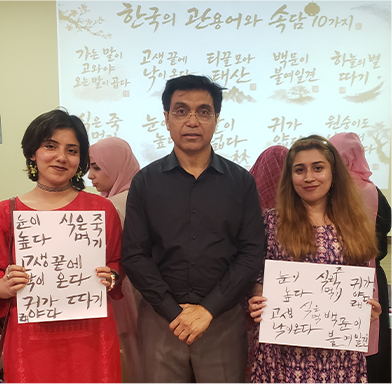
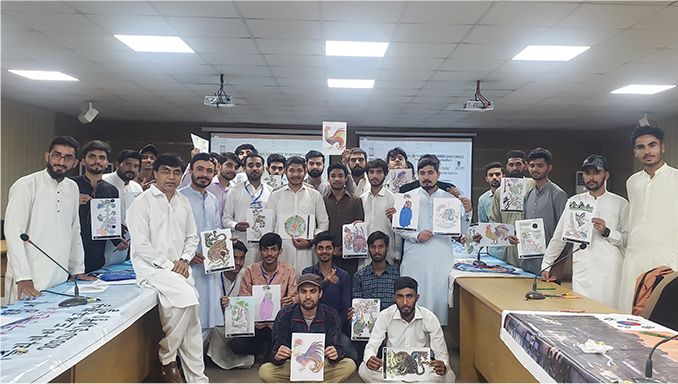
Commemorative photo of Syed Naveed Akhter with students following a Korean culture class
Q. Finally, what kind of teacher do you hope to be for learners at KSI Islamabad, Pakistan? Please share your hopes and aspirations.
A. Aamir I want to do more than just teach the language and culture. I want to help students truly understand and connect with Korean and Korea in meaningful ways. Through sincerity, patience, and understanding, I hope to guide my students so that learning Korean is not a difficult or burdensome process, but a joyful and meaningful journey.
I also want to be a lifelong learner. I aspire to continue growing, developing myself, and honing my abilities so that I can deliver even better lessons. Ultimately, my dream is to be a teacher who inspires students, supports their dreams, and grows alongside them.
I also want to be a lifelong learner. I aspire to continue growing, developing myself, and honing my abilities so that I can deliver even better lessons. Ultimately, my dream is to be a teacher who inspires students, supports their dreams, and grows alongside them.
A. Naveed More than a teacher who just imparts language skills, I want to be a mentor who supports the dreams and potential of students, who learns alongside them and grows together with them. I want to stand by their side as a source of strength, helping them connect to the wider world and march toward their dreams through the Korean language.
◇ From Students to Colleagues:
A Message of Encouragement from the Former Teacher
A Message of Encouragement from the Former Teacher
The person who first opened the door to the Korean language for both teachers was Faraz Atif, the current director of KSI Islamabad. For more than a decade, he has quietly and steadfastly nurtured Korean language education in Pakistan, planting the seeds and helping them blossom. His former students have gone on to become Korean language teachers and trusted colleagues. What has guided him throughout that remarkable journey?
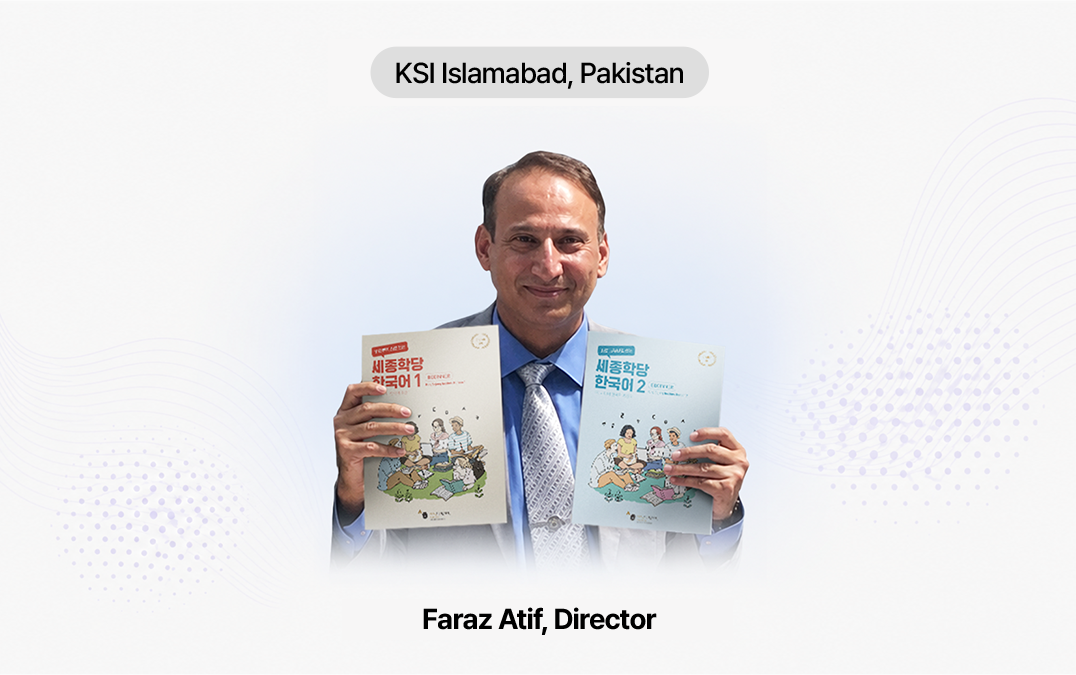
Q. Hello, Director Faraz Atif. To begin, could you briefly introduce yourself?
A. Hello. I am originally from Pakistan, and I first formed my connection with Korea while studying at Seoul National University for five years. I later obtained my master’s and doctoral degrees in Korean Studies at Sangmyung University. My career in Korean language education actually began in Korea when I took my first steps as a Korean language teacher through an organization called the Korean Language Globalization Foundation. I returned to Pakistan in 2006 and have been teaching at the National University of Modern Languages (NUML) ever since. NUML is somewhat similar to Hankuk University of Foreign Studies in Korea. It offers instruction in 27 languages, with Korean being one of them.
Frankly, before 2006, there was almost no structured Korean language education available in Pakistan. That changed in 2012 with the establishment of KSI Islamabad at NUML, where I have been serving as director ever since. I should also mention that I became a naturalized Korean citizen in 2005, so this year marks my 21st year since naturalization. These days, I often joke that I am living in Pakistan as a foreign national, a South Korean citizen, to be exact (laughs).
Frankly, before 2006, there was almost no structured Korean language education available in Pakistan. That changed in 2012 with the establishment of KSI Islamabad at NUML, where I have been serving as director ever since. I should also mention that I became a naturalized Korean citizen in 2005, so this year marks my 21st year since naturalization. These days, I often joke that I am living in Pakistan as a foreign national, a South Korean citizen, to be exact (laughs).
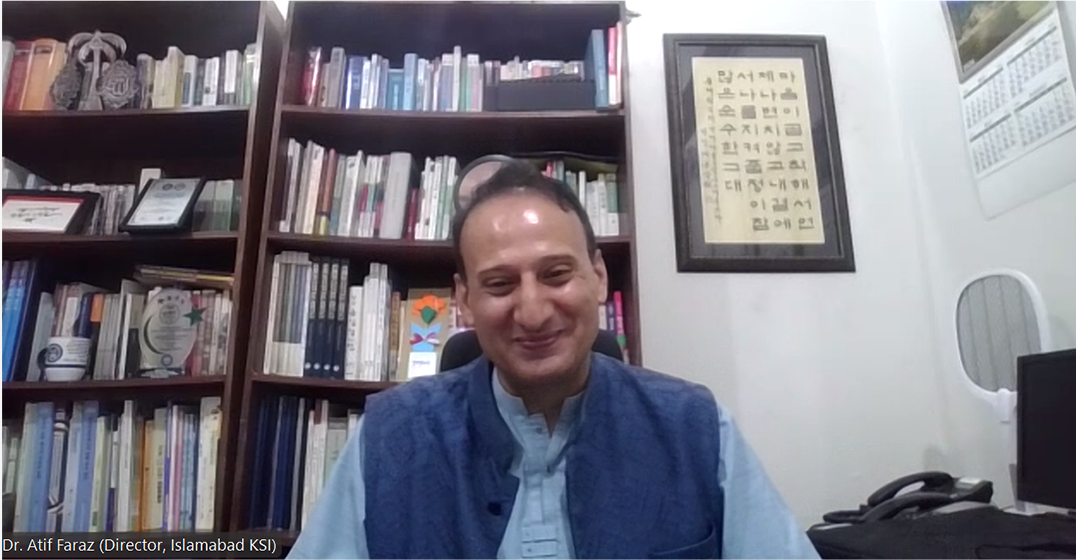
Director Faraz Atif of KSI Islamabad giving an online interview
with the KSIF via Zoom in celebration of Teachers’ Day
with the KSIF via Zoom in celebration of Teachers’ Day
Q. May 15 is Teachers’ Day in Korea, and it also marks the birth of King Sejong the Great, the creator of Hangeul. Looking back on your long journey teaching Korean to countless students in Pakistan, when have you felt the greatest sense of fulfillment as a teacher?
A. This question naturally leads me to reflect on how I arrived at where I am now. At the beginning of my own journey were the teachers who taught me Korean. When I first arrived in Korea, I didn’t even know the Korean alphabet. In fact, I was immediately singled out by my instructor at the Seoul National University Language Education Institute because my Korean was so limited. Thankfully, my homeroom teacher at the time started skipping lunch every day to give me one-on-one lessons right after regular class ended, from 1:00 PM to 2:00 PM. My first week there was one of the most important turning points in my life. Even now, thinking back to her dedication brings a strong wave of emotion. To this day, I always send her a message on Teachers’ Day, and she always replies. That’s a big source of pride for me.
Later, while studying Korean Studies at the Sangmyung University Graduate School, I was fortunate to receive encouragement and guidance from the university president and many of my professors. It was through their mentorship that my mission to establish and expand Korean language education in Pakistan began to take shape. Ultimately, my decision to become a naturalized Korean citizen was closely tied to that dream. Today, some of my former students have gone on to earn master’s and doctoral degrees in Korea and are building careers in their respective fields. Watching them create new opportunities and open doors for new generations of learners gives me the deepest sense of fulfillment as an educator. Looking back, I believe the greatest blessing in my life has been the opportunity to learn from wonderful teachers and, in turn, to teach wonderful students.
Later, while studying Korean Studies at the Sangmyung University Graduate School, I was fortunate to receive encouragement and guidance from the university president and many of my professors. It was through their mentorship that my mission to establish and expand Korean language education in Pakistan began to take shape. Ultimately, my decision to become a naturalized Korean citizen was closely tied to that dream. Today, some of my former students have gone on to earn master’s and doctoral degrees in Korea and are building careers in their respective fields. Watching them create new opportunities and open doors for new generations of learners gives me the deepest sense of fulfillment as an educator. Looking back, I believe the greatest blessing in my life has been the opportunity to learn from wonderful teachers and, in turn, to teach wonderful students.
Q. Aamir Ali and Syed Naveed Akhter were once your students and are now your fellow educators at the KSI Islamabad. What has it been like to witness their growth firsthand?
A. This is what makes teaching such a special profession. Few careers allow you to witness the growth of others so closely, and even fewer offer the chance to see people who have learned under you eventually become your colleagues. Aamir and Naveed were both dedicated students long before KSI Islamabad was formally established. They faithfully completed the beginner, intermediate, and advanced Korean language courses back when we operated as a simple language center. Aamir studied with me consistently over many years, while Naveed not only studied under me in Pakistan but also spent six to eight months studying in Korea to further develop his proficiency. Today, more than a decade later, both of them stand beside me as respected teachers and valued colleagues. As a teacher, that’s a source of tremendous pride. What makes me especially happy is seeing how actively they engage with their own students beyond the classroom. They take time to answer questions, offer guidance, and make themselves approachable and available. Whenever I witness that dedication, it naturally brings a smile to my face. I think to myself, “They truly are wonderful teachers.”
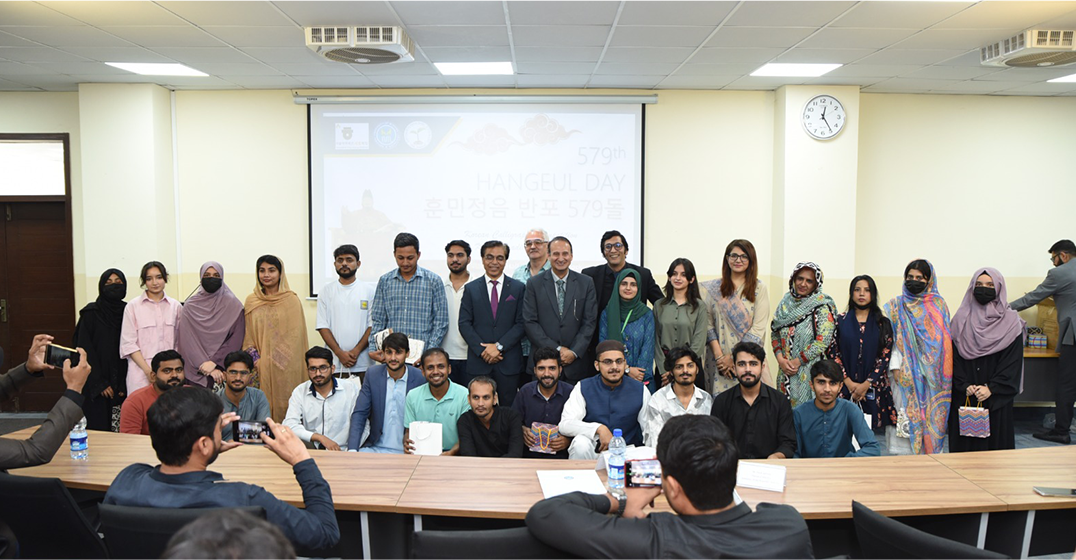
Group photo from the 2025 event at KSI Islamabad celebrating the 579th anniversary
of the promulgation of Hunminjeongeum (Hangeul)
of the promulgation of Hunminjeongeum (Hangeul)
Q. What message of encouragement would you like to share with these two former students who are now your colleagues?
A. The message I want to share with them most is simple: “Take it one step at a time, and give your best at every step.” I don’t believe there’s any great secret to success. More often than not, success comes from consistently doing your best wherever you are and in whatever role you have been given. When you approach each day with sincerity and dedication, good results follow naturally. Both of them are already doing an excellent job, and I hope they maintain the same mindset moving forward. If I could wish for one more thing, it would be for them to continue to grow academically as well. Both of them currently hold bachelor’s degrees, and I sincerely hope they will pursue master’s degrees, obtain official teaching qualifications, and eventually pursue doctoral studies. I can’t wait to see them take these steps toward an even brighter future. I want to express my deepest gratitude to both of them for always holding me in such high regard as a teacher and colleague.