KSIF and Hyundai Motor Group Join Forces to Support Customized Korean Language Education for Foreign Manufacturing Workers
글쓴이홍보협력팀
태그
작성일 2026-06-29
조회수39

KSIF and Hyundai Motor Group Join Forces to
Support Customized Korean Language Education for
Foreign Manufacturing Workers
Support Customized Korean Language Education for
Foreign Manufacturing Workers
> MCST, Hyundai Motor Group, K-Mobility Bridge Foundation, and KSIF sign MOU on Korean language education tailored to manufacturing sector
> Development and distribution of industry-specific Korean language textbooks focused on workplace safety and job adaptation
> Plans to support 130 Hyundai Motor Group partner companies and around 1,300 foreign workers by 2028
With the number of foreign workers employed in Korea now over 1.1 million, effective communication in industrial workplaces has become more than a language issue. It is now a critical factor directly linked to workplace safety. In response, there has been growing demand for practical Korean language education tailored to industrial settings in order to help foreign workers communicate effectively and adapt successfully to their jobs.
◇ Launch of Public-Private Partnership to Deliver Customized Korean Language Education
To address these needs, the King Sejong Institute Foundation (KSIF) signed a memorandum of understanding (MOU) on May 19 at the National Museum of Modern and Contemporary Art, Seoul, together with the Ministry of Culture, Sports and Tourism (MCST; Minister Choi Hwi-young), Hyundai Motor Group (President and Head of Strategy and Planning Sung Kim), and the K-Mobility Bridge Foundation (Chairman Ahn Jung-gu). The agreement establishes a collaborative framework among the government, public institutions, and private enterprises to address communication challenges in manufacturing workplaces and ensure safer and more supportive work environments for foreign workers.
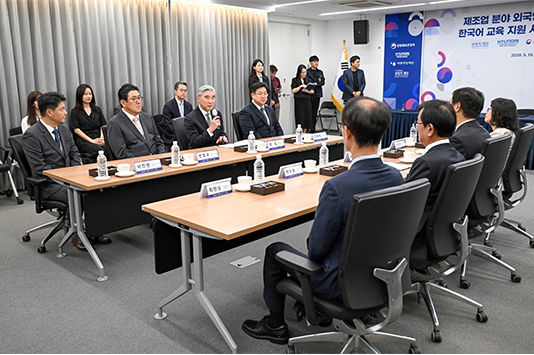
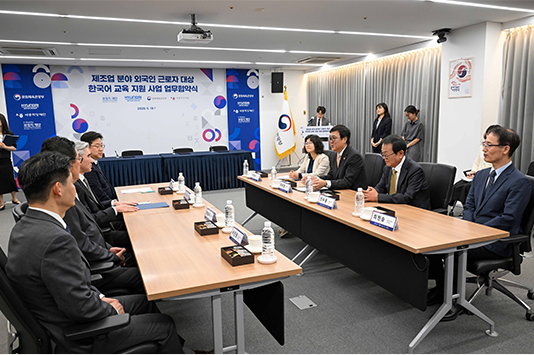
Key stakeholders discussing the Korean language education support initiative for
foreign workers in the manufacturing sector
foreign workers in the manufacturing sector
◇ Korean for the Shop Floor:
Development of Job- and Safety-Focused Learning Materials
Development of Job- and Safety-Focused Learning Materials
Under the agreement, each organization will contribute according to its area of expertise. The MCST will provide policy support, while Hyundai Motor Group will oversee project planning and funding, and the K-Mobility Bridge Foundation will manage field-based program operations. At the center of the initiative, the KSIF will lead overall project implementation, including curriculum design and the development of educational content.
Drawing on its extensive experience in developing Korean language materials for specific purposes, including for the agriculture, fisheries, and MICE* sectors, the KSIF will develop a new set of textbooks specifically tailored to manufacturing workplaces, with a strong focus on job performance and workplace safety.
*MICE: Meetings, incentive travel, conventions, and exhibitions & events.
The new materials will incorporate authentic workplace language used in manufacturing environments, including work instructions, safety procedures, and essential expressions used on the shop floor. These resources are expected to improve the job comprehension and workplace adaptation of foreign workers while contributing to safer and more efficient industrial operations.
Drawing on its extensive experience in developing Korean language materials for specific purposes, including for the agriculture, fisheries, and MICE* sectors, the KSIF will develop a new set of textbooks specifically tailored to manufacturing workplaces, with a strong focus on job performance and workplace safety.
*MICE: Meetings, incentive travel, conventions, and exhibitions & events.
The new materials will incorporate authentic workplace language used in manufacturing environments, including work instructions, safety procedures, and essential expressions used on the shop floor. These resources are expected to improve the job comprehension and workplace adaptation of foreign workers while contributing to safer and more efficient industrial operations.
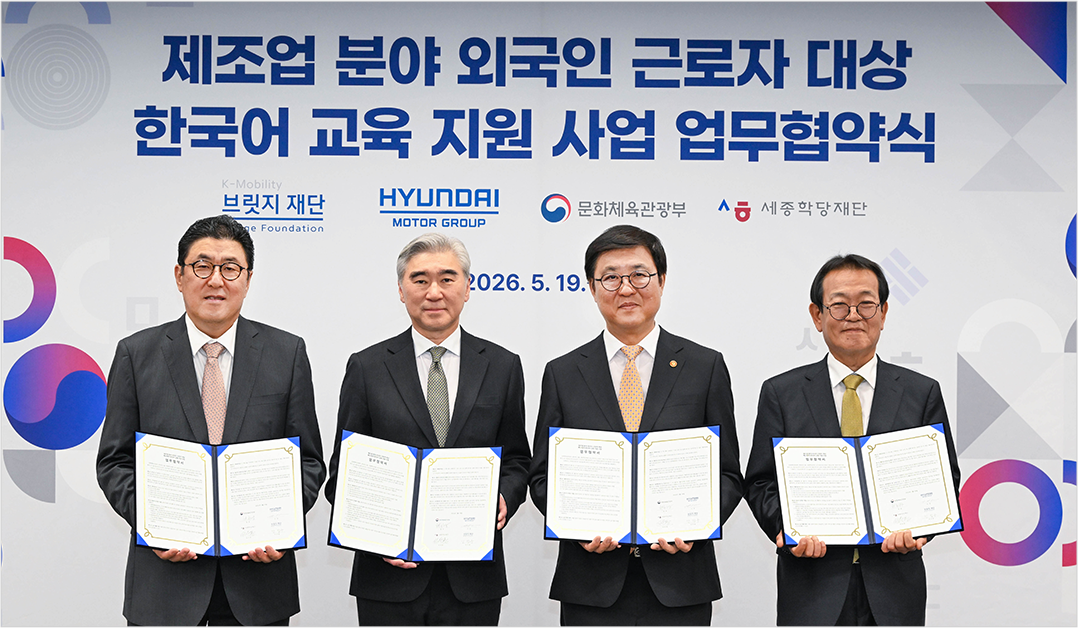
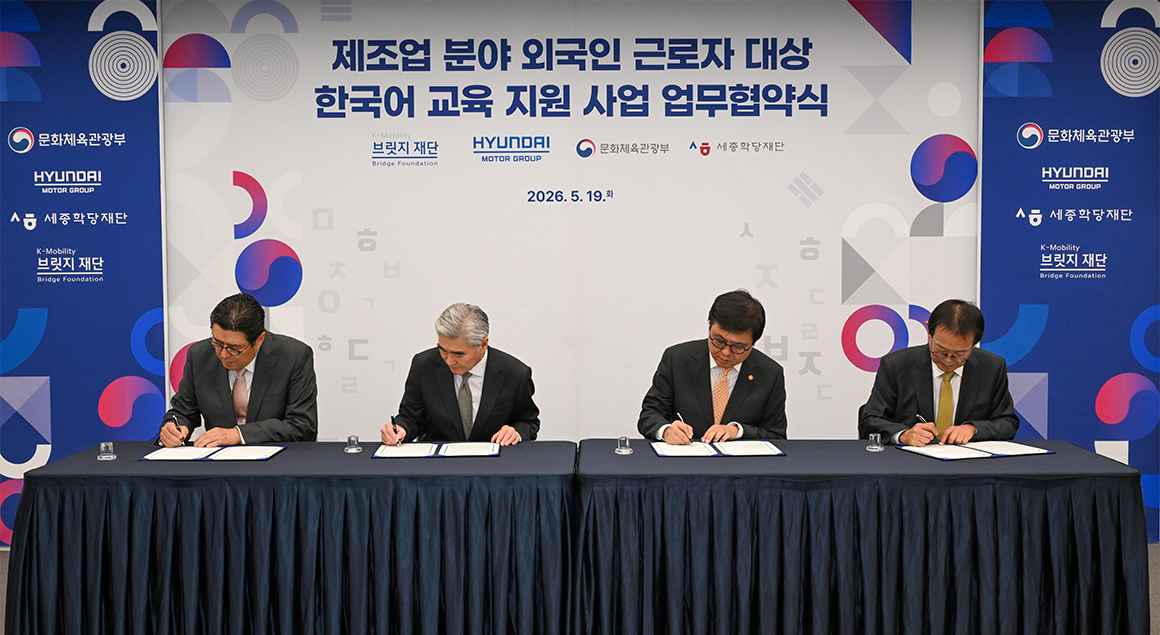
Group photo from the MOU signing ceremony for the Korean language education support initiative for
foreign workers in the manufacturing sector
(From left) Ahn Jung-gu, chairman of the K-Mobility Bridge Foundation; Sung Kim, president and head of
Strategy and Planning, Hyundai Motor Group; Choi Hwi-young, minister of Culture, Sports and Tourism;
and Jeon Woo-yong, president of the King Sejong Institute Foundation
foreign workers in the manufacturing sector
(From left) Ahn Jung-gu, chairman of the K-Mobility Bridge Foundation; Sung Kim, president and head of
Strategy and Planning, Hyundai Motor Group; Choi Hwi-young, minister of Culture, Sports and Tourism;
and Jeon Woo-yong, president of the King Sejong Institute Foundation
◇ Customized Korean Language Education to Reach 130 Hyundai Motor Group Partner Companies by 2028
The initiative will begin this year with a pilot program targeting roughly 20 Hyundai Motor Group partner companies. The program is expected to expand to 130 partner companies over the next three years and provide customized Korean language education to around 1,300 foreign workers by 2028. In addition, the teaching materials and educational content developed through the project will be released as public resources, and the scope of support will expand through cooperation with relevant government ministries so that these resources can be utilized across various other industrial sectors beyond manufacturing.
This project holds significant value as a practical, workplace-integrated model of Korean language education that extends beyond traditional classroom-based instruction. Participating organizations anticipate that the curriculum will enhance the safety, communication skills, and job comprehension of foreign workers while contributing to more stable and productive industrial operations.
Furthermore, by leveraging the KSIF’s global network of 252 KSIs in 87 countries, the initiative is expected to contribute to the wider dissemination of Korean language education in manufacturing and industrial settings around the world.
This project holds significant value as a practical, workplace-integrated model of Korean language education that extends beyond traditional classroom-based instruction. Participating organizations anticipate that the curriculum will enhance the safety, communication skills, and job comprehension of foreign workers while contributing to more stable and productive industrial operations.
Furthermore, by leveraging the KSIF’s global network of 252 KSIs in 87 countries, the initiative is expected to contribute to the wider dissemination of Korean language education in manufacturing and industrial settings around the world.