Translator of Han Kang’s We Do Not Part “The tragedy of the Jeju 4.3 Incident was painful to confront, but I wanted to convey it faithfully.”
글쓴이홍보협력팀
태그
작성일 2026-05-27
조회수173

Translator of Han Kang’s We Do Not Part
“The tragedy of the Jeju 4.3 Incident was painful to confront,
but I wanted to convey it faithfully.”
“The tragedy of the Jeju 4.3 Incident was painful to confront,
but I wanted to convey it faithfully.”
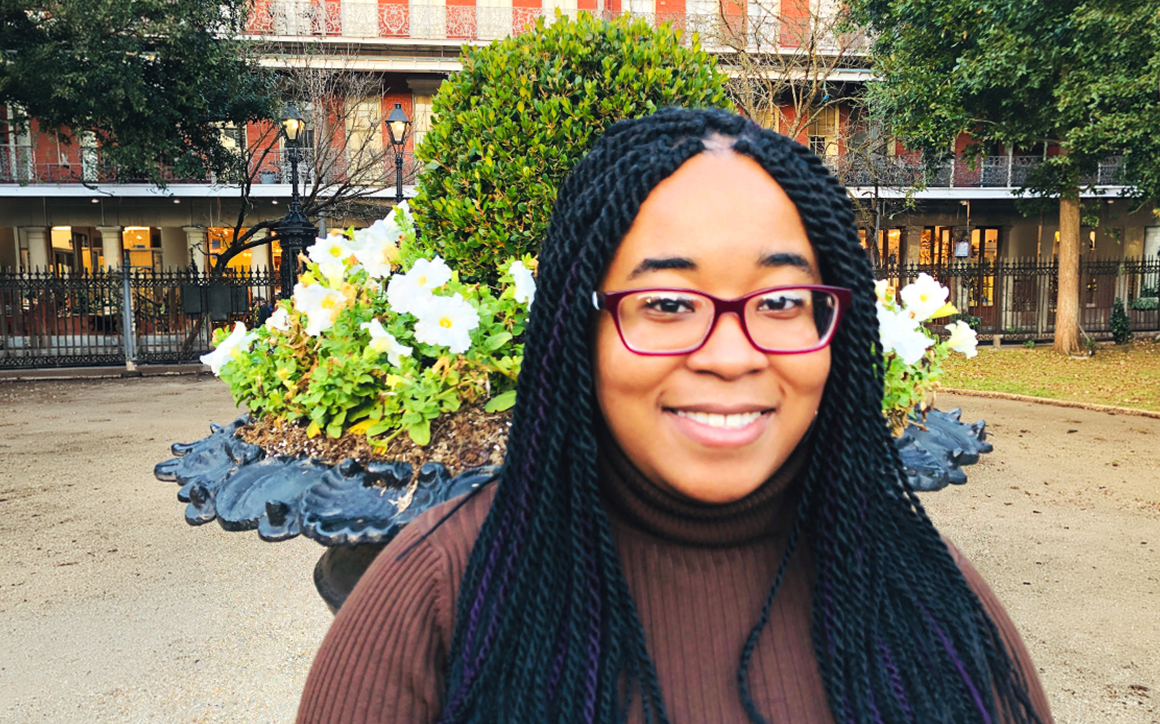
We Do Not Part by Han Kang won the National Book Critics Circle Award (NBCC) on March 26 (local time) for bringing the profound emotional depth of Korean literature to readers around the world. The award is especially meaningful, not only for recognizing the novel itself, but also for highlighting the role of the translator in faithfully conveying meaning and emotional resonance in another language. Paige Morris, an American writer and translator from New Jersey, is one of the translators of this award‑winning novel. We met with her to discuss the translation process, her journey as a translator, and the power of the Korean language.
◇ Sharing Han Kang’s Words with the World
Q. How did you feel when you heard that Han Kang had won the NBCC Award?
A. I was completely stunned, then overwhelmed with gratitude almost immediately afterward. In the literary world, the labor of translators often goes unsung, so such an outpouring of support was incredibly moving. It was a rare and meaningful moment of acknowledgment, not only for Han Kang’s extraordinary work, but also for the translators who quietly labor behind the scenes to bring such stories to readers around the world.
Q. How did you feel when you were first invited to translate We Do Not Part? What motivated you to join the project?
A. My co‑translator e. yaewon reached out to me one day and suggested we work on a translation project together. I’d long admired her work, so I accepted wholeheartedly. It was only afterward that I learned the project was We Do Not Part. I was deeply moved that she trusted me enough to collaborate on such a significant undertaking. I had long admired Han Kang, so knowing that I would be translating one of her works made me feel a strong sense of responsibility. I resolved to preserve the beauty and emotional depth of the original text as faithfully as possible.
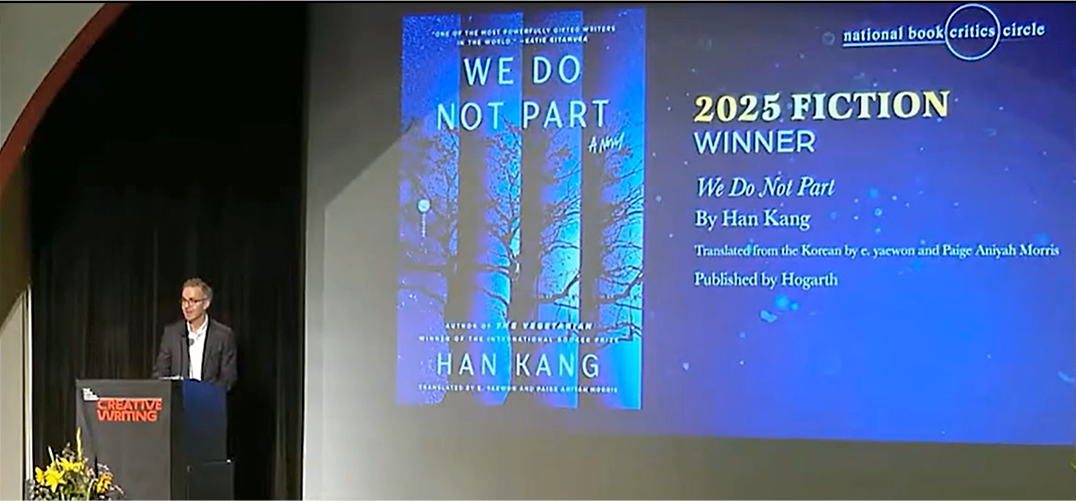
A publishing editor reading Han Kang’s acceptance speech at the 2025 NBCC Awards ceremony in New York
City (Photo courtesy of the Arirang News YouTube channel)
City (Photo courtesy of the Arirang News YouTube channel)
Q. We Do Not Part is set against the historical tragedy of the Jeju 4.3 Incident. How did you prepare yourself to understand such unfamiliar history and language? Did the process change you personally in any way?
A. I conducted extensive research on the Jeju dialect and the history surrounding the tragic Jeju 4.3 Incident. Because the novel incorporates real photographs, testimonies, and newspaper articles, I carefully examined relevant materials to ensure that the details were conveyed accurately in translation. I also read various academic papers to get a better feeling for how to express in English the brutality and emotional weight of the events depicted in the novel. To improve my understanding of regional expressions, I studied dictionaries and grammar resources for the Jeju dialect, many of which were compiled by local researchers and residents.
Throughout the process, I was careful to ensure that the context and meaning of the events weren’t diluted or distorted in translation. I feel that I changed through this experience as well. In the past, I was afraid to look too deeply into tragedies like these, but translating this work taught me the importance of confronting painful truths and conveying them faithfully. In that sense, I believe the experience made me more resilient.
Throughout the process, I was careful to ensure that the context and meaning of the events weren’t diluted or distorted in translation. I feel that I changed through this experience as well. In the past, I was afraid to look too deeply into tragedies like these, but translating this work taught me the importance of confronting painful truths and conveying them faithfully. In that sense, I believe the experience made me more resilient.
Q. Korean and English differ significantly in sentence structure, and Han Kang’s prose is uniquely poetic and nuanced. Translating it into English must have been an especially challenging process. What was the most difficult part of the translation process, and when did you feel the greatest sense of accomplishment?
A. While Han Kang’s prose is deeply poetic, it’s also remarkably precise and guided by a clear artistic vision. In many ways, this actually makes it easier to translate. The most difficult—but at the same time most rewarding—part of the process is determining whether I have faithfully recreated the emotions I experienced while reading the original text. Whenever I feel that those emotions have been fully revived in the translated version, I experience an immense sense of pride and accomplishment as a translator. I believe that ultimately, the essence of translation lies not only in conveying meaning, but also in conveying emotion.
Q. In her acceptance speech, Han Kang described her translators as “people who created remarkable connections between Korean and English.” What did the word “connection” mean to you?
A. I believe this novel is deeply rooted in the idea of connection. There’s recurring, cyclical imagery throughout that reflects how people remain connected across time and space. To me, translation is also an act of reaching toward others, an effort to build meaningful connections. The fact a story born from a completely different linguistic and cultural background thousands of kilometers away could resonate emotionally with readers of the English translation felt like proof that I’d truly created such a connection.
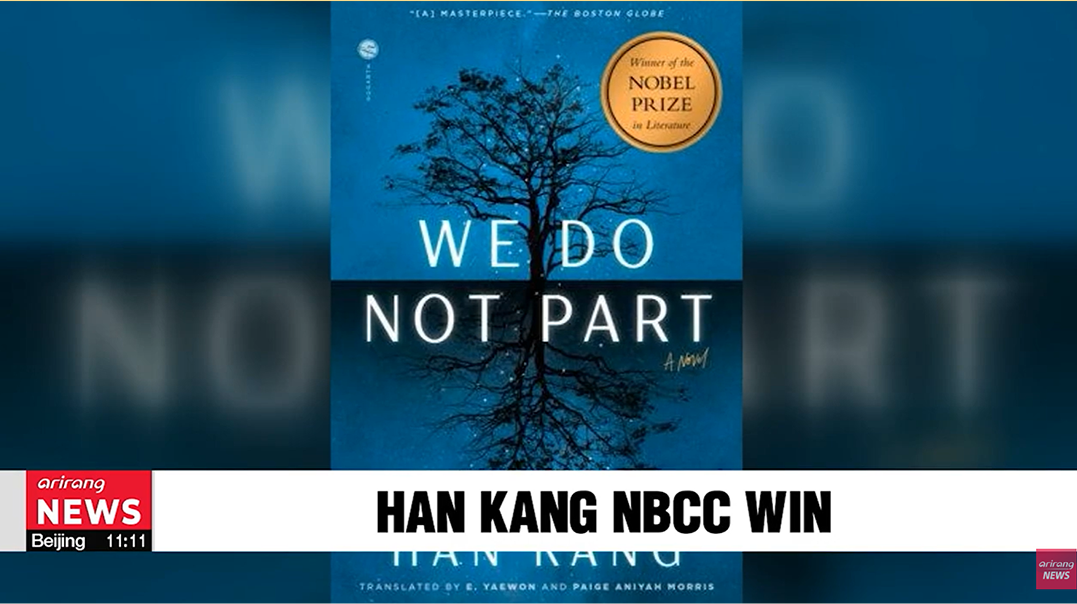
We Do Not Part winning the NBCC Award, as covered by Arirang News
(Photo courtesy of the Arirang News YouTube channel)
(Photo courtesy of the Arirang News YouTube channel)
◇ “Translation is more than just language conversion. It requires interpretation and judgment.”
Q. Do you recall your first encounter with the Korean language? What was your first impression, and does any of that initial feeling still resonate with you today?
A. Growing up in a culturally diverse city in the United States, I was naturally exposed to a variety of languages from a young age, and Korean was one of them. From the start, I found it uniquely appealing. It’s soft yet dynamic, and quite expressive. I first began studying Korean in high school. I had completed all the other language courses available at the school and my history teacher encouraged me to try something new. Looking back, I’m incredibly grateful for that nudge. Since then, Korean has been a ceaseless challenge for me. I remain deeply fascinated by its beauty and complexity, and by the endless ways it pushes me to grow.
Q. With so many career paths to choose from, what made you decide to become a translator?
A. I’ve always loved literature and believed I would eventually work in a related field. However, I never imagined becoming a translator. In 2016, while living in Korea as a Fulbright Program scholar, I encountered countless fascinating Korean authors and literary works in bookstores that had not yet been translated into English. I wanted to share those stories with friends and family back home, so I began translating small excerpts myself. Over time, that naturally led me to think, “Why not translate these works on my own?”
I later applied for the American Literary Translators Association’s mentorship program and, in 2020, was selected as a mentee of Janet Hong, who has been introducing Korean literature to English-speaking readers since the early 2000s. That experience marked the true beginning of my career as a literary translator. Since then, this path has brought me immense joy and allowed me to create many meaningful connections.
I later applied for the American Literary Translators Association’s mentorship program and, in 2020, was selected as a mentee of Janet Hong, who has been introducing Korean literature to English-speaking readers since the early 2000s. That experience marked the true beginning of my career as a literary translator. Since then, this path has brought me immense joy and allowed me to create many meaningful connections.
Q. What’s kept you dedicated to the path of a translator without giving up?
A. While the life of a translator can often be lonely and difficult, meeting wonderful colleagues and mentors has been my greatest source of strength. The support of fellow translators and the generous guidance of my mentors have helped me endure the difficult moments. When I face challenges, I often reflect on the words of Toni Morrison:
“If you are free, you need to free somebody else. If you have some power, then your job is to empower somebody else.”
I’ve only come this far because of the help and generosity of so many people. In the future, I hope to support and empower other translators in the same way.
“If you are free, you need to free somebody else. If you have some power, then your job is to empower somebody else.”
I’ve only come this far because of the help and generosity of so many people. In the future, I hope to support and empower other translators in the same way.
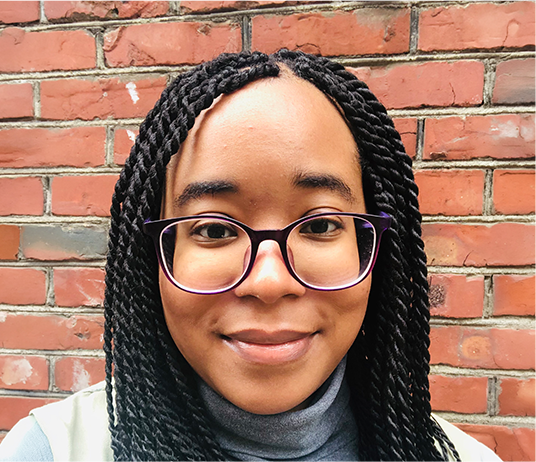
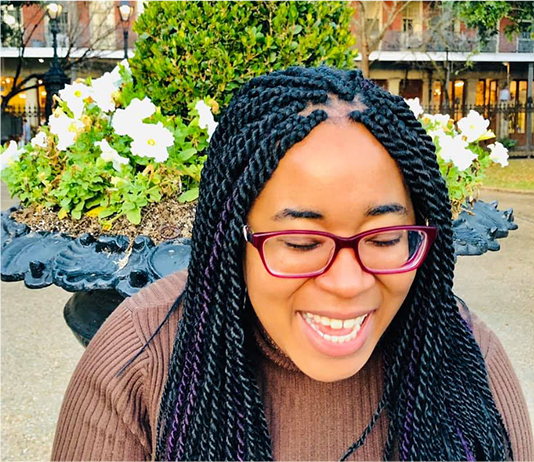
Paige Morris, translator of We Do Not Part by Han Kang
Q. In an era when AI translation tools are spreading rapidly, you continue to translate Korean literature by hand. What do you think only human translators can do that technology cannot replace?
A. Recently, I’ve noticed more and more people relying on AI translation tools. While these tools can produce translations of a certain quality, they still make a lot of errors. But more importantly, they often struggle to capture the human sensitivity that lies at the heart of translation as a creative act.
This is especially true for a highly context-dependent language like Korean, where meaning often extends far beyond the surface layer of words. Nuances, emotional undertones, and cultural implications frequently require the interpretation and judgment of a human translator. Translation is more than just converting one language into another; it is an ongoing process of making choices and solving creative problems.
I also believe that in order to be a good translator, you need to be a good writer. That’s not a skill you can develop overnight, but something cultivated through years of reading, writing, and revision. While technological advancements certainly offer many advantages, I believe the human role remains indispensable in fields that require creativity and sensitivity.
This is especially true for a highly context-dependent language like Korean, where meaning often extends far beyond the surface layer of words. Nuances, emotional undertones, and cultural implications frequently require the interpretation and judgment of a human translator. Translation is more than just converting one language into another; it is an ongoing process of making choices and solving creative problems.
I also believe that in order to be a good translator, you need to be a good writer. That’s not a skill you can develop overnight, but something cultivated through years of reading, writing, and revision. While technological advancements certainly offer many advantages, I believe the human role remains indispensable in fields that require creativity and sensitivity.
Q. Some people have gone on to become translators after learning Korean at KSIs. One example is Paula Martínez Gual, who translated I Want to Die but I Want to Eat Tteokbokki into Spanish in 2022. Stories like hers must be deeply inspiring for Korean learners who dream of becoming translators themselves. What words of encouragement would you like to share with aspiring translators?
A. For anyone learning a new language, I recommend reading as much as possible in that language. Learners of Korean are especially fortunate because they have access not only to literature, but also to a wide variety of content, including webtoons, web novels, dramas, and more. My own journey into translation began while I was still studying Korean. As my proficiency improved, I was able to understand and appreciate more stories. I naturally wanted to share those narratives with others by translating them. Regardless of your current level, I encourage you to study consistently and to try translating small pieces whenever you can. Through that process, you will undoubtedly notice your skills improving, and you never know where it will eventually lead you.