Hallyu Fuels Korean Language Boom, Driving Tourism and Consumption
글쓴이홍보협력팀
태그
작성일 2026-04-16
조회수258


Hallyu Fuels Korean Language Boom,
Driving Tourism and Consumption
Driving Tourism and Consumption
> Korean becoming part of everyday life in studies and spending
> KSI learner satisfaction reaches 93.1 points in 2025, rising for the sixth consecutive year
The recent global surge in Korean language learning has evolved beyond simple language acquisition into a virtuous cycle of cultural and economic engagement. Foreigners who have developed an affinity for Korea through K-pop, dramas, films, and other K-content are increasingly studying the language, with that interest further translating into purchases of Korean products and visits to Korea. Reflecting this momentum, the number of people enrolled at King Sejong Institutes (KSIs) in 2025 reached a record high of 239,020, an increase of around 28,000 compared to the previous year.
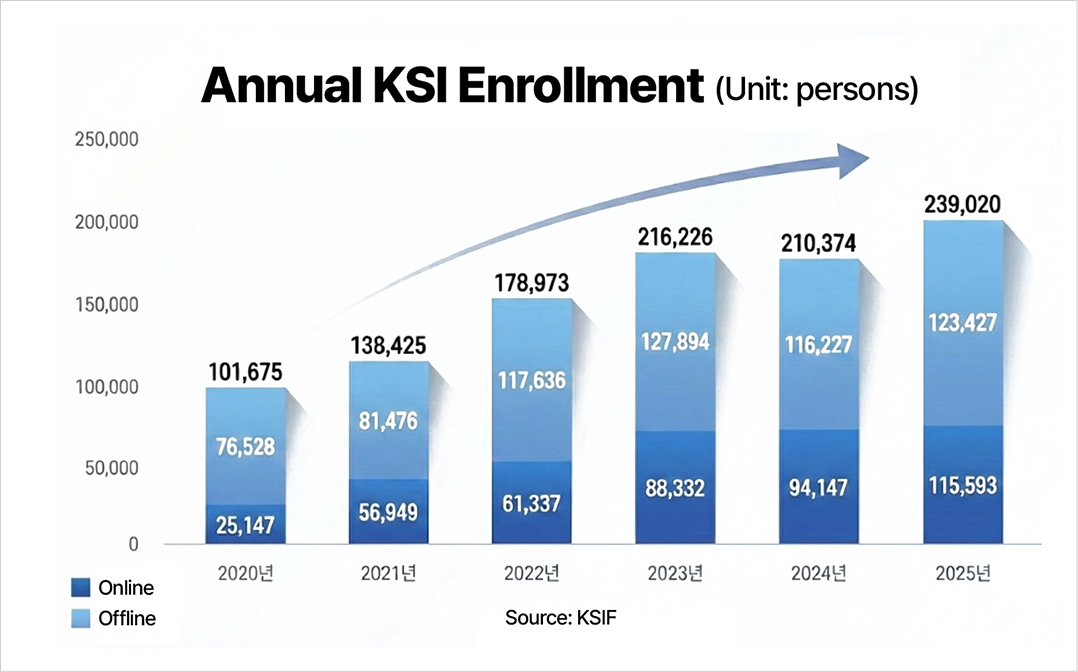
Annual KSI enrollment statistics
From Hobby to Academic Pursuit
Motivations behind learning Korean are shifting. What was once largely a hobby driven by interest in Hallyu has evolved into an academic and career pursuit. According to the 2025 Korean Language Status Survey conducted by the King Sejong Institute Foundation (KSIF), which surveyed a total of 19,451 respondents, comprising 1,323 foreign nationals interested in the Korean language and Korean culture and 18,128 KSI learners. Among the foreign nationals with experience learning Korean (N = 1,323), 50.9% reported studying the language in preparation for studying abroad or an academic program in Korea, while 37.0% cited career development as their primary motivation. In addition, 46.3% indicated that learning Korean had been helpful in pursuing a Korean-related major in their home country. These findings demonstrate that Korean has firmly established itself as a language of opportunity that’s closely tied to major life decisions.
The survey consisted of a Korean language status survey (September 12 – October 31, 2025) and a satisfaction survey (September 5, 2025 – January 9, 2026), and was aimed at comprehensively understanding Korean language education environments, the characteristics and needs of learners, and the global demand for Korean language lessons.
Motivations behind learning Korean are shifting. What was once largely a hobby driven by interest in Hallyu has evolved into an academic and career pursuit. According to the 2025 Korean Language Status Survey conducted by the King Sejong Institute Foundation (KSIF), which surveyed a total of 19,451 respondents, comprising 1,323 foreign nationals interested in the Korean language and Korean culture and 18,128 KSI learners. Among the foreign nationals with experience learning Korean (N = 1,323), 50.9% reported studying the language in preparation for studying abroad or an academic program in Korea, while 37.0% cited career development as their primary motivation. In addition, 46.3% indicated that learning Korean had been helpful in pursuing a Korean-related major in their home country. These findings demonstrate that Korean has firmly established itself as a language of opportunity that’s closely tied to major life decisions.
The survey consisted of a Korean language status survey (September 12 – October 31, 2025) and a satisfaction survey (September 5, 2025 – January 9, 2026), and was aimed at comprehensively understanding Korean language education environments, the characteristics and needs of learners, and the global demand for Korean language lessons.
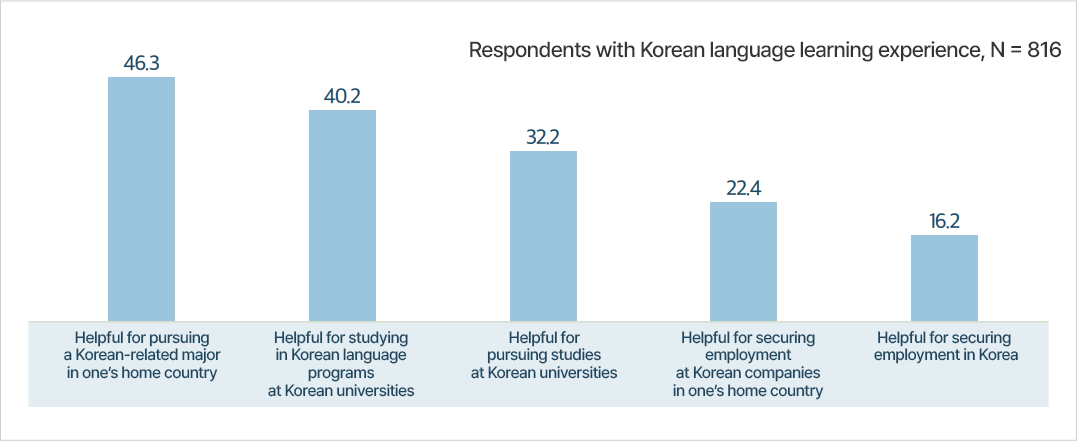
Key perceived benefits of learning Korean (multiple responses)
Reasons for Choosing KSIs: “Credibility” and “High Quality of Instruction”
The brand power of the KSIs, a cornerstone of Korean language education worldwide, is steadily growing. According to the 2025 survey, 80% of foreign nationals with an interest in the Korean language and Korean culture (N = 1,323) were aware of KSIs, and even among those who had never used their services, 97.7% expressed a willingness to do so in the future. The main reasons for choosing KSIs were their credibility as institutions supported by the Korean government (81.5%) and the high quality of instruction (75.4%). Built on this strong foundation of trust, KSIs achieved a learner satisfaction score of 93.1 in 2025, an all-time high and the sixth consecutive year-on-year improvement.
The brand power of the KSIs, a cornerstone of Korean language education worldwide, is steadily growing. According to the 2025 survey, 80% of foreign nationals with an interest in the Korean language and Korean culture (N = 1,323) were aware of KSIs, and even among those who had never used their services, 97.7% expressed a willingness to do so in the future. The main reasons for choosing KSIs were their credibility as institutions supported by the Korean government (81.5%) and the high quality of instruction (75.4%). Built on this strong foundation of trust, KSIs achieved a learner satisfaction score of 93.1 in 2025, an all-time high and the sixth consecutive year-on-year improvement.
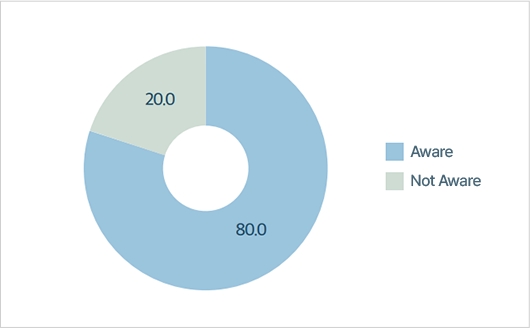
Awareness of KSIs (Unit: %)
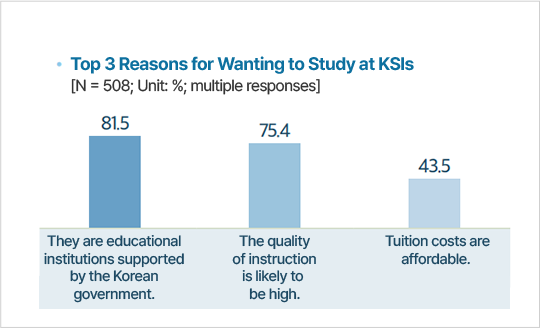
Top 3 Reasons for Wanting to Study at KSIs
For people outside Korea, learning Korean has moved beyond simple curiosity to become a structured part of daily life. A total of 94.1% of respondents reported having experience learning Korean, and among foreign nationals interested in the Korean language and Korean culture (N = 1,323), an overwhelming 98.8% expressed willingness to learn Korean in the future, highlighting substantial latent demand for Korean language education. Among those intending to study Korean, 86.6% preferred in-person classes for a deeper, more immersive learning experiences. Learner engagement is also notably high: 51.3% of foreign learners with prior experience devote an average of one to three hours per day to studying Korean, and 77.9% actively use the language in their daily lives, internalizing it through real-world practice. Importantly, this learning experience extends well beyond personal enrichment. Korean ability is increasingly shaping academic and career trajectories, leading learners toward outcomes such as pursuing Korean-related majors in their home countries (46.3%) and enrolling in language programs at Korean universities (40.2%).

Global Korean education status
Driving High-Value Consumption: Automobiles, Healthcare, and Tourism
This trend is also shaping consumer behavior related to Korea. Influenced by their experience learning the Korean language, respondents demonstrated a strong willingness to spend in high-value sectors, including automobiles (approx. KRW 36.39 million) and medical services (approx. KRW 4.04 million). Demand is particularly strong in the tourism sector: 94.3% of respondents who had previously visited Korea expressed a desire to return, while 96.1% of those who had never visited said they would like to do so in the future. This indicates an exceptionally high potential tourism demand. Among respondents intending to purchase Korean products and visit Korea, the average expected spending per trip was around KRW 3.746 million, demonstrating the substantial economic ripple effects of Korean language promotion.
This trend is also shaping consumer behavior related to Korea. Influenced by their experience learning the Korean language, respondents demonstrated a strong willingness to spend in high-value sectors, including automobiles (approx. KRW 36.39 million) and medical services (approx. KRW 4.04 million). Demand is particularly strong in the tourism sector: 94.3% of respondents who had previously visited Korea expressed a desire to return, while 96.1% of those who had never visited said they would like to do so in the future. This indicates an exceptionally high potential tourism demand. Among respondents intending to purchase Korean products and visit Korea, the average expected spending per trip was around KRW 3.746 million, demonstrating the substantial economic ripple effects of Korean language promotion.
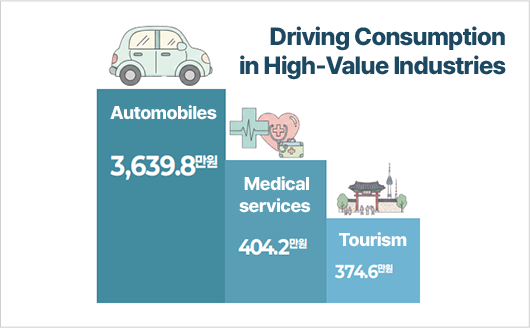
Maximum amount the respondents are willing
to pay per purchase (one month) among respondents
intending to purchase Korean products
to pay per purchase (one month) among respondents
intending to purchase Korean products
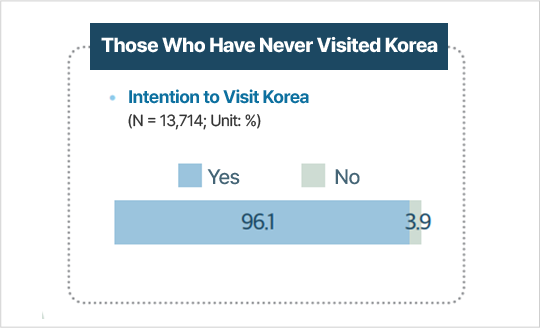
Intention to visit Korea among those who have never
been to Korea
been to Korea
The global spread of the Korean language is proving to be a powerful driver of Korean cultural consumption and inbound tourism, extending well beyond language education. Against this backdrop, KSIs are responding flexibly to growing overseas demand by expanding the number of learners and steadily enhancing learner satisfaction, thereby fulfilling their role as global hubs for Korean language education. Based on the findings of this survey, the KSIF plans to further strengthen the quality of learner-centered education and develop region-specific programs to bolster the international competitiveness of KSIs.