“I hope this served as an opportunity to better understand the diverse environments surrounding the KSI.” Meeting with Director Lee Dang-Kwon, Who Participated in the 2025 Europe KSI Workshop
글쓴이홍보협력팀
태그
작성일 2025-12-26
조회수80

“I hope this served as an opportunity
to better understand the diverse environments surrounding the KSI.”
to better understand the diverse environments surrounding the KSI.”
Meeting with Director Lee Dang-Kwon,
Who Participated in the 2025 Europe KSI Workshop
Who Participated in the 2025 Europe KSI Workshop
Director Lee Dang-Kwon, the current KSI leader at the KSI Korean Cultural Center, Poland, attended the 2025 Europe KSI Workshop, held from November 4 to 6, where he engaged in in-depth discussions on the role and operational direction of KSIs across Europe. Director Lee is striving to ensure that KSI learners enjoy richer cultural experiences alongside Korean language education. We met with him to hear his reflections on participating in the workshop and his thoughts on future directions for cooperation among KSIs in Europe.
Q. Hello, Director Lee Dang-Kwon! It’s a pleasure to meet you. First, could you please briefly introduce yourself to the readers of “Monthly Knock Knock,” and tell us about the KSI operated by the KSI Korean Cultural Center, Poland?
A. Hello. I am Lee Dang-Kwon, director of the KSI Korean Cultural Center, Poland, and head of its KSI. I began working here in Warsaw in February 2024, and for the past year and a half, I have continued both my professional duties and daily life in Poland. The KSI Korean Cultural Center, Poland, opened in 2010 and was the first Korean Cultural Center established in the Central European region. At the time, I was working at the Ministry of Culture, Sports and Tourism and in charge of promoting Korean culture, and I reviewed Poland, Central Europe’s largest country, as a priority country. Being able to work in Poland now makes the experience all the more meaningful to me.
The KSI began operating simultaneously with the establishment the KSI Korean Cultural Center, Poland, and quickly became a starting point for Korean language education for the general public in Poland, as it offered an alternative to the previously university-centered programs limited to Korean studies departments. As Poland’s first KSI and an institution directly operated by a cultural center, we continuously work with administrative staff and dispatched teachers to develop a standardized, foundational curriculum. As an extension of these efforts, we have contributed to expanding the foundation of Korean language education in Poland by supporting dispatched teachers through MOUs during the establishment of Korean studies departments at local universities. In addition, being located at a cultural center provides a number of benefits, which we have leveraged to operate a wide range of cultural and arts programs alongside Korean language education as we strive to provide learners with richer cultural experiences.
The KSI began operating simultaneously with the establishment the KSI Korean Cultural Center, Poland, and quickly became a starting point for Korean language education for the general public in Poland, as it offered an alternative to the previously university-centered programs limited to Korean studies departments. As Poland’s first KSI and an institution directly operated by a cultural center, we continuously work with administrative staff and dispatched teachers to develop a standardized, foundational curriculum. As an extension of these efforts, we have contributed to expanding the foundation of Korean language education in Poland by supporting dispatched teachers through MOUs during the establishment of Korean studies departments at local universities. In addition, being located at a cultural center provides a number of benefits, which we have leveraged to operate a wide range of cultural and arts programs alongside Korean language education as we strive to provide learners with richer cultural experiences.
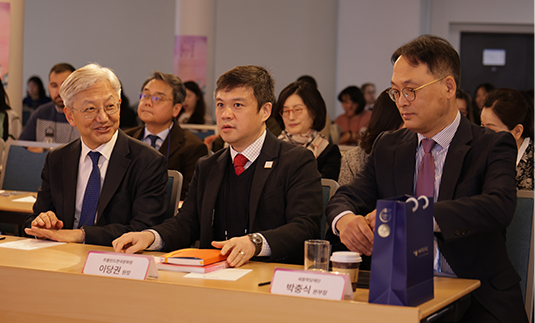
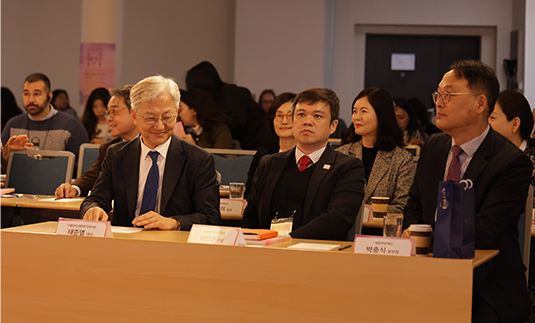
Director Lee Dang-Kwon of the KSI Korean Cultural Center, Poland (center),
at the opening ceremony of the 2025 Europe KSI Workshop
at the opening ceremony of the 2025 Europe KSI Workshop
Q. The 2025 Europe KSI Workshop, held from November 4 to 6, was jointly hosted by the KSIF and the KSI Korean Cultural Center, Poland. As one of the cohosts, what did you place the greatest emphasis on, and were there any particular goals you hoped to achieve through the workshop?
A. The KSIF working-level staff prepared everything very thoroughly, from the overall framework of the workshop to the detailed programs, so there was not much that the cultural center needed to assist with separately. I would like to take this opportunity to once again express my sincere gratitude to the KSIF staff for their meticulous preparations.
Before being assigned to Poland, I personally served as a director at the cultural center in Hungary, where I also operated a KSI. I also had the opportunity to observe the process of establishing a new KSI at institutions such as the University of Debrecen and Eötvös Loránd University in Budapest. After being assigned again to the Central European region, I came to realize anew that while people in Korea often tend to view Europe as a single entity, whether broadly as Europe as a whole or more narrowly as Central Europe, in reality, many countries, ethnic groups, and languages coexist here, so there’s significant diversity. I hope that this Europe KSI Workshop served as an opportunity for teachers across Europe to work together toward the shared goal of globalizing Korean language education, to better understand the diverse environments surrounding KSIs in their respective countries and regions, and to exchange small but meaningful insights along the way.
Before being assigned to Poland, I personally served as a director at the cultural center in Hungary, where I also operated a KSI. I also had the opportunity to observe the process of establishing a new KSI at institutions such as the University of Debrecen and Eötvös Loránd University in Budapest. After being assigned again to the Central European region, I came to realize anew that while people in Korea often tend to view Europe as a single entity, whether broadly as Europe as a whole or more narrowly as Central Europe, in reality, many countries, ethnic groups, and languages coexist here, so there’s significant diversity. I hope that this Europe KSI Workshop served as an opportunity for teachers across Europe to work together toward the shared goal of globalizing Korean language education, to better understand the diverse environments surrounding KSIs in their respective countries and regions, and to exchange small but meaningful insights along the way.
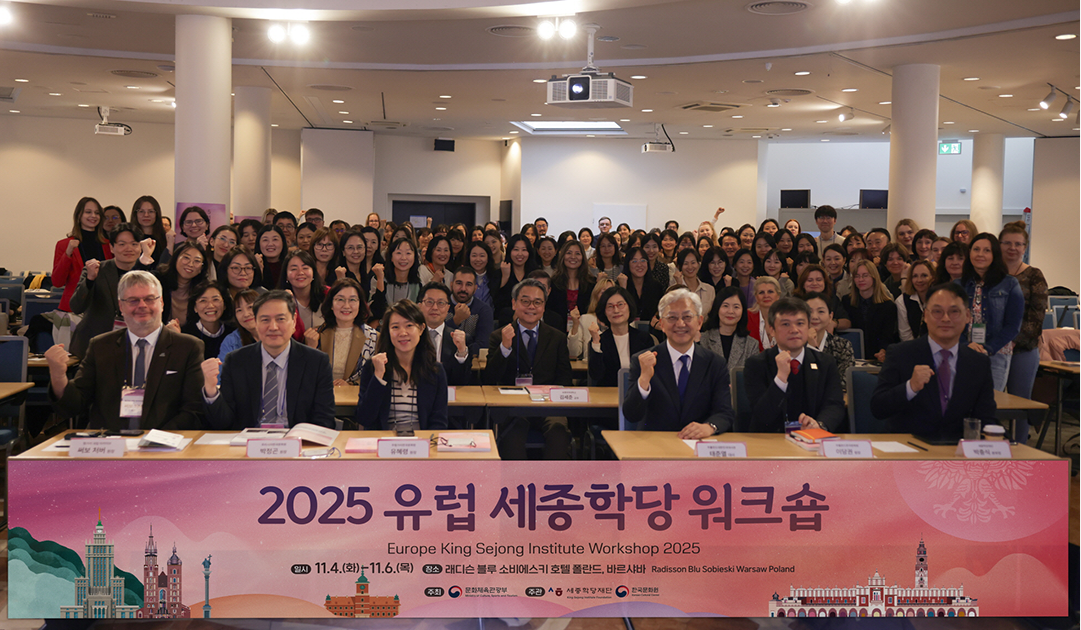
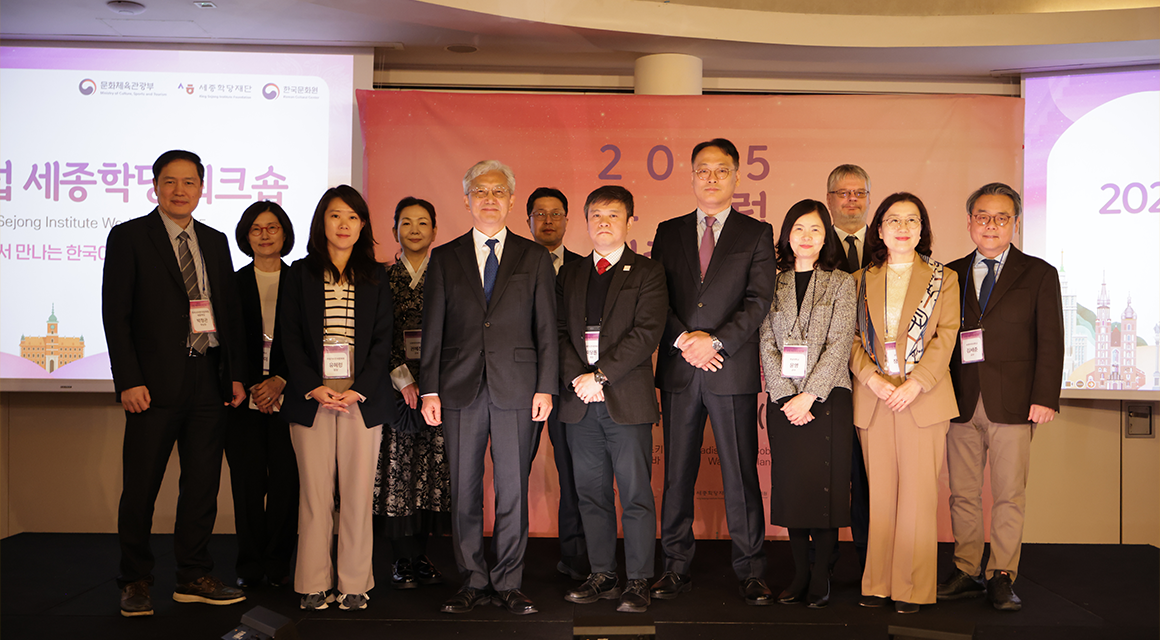
Group photo of participants at the 2025 Europe KSI Workshop
Q. Held under the theme “Korean Language and Korean Culture in Europe,” this workshop brought together KSI representatives from 40 locations in 23 European countries. Was there a particularly memorable moment for you during the program?
A. The thing that left the strongest impression on me was the passion and enthusiasm of the KSI teachers. The lively performances by traditional singers at the opening ceremony and opening dinner on the first day were certainly exciting, but even more impressive were the loud cheers and passionate responses that erupted from the audience. Although we have hosted many performances at the cultural center, it’s rare to see such a strong response. I still have a very vivid memory of it.
That overflowing enthusiasm of the KSI teachers and operations staff continued to the final day of the workshop, particularly in the Korean cuisine experience program where they personally pounded rice cakes using a mortar and mallet. While the positive image of Korean culture, often represented by the “Korean Wave,” has certainly contributed to the rapid spread of KSIs across Europe, I believe that the shared sense of enthusiasm among KSI administrators, who actively engage and communicate with learners in each country, has also played a significant role.
That overflowing enthusiasm of the KSI teachers and operations staff continued to the final day of the workshop, particularly in the Korean cuisine experience program where they personally pounded rice cakes using a mortar and mallet. While the positive image of Korean culture, often represented by the “Korean Wave,” has certainly contributed to the rapid spread of KSIs across Europe, I believe that the shared sense of enthusiasm among KSI administrators, who actively engage and communicate with learners in each country, has also played a significant role.
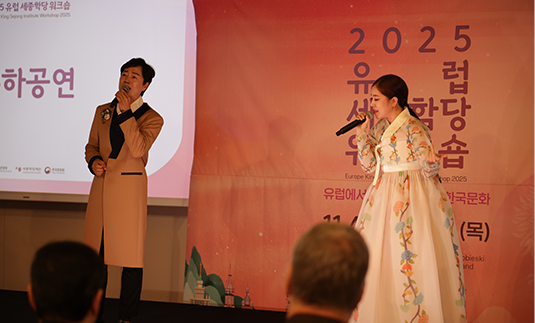
Congratulatory performance by traditional singers
during the workshop’s opening ceremony
during the workshop’s opening ceremony
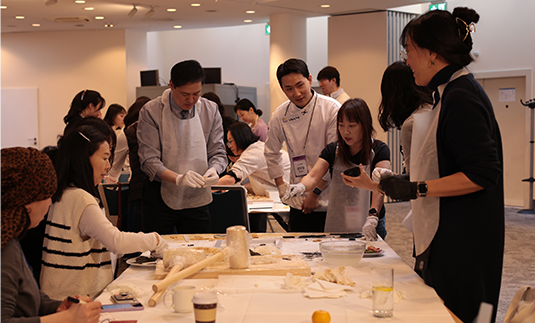
Participating teachers taking part in hands-on
activities during the “Korean Culture Training
(Korean Cuisine)” session of the workshop
activities during the “Korean Culture Training
(Korean Cuisine)” session of the workshop
Q. The latest educational trends were shared during workshop sessions such as “Methods for Korean Language Education Using AI,” “Hallyu Trends in Europe and the Future of KSIs,” and “Interculturalism-Based Teaching Methods.” How do you expect these trends to influence the field of Korean language and Korean culture education in Europe going forward?
A. AI, Hallyu trends, and interculturalism have become extremely important currents not only in Korean language education at KSIs but in all fields of contemporary society. In particular, I’ve been very impressed by the ability to use AI to develop a wide range of materials that reflect the cultural backgrounds of learners and to provide customized resources that take learner convenience into account. At the same time, I observed a trend where people who are learning Korean as a hobby tend to use learning apps, while those who want to pursue more advanced studies move on to universities with Korean studies departments. This prompted me to reflect once again on the role of the KSI.
Hallyu, the catalyst that sparked the boom in Korean language education, is a trend that all KSI administrators must pay close attention to, especially in Europe, where so many diverse languages, ethnicities, nations, and cultures coexist. In fact, an intercultural approach is a key issue that should be considered by KSIs worldwide. I believe this workshop provided an opportunity for educators at KSI sites to once again recognize and reflect on the importance of these themes. The thematic sessions in particular were very beneficial because they didn’t only address overarching trends, they also shared concrete examples that can be applied in actual Korean language education settings and clearly identified key issues.
Hallyu, the catalyst that sparked the boom in Korean language education, is a trend that all KSI administrators must pay close attention to, especially in Europe, where so many diverse languages, ethnicities, nations, and cultures coexist. In fact, an intercultural approach is a key issue that should be considered by KSIs worldwide. I believe this workshop provided an opportunity for educators at KSI sites to once again recognize and reflect on the importance of these themes. The thematic sessions in particular were very beneficial because they didn’t only address overarching trends, they also shared concrete examples that can be applied in actual Korean language education settings and clearly identified key issues.
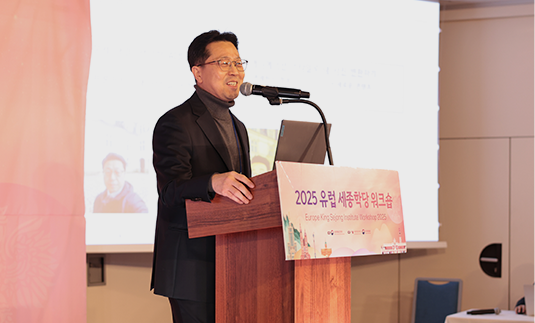
Professor Kim Jung-hoon conducting the session
“Methods for Korean Language Education Using AI”
on Day 2 of the workshop
“Methods for Korean Language Education Using AI”
on Day 2 of the workshop
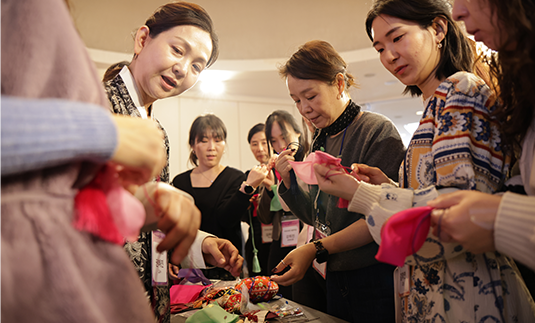
Participating teachers taking part in a hands-on
training during the “Korean Culture Training (Hanbok)”
session of the workshop
training during the “Korean Culture Training (Hanbok)”
session of the workshop
Q. Building on this workshop, what are your plans to further develop a cooperative network among KSIs in Europe, and could you share the specific vision of the KSI at the KSI Korean Cultural Center, Poland?
A. This workshop served as an opportunity to once again recognize the necessity of exchange and cooperative networks among KSIs. Currently, there are three KSIs operating in Poland: the KSI at the KSI Korean Cultural Center, Warsaw; the KSI at Adam Mickiewicz University in Poznań; and the KSI at the University of Silesia in Katowice, which was newly established in 2024. However, due to differences in academic calendars and the geographical distances, there have been very few opportunities for us to gather together or even exchange greetings. This Europe KSI Workshop, held in Warsaw, provided not only a platform for exchange among KSIs across Europe but also an opportunity for KSIs within Poland to share their opinions.
With this workshop as a starting point, we plan to create opportunities beginning next year for the three KSIs in Poland to come together. This will start with small-scale efforts such as supporting Korean cultural experience programs and sharing materials through the cultural center, but we hope to gradually expand cooperation at the national and regional levels and use these gatherings as a forum for exchanging opinions and sharing good ideas.
With this workshop as a starting point, we plan to create opportunities beginning next year for the three KSIs in Poland to come together. This will start with small-scale efforts such as supporting Korean cultural experience programs and sharing materials through the cultural center, but we hope to gradually expand cooperation at the national and regional levels and use these gatherings as a forum for exchanging opinions and sharing good ideas.