“A place for sharing culture beyond language— at the heart of it is the KSI.” Meeting with Teacher Jang So-young, Who Participated in the 2025 Europe KSI Workshop
글쓴이홍보협력팀
태그
작성일 2025-12-26
조회수85

“A place for sharing culture beyond language—
at the heart of it is the KSI.”
at the heart of it is the KSI.”
Meeting with Teacher Jang So-young,
Who Participated in the 2025 Europe KSI Workshop
Who Participated in the 2025 Europe KSI Workshop
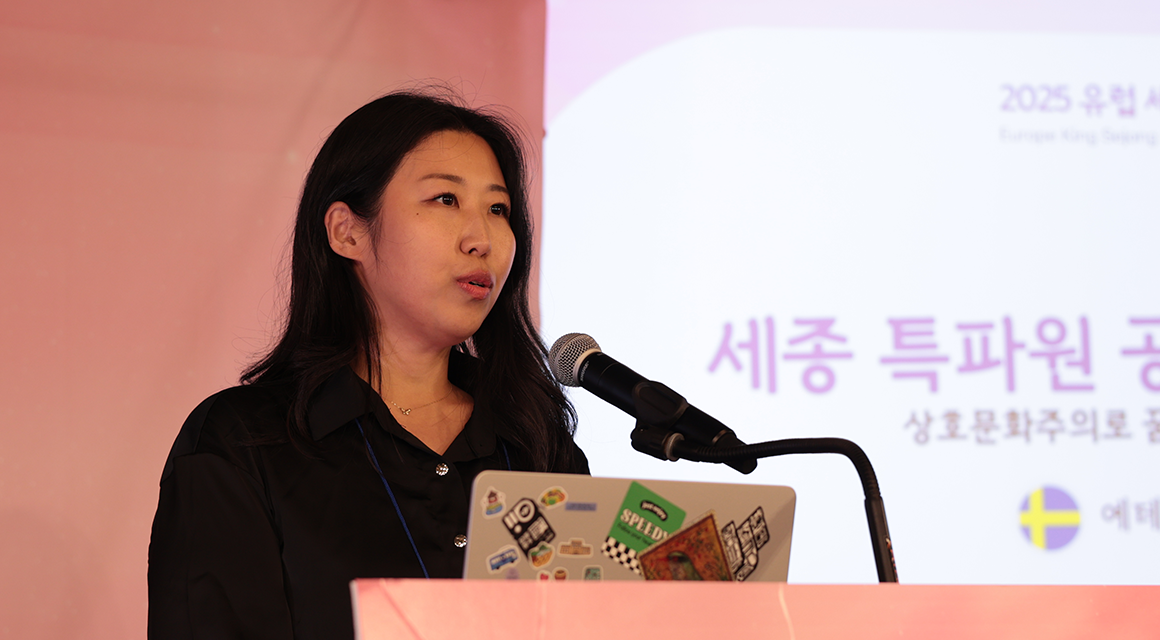
On November 4, Jang So-young, a teacher at KSI Gothenburg, Sweden, won the Grand Prize in the “KSI Correspondent” video contest at the 2025 Europe KSI Workshop. We met with Jang So-young, who has been teaching Korean at KSI Gothenburg since the second half of this year, to hear her thoughts on receiving the award as well as the stories about KSI Gothenburg featured in the video.
Q. Hello, Ms. Jang So-young! It’s a pleasure to meet you. First, could you please briefly introduce yourself to the readers of “Monthly Knock Knock” and tell us about the KSI where you currently teach?
A. Hello. I am Jang So-young, one of the Korean teachers at KSI Gothenburg, Sweden. It’s a pleasure to meet you all! KSI Gothenburg opened in 2020 on Sweden’s west coast, and has established itself as a welcoming space where people can learn the Korean language and experience Korean culture. We have a diverse group of learners at KSI Gothenburg, including people who want to communicate better with their Korean spouses or friends, people who became interested in Korea through Korean dramas or K-pop, and even Korean adoptees. Due to Swedish culture, many learners are a bit reserved at first, but as classes continue, it is very rewarding to see them gradually open up and become friends with one another. It’s a great joy to see learners from diverse backgrounds come together, express themselves in Korean, and share their stories.
Q. How long have you been teaching Korean at KSI Gothenburg? What led you to teach Korean here, and how has that experience influenced you as a teacher?
A. I began teaching Korean at KSI Gothenburg in the second half of this year. Even before moving to Sweden, I had set the goal of becoming a Korean language teacher and obtained the relevant qualifications in KoreAfter arriving here, I found that far more foreigners than I had expected had a deep interest in Korean language and culture. Meeting these learners naturally inspired me to share my experience with language and cultural education, and that’s how I began teaching at KSI Gothenburg. Through the process of preparing and conducting Korean language classes, I feel that I am continually learning and growing as well. In particular, as I strive to understand the interests and cultural backgrounds of local learners, my perspective has broadened, and my thinking has become much more flexible than before.
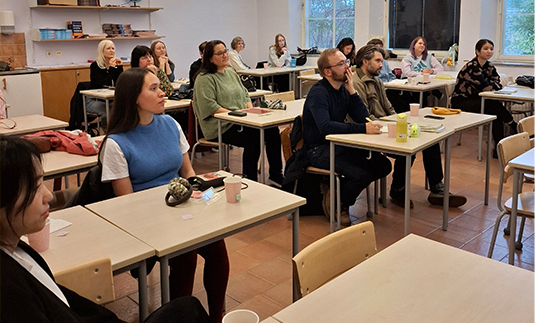
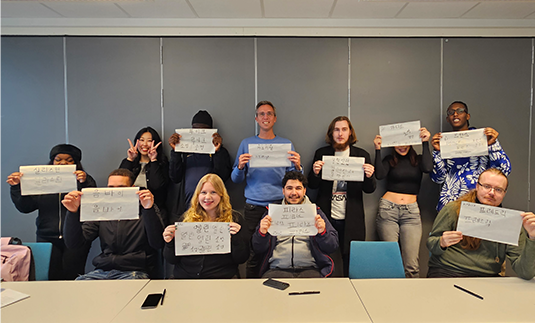
Learners at KSI Gothenburg participating in one of Teacher Jang So-young’s classes
Q. On November 4, you received the Grand Prize in the KSI Correspondent Video Contest during the 2025 Europe KSI Workshop. Congratulations! Could you share your thoughts on winning the award and tell us about your winning video?
A. I am truly happy and honored to have received the Grand Prize for this year’s KSI Correspondent Video Contest. Above all, this award was made possible thanks to the support of the learners and staff at KSI Gothenburg. The video I submitted to the contest captures scenes from various classes and programs that I conduct regularly. First, it features a Level 1A class in which learners are having fun learning native Korean numbers, followed by scenes from a Korean Travel Workshop where learners experience language and culture together by learning useful expressions and information for traveling in Korea.
In one notable scene, the learners and I enjoy fika, a representative Swedish tea-time culture, before beginning a folk painting class. Sharing relaxed conversations within a familiar, everyday part of Swedish culture created space for mutual understanding, and the way this naturally flowed into the Korean folk painting lesson was especially impressive. Watching learners embrace Korean culture more warmly in an atmosphere of mutual respect and enjoyment of one another’s cultures was very fulfilling to see as a teacher. The video also features scenes from the Språk Café, where learners voluntarily gather to practice Korean and Swedish together. Through this, I wanted to convey the message that the KSI is not merely a place to learn a language, but a “space for communication” where people can understand and enjoy each other’s cultures.
In one notable scene, the learners and I enjoy fika, a representative Swedish tea-time culture, before beginning a folk painting class. Sharing relaxed conversations within a familiar, everyday part of Swedish culture created space for mutual understanding, and the way this naturally flowed into the Korean folk painting lesson was especially impressive. Watching learners embrace Korean culture more warmly in an atmosphere of mutual respect and enjoyment of one another’s cultures was very fulfilling to see as a teacher. The video also features scenes from the Språk Café, where learners voluntarily gather to practice Korean and Swedish together. Through this, I wanted to convey the message that the KSI is not merely a place to learn a language, but a “space for communication” where people can understand and enjoy each other’s cultures.
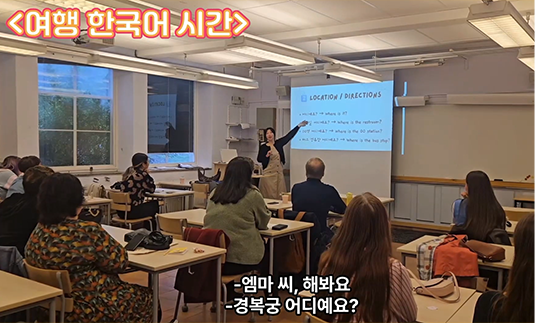
Scene from the Korean Travel Workshop Featured
in the video
in the video
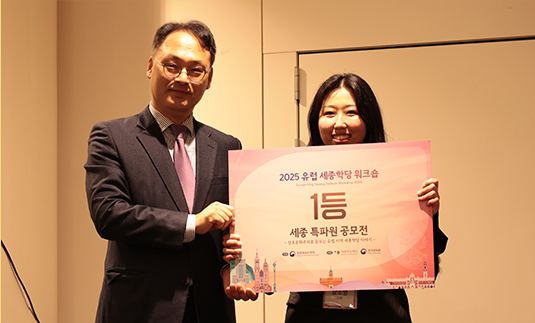
Teacher Jang So-young (right), winner of the Grand
Prize in the KSI Correspondent Video Contest
Prize in the KSI Correspondent Video Contest
Q. In your award-winning video “Hello, Sweden,” one of the scenes that sees to best align with the contest theme, “Stories of KSI in Europe Dreaming of Interculturalism,” was the “Språk Café, a signature cultural activity at KSI Gothenburg. Could you please tell us what the Språk Café is, and share any particularly memorable moments or reflections you had as a Korean language teacher through this activity?
A. “Språk Café” is a combination of “språk,” which means language in Swedish, and “café.” It refers to a language and cultural exchange gathering. In Sweden, there are a lot of active language cafés for various languages, such as Italian and Czech. At KSI Gothenburg, we wanted to apply this trend to Korean language learning as well. The idea grew out of the intercultural atmosphere in Sweden, where there are many immigrants and people naturally enjoy learning each other’s languages. At the Språk Café, there are not only Swedes learning Korean, but also Koreans learning Swedish, which allows for a natural exchange of language and culture.
Currently, the Språk Café is held about three times per semester at a municipal library in a drop-in format, meaning participants are free to join. Participation has been high, to the point that we’ve had many requests for the gatherings to be held more frequently. To me, what stands out most about the Språk Café are the moments when learners naturally demonstrate a level of confidence and language ability that is rare to see in regular classes. Watching them try out expressions they have learned, freely express their thoughts, and naturally internalize Korean in real-life situations makes me feel like we should offer these activities more often. It’s made me realize how powerfully experiences outside the classroom reinforce learning inside the classroom. I believe that activities like this, where different languages and cultures naturally blend together, create moments when interculturalism is realized most vividly.
Currently, the Språk Café is held about three times per semester at a municipal library in a drop-in format, meaning participants are free to join. Participation has been high, to the point that we’ve had many requests for the gatherings to be held more frequently. To me, what stands out most about the Språk Café are the moments when learners naturally demonstrate a level of confidence and language ability that is rare to see in regular classes. Watching them try out expressions they have learned, freely express their thoughts, and naturally internalize Korean in real-life situations makes me feel like we should offer these activities more often. It’s made me realize how powerfully experiences outside the classroom reinforce learning inside the classroom. I believe that activities like this, where different languages and cultures naturally blend together, create moments when interculturalism is realized most vividly.
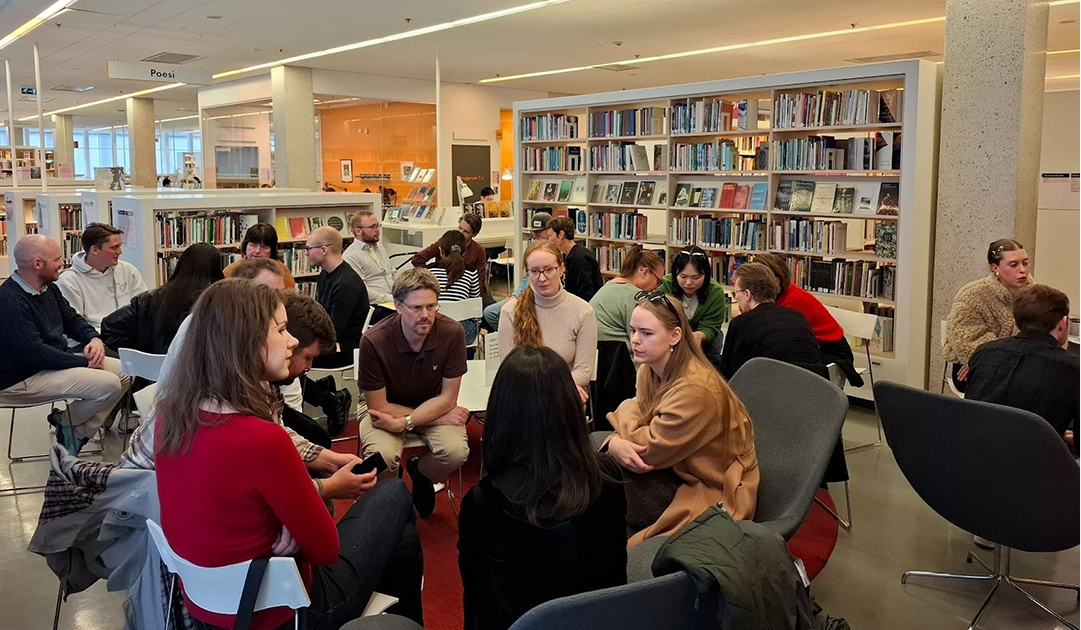
A Scene from the Språk Café, a language and cultural exchange activity
Q. This workshop also provided an opportunity for KSI representatives from across Europe, including directors, operations staff, and teachers, to get together and connect. Were there any particularly meaningful takeaways or impressions you gained through your exchanges with KSI representatives from elsewhere in Europea?
A. It was truly a pleasure to meet KSI representatives from all across Europe in person at this workshop. Although each country has its own environment and teaching approaches differ slightly, it was heartening to realize that everyone shares the same commitment to promoting Korean language and culture. Listening to the class ideas and program initiatives being implemented at other KSIs made me think, “Oh, that’s a great approach.” So I learned a great deal from those exchanges. As a result, I got a lot of ideas that I would like to try applying at KSI Gothenburg as well. It was also reassuring to be able to share some of the common challenges we all encounter in both teaching and operations. Through this meeting, I was once again reminded of the warm network of connections among KSIs in Europe, where we support and learn from one another.
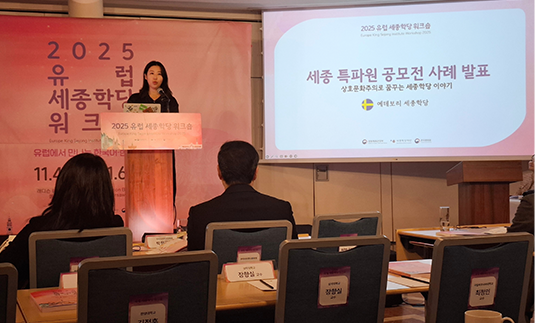
Teacher Jang So-young presenting a case
from the KSI Correspondent Contest
at the 2025 Europe KSI Workshop
from the KSI Correspondent Contest
at the 2025 Europe KSI Workshop
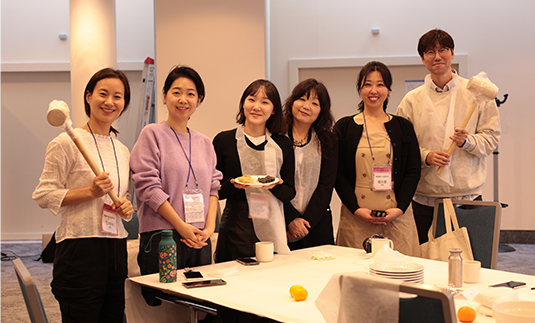
Teacher Jang So-young (second from the right),
participating in the “Korean Culture Training
(Korean Cuisine)” program during the workshop
participating in the “Korean Culture Training
(Korean Cuisine)” program during the workshop
Q. Lastly, could you share the goals you hope to achieve at KSI Gothenburg? Also, please tell us about your personal goals as a Korean language teacher.v
A. The primary goal I hope to achieve at KSI Gothenburg is to create a vibrant learning environment where learners can naturally experience Korean culture while learning the language, practice communicating with one another in Korean, and find joy in the process. Through various cultural experience activities, including the Språk Café, I want to help learners use Korean with confidence and become natural bridges that connecting Korea with Sweden and other cultures. On a personal level, my goal is to guide each learner so that they can freely express their thoughts and experiences in Korean and feel a sense of accomplishment by using the language. Going forward, I hope to develop more creative and enjoyable teaching methods tailored to the interests and needs of local learners.