“It was a meaningful opportunity to share cases such as KSI Budapest’s open KSI operations in partnership with the local community and its slow-paced class program.” Meeting with Operations Staff Jin Kyoung-Ae, Who Participated in the 2025 Europe KSI Workshop
글쓴이홍보협력팀
태그
작성일 2025-12-26
조회수85

“It was a meaningful opportunity to share cases such
as KSI Budapest’s open KSI operations
in partnership with the local community
and its slow-paced class program.”
as KSI Budapest’s open KSI operations
in partnership with the local community
and its slow-paced class program.”
Meeting with Operations Staff Jin Kyoung-Ae,
Who Participated in the 2025 Europe KSI Workshop
Who Participated in the 2025 Europe KSI Workshop
On November 4, Jin Kyoung-Ae, an operations staff at KSI Budapest, Hungary, participated in the 2025 Europe KSI Workshop and presented some of the best practices for Korean language and culture education at KSI Budapest. Serving as a bridge between universities and the local community, KSI Budapest has brought about meaningful changes in the lives of local learners through initiatives such as open KSI operations, slow-paced classes, and a variety of local partnership activities. In this interview, we spoke with Ms. Jin about her impressions from participating in the workshop, the operational cases she presented, and her goals as an operations staff.
Q. Hello, Ms. Jin Kyoung-Ae! It’s a pleasure to meet you. First, could you please briefly introduce yourself to the readers of “Monthly Knock Knock” and tell us about the KSI where you are currently working?
A. Hello. I am Jin Kyoung-Ae, operations staff at KSI Budapest, Hungary. KSI Budapest began its pilot semester in July 2021 under an independent operating system at Eötvös Loránd University (ELTE). ELTE is the oldest and largest comprehensive university in Hungary and is often regarded as the cradle of Hungarian intellectual life, as it has produced a number of Nobel laureates. Both the current prime minister of Hungary and László Krasznahorkai, the recipient of the 2025 Nobel Prize in Literature, are alumni of ELTE. It is also the first university in Hungary to establish a department of Korean studies. Perhaps because of this background, learners at KSI Budapest pursue their studies with the goal of gaining not only systematic Korean language education but also a deep understanding of Korean culture.
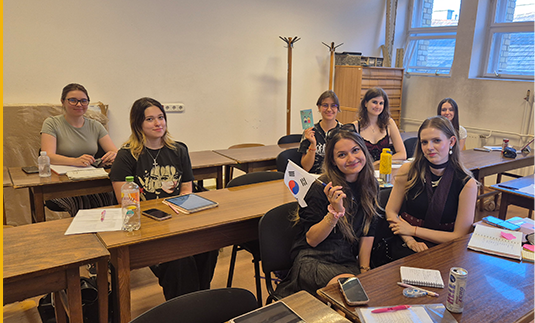
Learners in the Practical Korean 2A class
at KSI Budapest
at KSI Budapest

Learners enjoying a picnic during the
“Fighting! Pajti-ing!” class in the Language
and Cultural Exchange Program
“Fighting! Pajti-ing!” class in the Language
and Cultural Exchange Program
Q. How long have you been working as an operations staff at KSI Budapest? What led you to take on this role locally, and how has that experience influenced you?
A. I am a founding member of KSI Budapest. At the time, the Department of Korean Studies at ELTE was facing significant challenges in providing Korean language education. While working at the department and exploring various solutions, I learned about the KSIF system, which provides systematic educational materials and curricula and, when necessary, dispatches teachers as well. The KSI offers Korean language and culture education to the general public, so its operational purpose differs from that of a university-based department of Korean studies. However, I believed that establishing a KSI within the university would give students direct access to the highest level of Korean language and culture education, and would also have positive direct and indirect effects on Korean language education within the Department of Korean Studies. At the time, Director Lee Dang-Kwon of the KSI Korean Cultural Center, Hungary, offered encouragement and support, and Hamar Imre, vice president for international relations at ELTE and head of the Department of East Asian Studies, agreed to serve as head of the KSI, making the establishment of KSI Budapest possible.
Since then, I have worked as an operations staff at KSI Budapest, coordinating various requirements from both Korean and Hungarian institutions. Through this process, I have learned many things I had not anticipated. As I came to understand the operational systems of both countries more deeply, I realized that to establish a stable overseas project, a broad and in-depth cultural understanding across various fields must come first. As someone involved in teaching Korean language and culture abroad, I believe this was an invaluable learning experience, one that couldn’t be replaced by anything else. I am reminded every day that teaching and learning are never one-directional.
Since then, I have worked as an operations staff at KSI Budapest, coordinating various requirements from both Korean and Hungarian institutions. Through this process, I have learned many things I had not anticipated. As I came to understand the operational systems of both countries more deeply, I realized that to establish a stable overseas project, a broad and in-depth cultural understanding across various fields must come first. As someone involved in teaching Korean language and culture abroad, I believe this was an invaluable learning experience, one that couldn’t be replaced by anything else. I am reminded every day that teaching and learning are never one-directional.
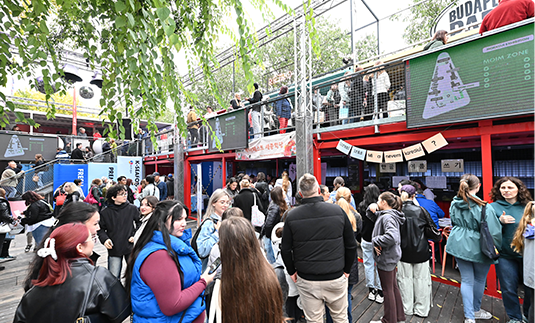
Visitors to the KSI Budapest space during the 2024
Hungarian “Mokkoji” (specialized) event
Hungarian “Mokkoji” (specialized) event
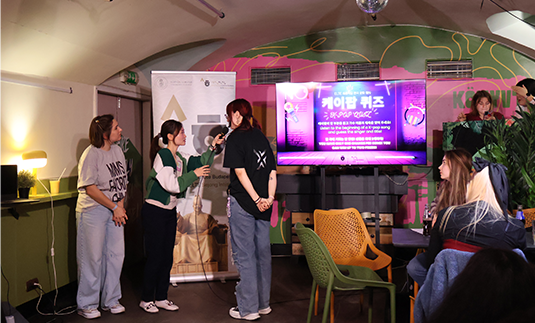
A K-pop quiz at KSI Budapest’s
K-pop Night culture event
K-pop Night culture event
Q. On November 4, you presented “Best Practices in Korean Language and Korean Culture Education at KSI Budapest” at the 2025 Europe KSI Workshop. The case of open KSI operations in partnership with the local community left a particularly strong impression. Could you please explain this operational case in more detail?
A. Eötvös Loránd University has a long history and operates a wide range of language education programs, covering 115 languages in total, with 71 offered as part of regular degree programs. Thanks to this experience, establishing Korean language education and the Department of Korean Studies in 2006 went relatively smoothly. At the time, ELTE’s Department of Korean Studies was the only Korean language education institution in Hungary, so it was receiving a lot of requests not only for Korean language education but also for Korean interpretation services and recommendations of personnel for Korean companies.
Notably, Korean corporate investment in Hungary reached an all-time high in 2021, leading to a sharp increase in demand for Korean language skills. However, it was difficult for the university to directly engage in such projects due to limitations in human resources and institutional frameworks. At this time, KSI Budapest, which was established at ELTE, served as an important bridge, flexibly connecting learners who wished to study Korean with the needs of the local community in Hungary. Korean companies did not hesitate to provide sponsorship in order to secure talented personnel, and the KSI actively supported job fairs and company visit programs to introduce these companies.
KSI Budapest aims to build an open network that encompasses not only Korean language learners but also Korean international students, Korean residents, and local public institutions and companies. This is precisely the direction that the KSI wants to pursue: education in which the local community participates directly through language exchange programs, mentoring, and joint projects between Korean international students and KSI learners.
In addition, KSI Budapest has expanded its role and points of contact for the dissemination of Korean culture by cooperating not only with the Embassy of the Republic of Korea in Hungary and the Korean Cultural Center, but also with major organizations such as the Hungarian Ministry of Foreign Affairs and Samsung SDI. This operational approach has helped establish an educational foundation that goes beyond the temporary popularity of Hallyu, expanding interest in Korea into diverse areas such as history, traditional culture, contemporary culture, and future industries. KSI Budapest has been recognized for the achievements these efforts have brought by winning awards at the World Korean Educator Conference for three consecutive years. In 2023, a children’s story translation and video production project was recognized as a best practice; in 2024, a language exchange and mentoring program received recognition; and in 2025, expanded, project-based cultural exchange activities were acknowledged as an outstanding case.
Notably, Korean corporate investment in Hungary reached an all-time high in 2021, leading to a sharp increase in demand for Korean language skills. However, it was difficult for the university to directly engage in such projects due to limitations in human resources and institutional frameworks. At this time, KSI Budapest, which was established at ELTE, served as an important bridge, flexibly connecting learners who wished to study Korean with the needs of the local community in Hungary. Korean companies did not hesitate to provide sponsorship in order to secure talented personnel, and the KSI actively supported job fairs and company visit programs to introduce these companies.
KSI Budapest aims to build an open network that encompasses not only Korean language learners but also Korean international students, Korean residents, and local public institutions and companies. This is precisely the direction that the KSI wants to pursue: education in which the local community participates directly through language exchange programs, mentoring, and joint projects between Korean international students and KSI learners.
In addition, KSI Budapest has expanded its role and points of contact for the dissemination of Korean culture by cooperating not only with the Embassy of the Republic of Korea in Hungary and the Korean Cultural Center, but also with major organizations such as the Hungarian Ministry of Foreign Affairs and Samsung SDI. This operational approach has helped establish an educational foundation that goes beyond the temporary popularity of Hallyu, expanding interest in Korea into diverse areas such as history, traditional culture, contemporary culture, and future industries. KSI Budapest has been recognized for the achievements these efforts have brought by winning awards at the World Korean Educator Conference for three consecutive years. In 2023, a children’s story translation and video production project was recognized as a best practice; in 2024, a language exchange and mentoring program received recognition; and in 2025, expanded, project-based cultural exchange activities were acknowledged as an outstanding case.
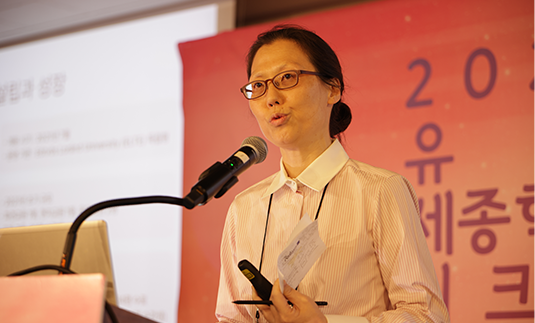
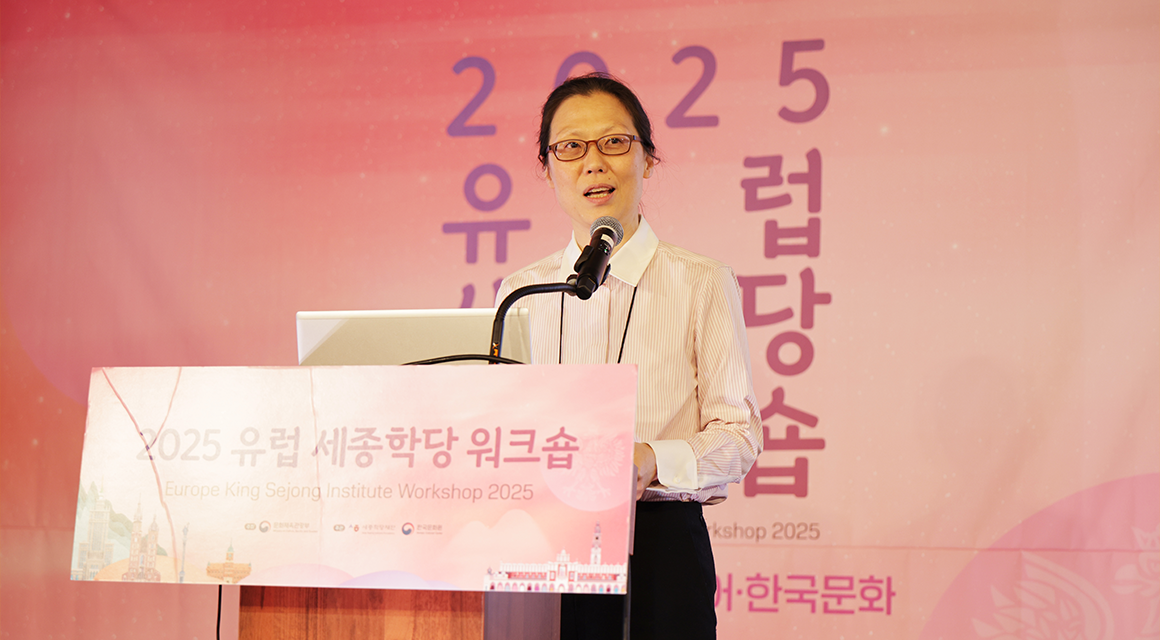
Operations Staff Jin Kyoung-Ae presenting best
practices at the 2025 Europe KSI Workshop
practices at the 2025 Europe KSI Workshop
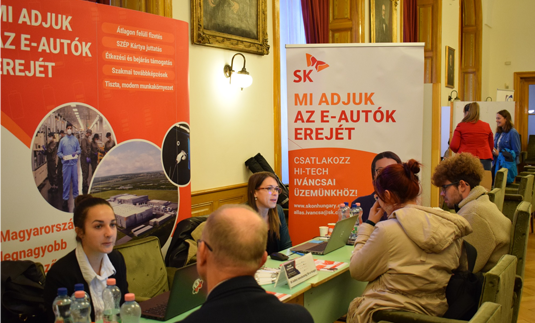
ELTE Job Fair supported by KSI Budapest
in September 2022
in September 2022
Q. I understand that KSI Budapest operates differentiated programs that reflect the characteristics of local learners and the needs of the local community. Could you share a case from one of the programs you’ve run that you found particularly meaningful?
A. After presenting our best practices at this workshop, the questions I received most frequently from other KSIs were about the operation of our slow-paced classes. In Europe, the learning environment includes far more hobby-oriented learners who study Korean out of curiosity about the language itself or a desire to enjoy Korean culture more deeply, rather than for employment or career advancement. There was strong consensus on the need for programs that reflect these learner characteristics.
The standard Korean language curriculum at the KSI is designed as a 15-week course, with 60 hours in total per level. However, for Hungarian learners encountering Korean for the first time in a completely different cultural context, the volume could seem burdensome, and even a single semester may feel too long. In response, KSI Budapest introduced slow-paced classes that cover only half of the regular curriculum while incorporating a greater variety of cultural activities.
This program yielded results far beyond our expectations. Both working professionals and learners as old as 83 were able to complete courses without difficulty. This gave them a strong sense of achievement, which naturally led them to enroll in the next level. Adjusting the pace of learning allowed learners to build positive experiences that made them feel, “Korean is a language I can learn.”
Hungary borders seven countries, and the European Union recognizes as many as 24 official languages, making it an exceptionally diverse linguistic environment. Within this context, KSI Budapest plays a role in laying a foundation for Korean language education and in helping learners experience small but meaningful achievements and sustained motivation, even if they don’t end up pursuing a career that involves using Korean. This has been one of the most meaningful experiences in the operation of KSI Budapest.
The standard Korean language curriculum at the KSI is designed as a 15-week course, with 60 hours in total per level. However, for Hungarian learners encountering Korean for the first time in a completely different cultural context, the volume could seem burdensome, and even a single semester may feel too long. In response, KSI Budapest introduced slow-paced classes that cover only half of the regular curriculum while incorporating a greater variety of cultural activities.
This program yielded results far beyond our expectations. Both working professionals and learners as old as 83 were able to complete courses without difficulty. This gave them a strong sense of achievement, which naturally led them to enroll in the next level. Adjusting the pace of learning allowed learners to build positive experiences that made them feel, “Korean is a language I can learn.”
Hungary borders seven countries, and the European Union recognizes as many as 24 official languages, making it an exceptionally diverse linguistic environment. Within this context, KSI Budapest plays a role in laying a foundation for Korean language education and in helping learners experience small but meaningful achievements and sustained motivation, even if they don’t end up pursuing a career that involves using Korean. This has been one of the most meaningful experiences in the operation of KSI Budapest.
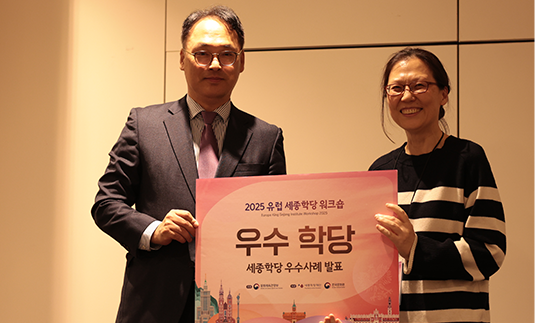
Outstanding KSI awards ceremony for during
the best practice presentations
the best practice presentations
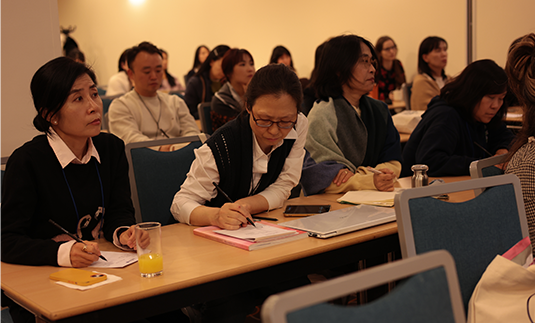
Operations Staff Jin Kyoung-Ae (center) attending
the Operations Division training session on the second day
of the workshop
the Operations Division training session on the second day
of the workshop
Q. This workshop also served as an opportunity for KSI representatives from across Europe, including directors, operations staff, and teachers, to gather together and exchange ideas. Did you get any particularly meaningful lessons or impressions through your interactions with other KSI representatives from the European region?
A. This workshop was a valuable opportunity to meet KSI representatives working in various parts of Europe all in one place. Listening to the different operational approaches and on-site cases from multiple KSIs taught me more than ever before.
Although local conditions and circumstances vary widely, simply hearing how each KSI addresses challenges and supports learners was deeply inspiring. Above all, what left the strongest impression on me was the realization that each KSI is ultimately built by people, and operated based on a deep understanding of the local community and personal dedication, even in challenging environments. Hearing these stories was deeply moving. This moment made me keenly aware once again that KSIs as they exist today are shaped by the combined efforts and commitment of the people quietly conducting classes on Korean language and culture.
Although local conditions and circumstances vary widely, simply hearing how each KSI addresses challenges and supports learners was deeply inspiring. Above all, what left the strongest impression on me was the realization that each KSI is ultimately built by people, and operated based on a deep understanding of the local community and personal dedication, even in challenging environments. Hearing these stories was deeply moving. This moment made me keenly aware once again that KSIs as they exist today are shaped by the combined efforts and commitment of the people quietly conducting classes on Korean language and culture.

Q. Lastly, could you share the goals you hope to achieve at KSI Budapest? Also, please tell us about your personal goals as an operations staff.
A. The goals of KSI Budapest go beyond simply teaching Korean language and culture. When King Sejong created Hangeul, his hope was to enable more people to freely express their thoughts and take ownership of their lives through learning. I believe that the KSI today is carrying that same spirit forward.
In modern terms, the KSI is a place where anyone can expand their world through learning and put into practice the spirit of “aemin,” or benevolence toward the people, by supporting one another. I hope that KSI Budapest will continue to share these values within the local community and fulfill its role as a bridge connecting people through Korean language and culture.
On a personal level, my goal is to help KSI Budapest become not just an educational institution for learners, but a “learning community” where individuals discover their potential and have a positive influence on one another. I believe that contributions to learners’ growth and stronger connections with the local community, no matter how small, represent the greatest meaning of my role.
In modern terms, the KSI is a place where anyone can expand their world through learning and put into practice the spirit of “aemin,” or benevolence toward the people, by supporting one another. I hope that KSI Budapest will continue to share these values within the local community and fulfill its role as a bridge connecting people through Korean language and culture.
On a personal level, my goal is to help KSI Budapest become not just an educational institution for learners, but a “learning community” where individuals discover their potential and have a positive influence on one another. I believe that contributions to learners’ growth and stronger connections with the local community, no matter how small, represent the greatest meaning of my role.