KSIF Successfully Concludes 2025 Europe KSI Workshop
글쓴이홍보협력팀
태그
작성일 2025-12-26
조회수41

KSIF Successfully Concludes
2025 Europe KSI Workshop
2025 Europe KSI Workshop
> Jointly hosted with the KSI Korean Cultural Center, Poland, on November 4–6 in Warsaw, Poland
> Approximately 160 teachers and administrators from 40 KSIs across 23 European countries attended
> Approximately 160 teachers and administrators from 40 KSIs across 23 European countries attended
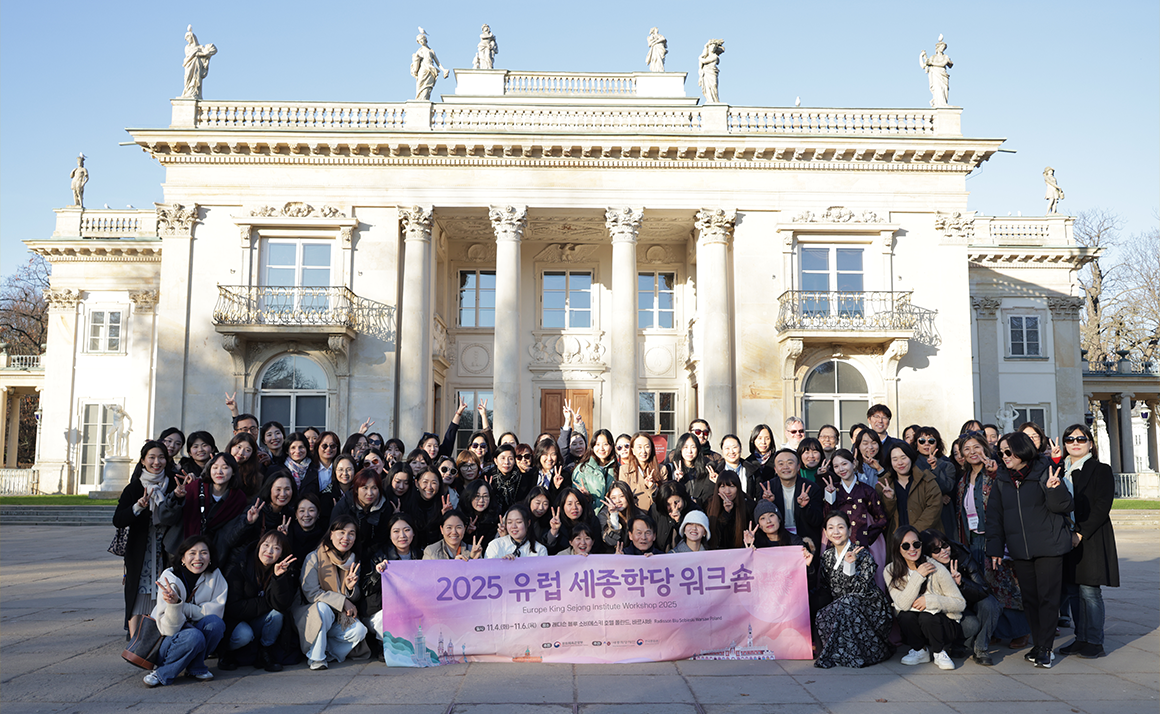
The King Sejong Institute Foundation (Acting President and Secretary General Choi Hyun-Seung, hereafter referred to as the KSIF) successfully concluded the 2025 Europe KSI Workshop, which was held from November 4 to 6 in Warsaw, Poland.
The workshop was co-hosted with the KSI Korean Cultural Center, Poland, and was held under the theme “Korean Language and Korean Culture in Europe.” Approximately 160 representatives from 40 KSIs in 23 European countries, including Germany, Finland, and Romania, gathered to discuss ways of further promoting Korean language and culture and strengthening mutual exchange and cooperation.
The workshop was co-hosted with the KSI Korean Cultural Center, Poland, and was held under the theme “Korean Language and Korean Culture in Europe.” Approximately 160 representatives from 40 KSIs in 23 European countries, including Germany, Finland, and Romania, gathered to discuss ways of further promoting Korean language and culture and strengthening mutual exchange and cooperation.
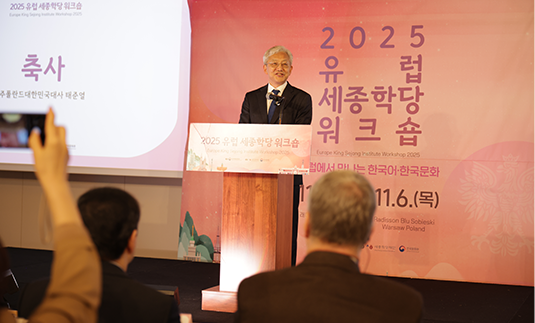
Ambassador Tae Jun-yeol of the Embassy of the
Republic of Korea in Poland Delivering
a Congratulatory address at the 2025 Europe KSI Workshop
Republic of Korea in Poland Delivering
a Congratulatory address at the 2025 Europe KSI Workshop
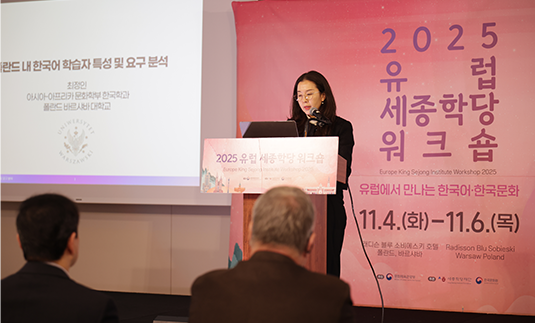
Professor Choi Jeong-in of the University of Warsaw
giving a special lecture titled “Analysis of the
Characteristics and Needs of Korean Language
Learners in Poland”
giving a special lecture titled “Analysis of the
Characteristics and Needs of Korean Language
Learners in Poland”
On the first day, special lectures were delivered by Professor Choi Jeong-in of the University of Warsaw on the topics “The Current State of Korean Language and Korean Culture Education in Europe and the Role of KSI Korean Language Educators” and “Analysis of the Characteristics and Needs of Korean Language Learners in Poland.” This was followed by presentations on the best operational practices at KSIs, success stories of learners in employment and overseas study, and award-winning entries from the interculturalism cases contest, all of which received enthusiastic responses from participants.
The second day featured hands-on programs designed for local educational settings. Sessions reflecting the latest educational trends were offered on topics such as “Methods for Korean Language Education Using AI,” “Hallyu Trends in Europe and the Future of KSIs,” and “Interculturalism-Based Teaching Methods for Korean Language and Korean Culture in Europe.” Training aimed at strengthening the practical competencies of teachers and administrators was also provided.
The second day featured hands-on programs designed for local educational settings. Sessions reflecting the latest educational trends were offered on topics such as “Methods for Korean Language Education Using AI,” “Hallyu Trends in Europe and the Future of KSIs,” and “Interculturalism-Based Teaching Methods for Korean Language and Korean Culture in Europe.” Training aimed at strengthening the practical competencies of teachers and administrators was also provided.
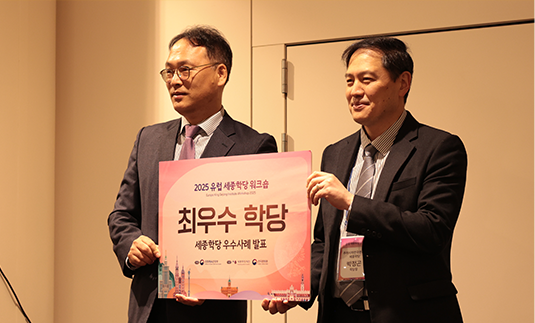
Outstanding KSI awards ceremony for during
the best practice presentations
the best practice presentations

Participating teachers touring the exhibition
space during the workshop
space during the workshop
The final day included programs centered on hands-on Korean culture experiences. Participants broadened their understanding of teaching methods for Korean culture and shared ways of applying them in educational settings through various cultural training sessions covering Korean cuisine, hanbok, Korean films and dramas, and more.
Notably, in response to the growing demand for Korean language and culture across Europe, the workshop also hosted a consultation desk for applications to designate new KSIs. Representatives from five major universities in countries such as Greece and Spain who participated in the consultations expressed positive feedback, stating that “it provided an opportunity to gain an in-depth understanding of the procedures and operational direction for establishing a KSI, and we are actively considering applying for a KSI designation in the future.”
Notably, in response to the growing demand for Korean language and culture across Europe, the workshop also hosted a consultation desk for applications to designate new KSIs. Representatives from five major universities in countries such as Greece and Spain who participated in the consultations expressed positive feedback, stating that “it provided an opportunity to gain an in-depth understanding of the procedures and operational direction for establishing a KSI, and we are actively considering applying for a KSI designation in the future.”
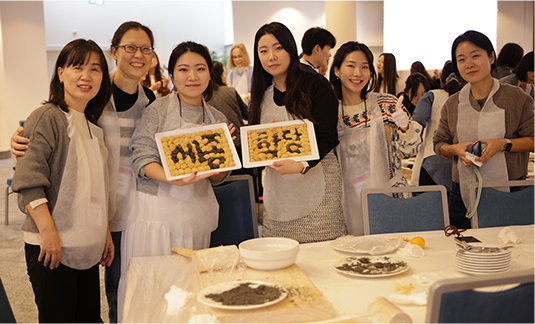
Teachers participating in the
“Korean Culture Training (Korean Cuisine)” program
for Korean Language Educators
“Korean Culture Training (Korean Cuisine)” program
for Korean Language Educators
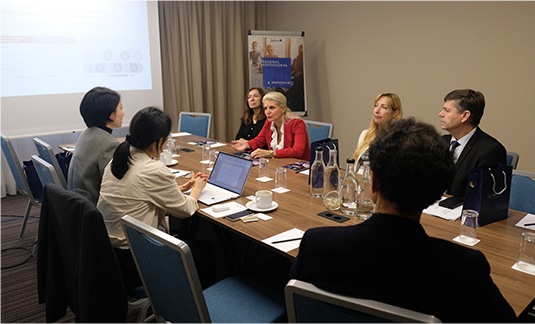
Officials visiting the consultation desk
for applying for a new KSI designation
that was operated during the workshop
for applying for a new KSI designation
that was operated during the workshop
Secretary General Choi Hyun-Seung of the KSIF stated, “The needs of KSI learners vary by continent and region, and demand for Korean culture is particularly high in Europe. Going forward, the KSIF will continue to serve as a central hub for the global expansion of Korean language and culture by strengthening networks and providing customized training programs that reflect regional characteristics and needs.”