KSIF Wins 2025 Minister’s Award for Excellence in Public Domain Content Disclosure Meeting with Assistant Manager Oh Eun-bi of the Content Development Team, Who Oversees Public Domain Content Operations at KSIF
글쓴이홍보협력팀
태그
작성일 2025-12-26
조회수37

KSIF Wins 2025 Minister’s Award
for Excellence in Public Domain Content Disclosure
for Excellence in Public Domain Content Disclosure
Meeting with Assistant Manager Oh Eun-bi
of the Content Development Team,
Who Oversees Public Domain Content Operations at KSIF
of the Content Development Team,
Who Oversees Public Domain Content Operations at KSIF
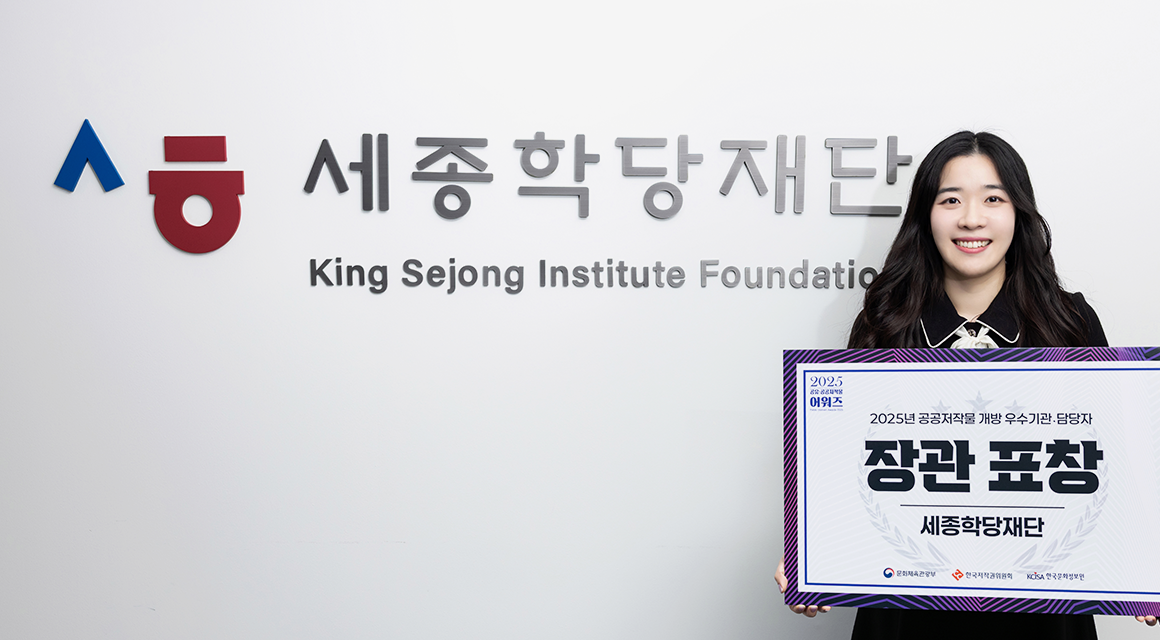
On November 12, the KSIF received the Minister’s Award as an outstanding institution for public domain content disclosure at the 2025 Public Domain Awards 2025, which were held as part of the month-long Copyright Festival. From October 2024 to September 2025, the KSIF made 11,520 public domain works available, contributing to global Korean language education by enabling anyone around the world to easily use Korean language and Korean culture materials in educational settings. To learn more about this achievement, we spoke with Assistant Manager Oh Eun-bi, who is in charge of public domain content management, about her thoughts on the award, the significance of public domain content disclosure, and future plans.
Q. Hello, Ms. Oh Eun-bi. Thank you for agreeing to this interview. First, could you briefly introduce yourself to the readers of “Monthly Knock Knock,” and tell us about your role in the Content Development Team at the KSIF?
A. Hello. I am Oh Eun-bi, assistant manager of the Content Development Team in the Content Business Division at the KSIF. I am currently responsible for digitizing educational materials, which includes the production of Korean language education content, metadata creation, and the development of transcription datI also handle the management of public domain content and educational content deliverables.
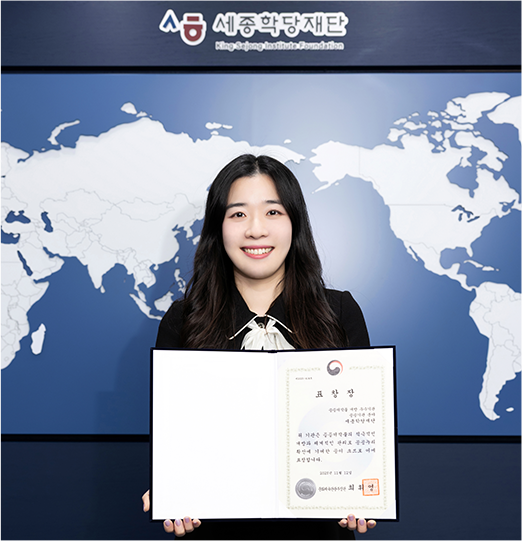

Assistant Manager Oh Eun-bi of the Content Development Team at the KSIF,
who oversees public domain content operations
who oversees public domain content operations
Q. On November 12, the KSIF received the Minister’s Award as an outstanding institution for public domain content disclosure at the 2025 Public Domain Awards 2025, which were held as part of the Copyright Festival. As the staff member in charge, could you share your thoughts on receiving this award, explain what the Minister’s Award for Excellence in Public Domain Content Disclosure represents, and tell us what this achievement means for the KSIF?
A. First of all, as the staff member responsible for public domain content management, I am very happy and proud that the KSIF received the Minister’s Award as an outstanding institution for public domain content disclosure at the 2025 Public Domain Awards. The Minister’s Award for Excellence in Public Domain Content Disclosure is an official government commendation presented by the Ministry of Culture, Sports and Tourism to the public organizations that demonstrates the most outstanding performance in opening and utilizing public domain content.
This award is significant not only because of the quantitative achievement of opening up a large volume of public domain content, but also because it officially recognizes that, over the past year, the KSIF has newly established a comprehensive public domain content management system and laid the groundwork for the entire process, from securing copyrights to developing educational materials for the dissemination of Korean language and culture, so that the wider public and Korean language learners around the world can access and use these resources. Above all, this award is the result of a collective effort by all members of the KSIF. What makes it especially meaningful is that we built and advanced this system together from the ground up by revising organizational regulations, establishing guidelines, designating responsible staff, and providing training for all employees.
This award is significant not only because of the quantitative achievement of opening up a large volume of public domain content, but also because it officially recognizes that, over the past year, the KSIF has newly established a comprehensive public domain content management system and laid the groundwork for the entire process, from securing copyrights to developing educational materials for the dissemination of Korean language and culture, so that the wider public and Korean language learners around the world can access and use these resources. Above all, this award is the result of a collective effort by all members of the KSIF. What makes it especially meaningful is that we built and advanced this system together from the ground up by revising organizational regulations, establishing guidelines, designating responsible staff, and providing training for all employees.
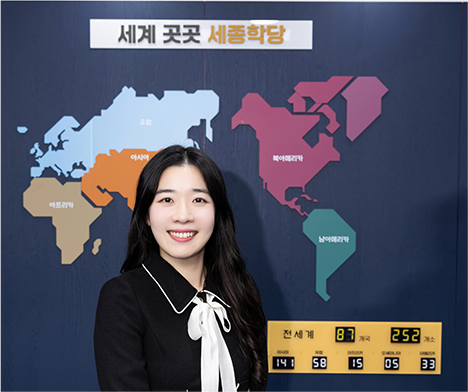
Assistant Manager Oh Eun-bi in front
of the KSIF Exhibition Hall
of the KSIF Exhibition Hall
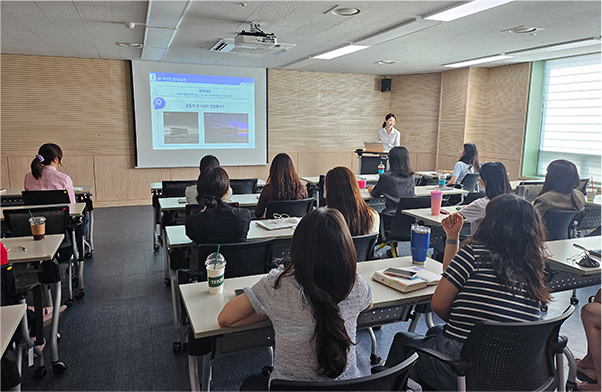
A training session for public domain content officers
in progress
in progress
Q. From October 2024 to September 2025, the KSIF made a total of 11,520 public domain works available, which has improved the accessibility and usability of learning materials for the general public and foreign learners alike. In the course of opening such a large volume of digital resources, were there any particular challenges you faced in practice, or any areas you focused on more?
A. The biggest challenge was that there was no separate public domain content management system in place within the organization. As a result, we had to start by building the system itself. We established the KSIF’s first-ever guidelines for public domain copyright management, formulated an annual management plan, and conducted training for all employees. In addition, to strengthen the expertise of the responsible staff, public domain content officers participated in training programs.
One area we focused on in particular was the production of new public domain content through interdepartmental collaboration. We were selected for the Copyright Acquisition Support Project for Digital Public Domain Content Disclosure, which is supported by the Korea Culture Information Service Agency, and carried out collaborative work through the project. As a result, we produced Korean culture photo content, which we opened on Nuri KSI as Type 1 learning materials and also incorporated into the “Sejong Korean Culture” textbooks.
In addition to inter-institutional cooperation, we also promoted collaborations between departments. Through cooperation with the Online Service Team, we developed a Public Nuri script function for the KSIF website and carried out work to attach Public Nuri license types to KSIF public domain content, thereby expanding the disclosure of public domain works.
One area we focused on in particular was the production of new public domain content through interdepartmental collaboration. We were selected for the Copyright Acquisition Support Project for Digital Public Domain Content Disclosure, which is supported by the Korea Culture Information Service Agency, and carried out collaborative work through the project. As a result, we produced Korean culture photo content, which we opened on Nuri KSI as Type 1 learning materials and also incorporated into the “Sejong Korean Culture” textbooks.
In addition to inter-institutional cooperation, we also promoted collaborations between departments. Through cooperation with the Online Service Team, we developed a Public Nuri script function for the KSIF website and carried out work to attach Public Nuri license types to KSIF public domain content, thereby expanding the disclosure of public domain works.
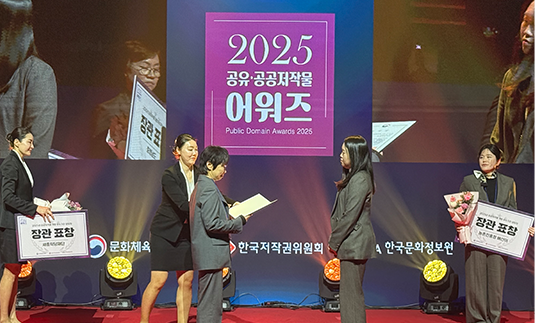
Award ceremony where the KSIF received
the Minister’s Award for Excellence
in Public Domain Content Disclosure
the Minister’s Award for Excellence
in Public Domain Content Disclosure
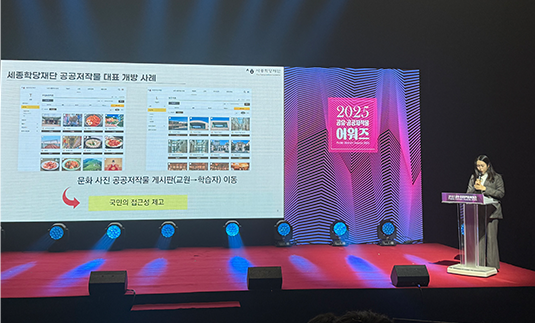
KSIF’s “Public Domain Content Utilization Cases”
presentation at the 2025 Public Domain Awards
presentation at the 2025 Public Domain Awards
Q. We understand that KSIF’s case was introduced through the presentation “Public Domain Content Utilization Cases” at the 2025 Public Domain Awards. Could you share the key points of the presentation, as well as the direction the KSIF aimed to pursue through public domain content disclosure?
A. In the presentation, the KSIF’s public domain content utilization cases were introduced in two main categories. First were the outcomes of digital-based resource disclosure. The KSIF opened a total of 10,456 resources, including Nuri KSI learning materials, by linking them to the Public Nuri database, and applied simplified script functions to seven bulletin boards on the foundation’s official website. Through these efforts, a total of 11,520 public domain works were made available.
Second was the production of new public domain content based on secured copyrights. Since 2024, the KSIF has participated in the Korea Culture Information Service Agency’s copyright acquisition support project, producing 115 Korean culture photo works with secured copyrights. These materials, which feature major cultural heritage sites and tourist attractions photographed from various angles, were opened as Type 1 public domain content, released on the online platform Nuri KSI, and also incorporated into revised editions of the “Sejong Korean Culture” textbooks.
The direction the KSIF has pursued was not simply to disclose materials, but to create resources with real value that anyone around the world can easily use in Korean language education settings. Going forward, we hope to see public domain content actively utilized in educational environments and provide practical support to a wide range of learners and teachers.
Second was the production of new public domain content based on secured copyrights. Since 2024, the KSIF has participated in the Korea Culture Information Service Agency’s copyright acquisition support project, producing 115 Korean culture photo works with secured copyrights. These materials, which feature major cultural heritage sites and tourist attractions photographed from various angles, were opened as Type 1 public domain content, released on the online platform Nuri KSI, and also incorporated into revised editions of the “Sejong Korean Culture” textbooks.
The direction the KSIF has pursued was not simply to disclose materials, but to create resources with real value that anyone around the world can easily use in Korean language education settings. Going forward, we hope to see public domain content actively utilized in educational environments and provide practical support to a wide range of learners and teachers.
Q. The KSIF’s public domain content is being used not only through simple digital disclosure but also in real educational settings for Korean language and culture around the world. How do you hope it will be utilized more broadly going forward?
A. I hope that the KSIF’s public domain content will be widely used not only by KSI teachers worldwide but also by all learners studying Korean language and culture. Beyond teaching and leavrning materials at institutions in Korea and abroad, I look forward to seeing it used in a wide range of ways, such as for individual research and content creation.
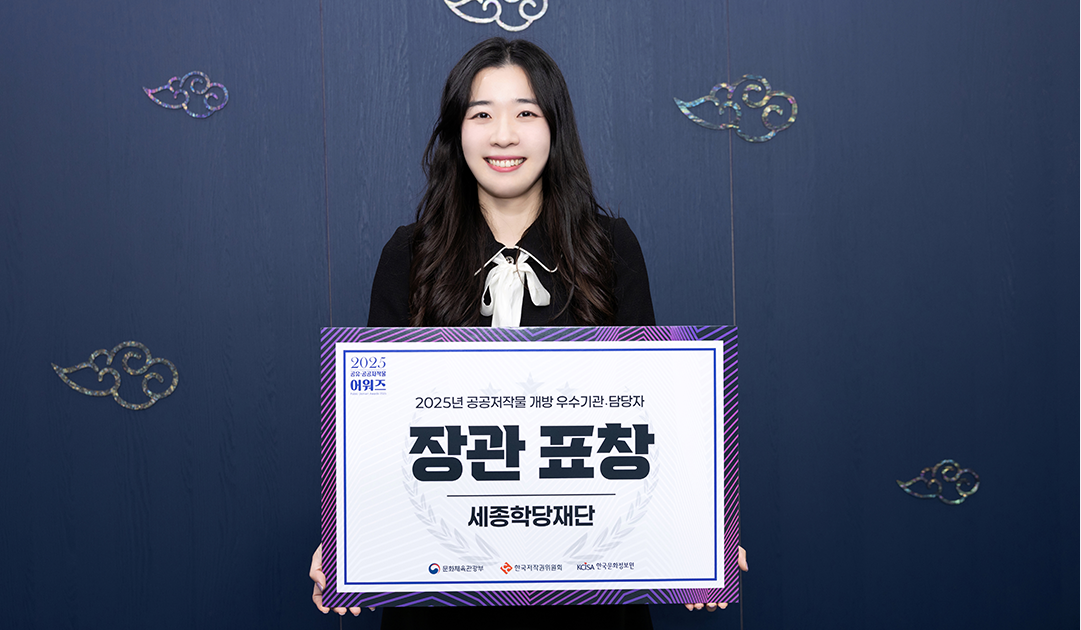
Q. Lastly, do you have a message you would like to share with Korean language teachers around the world who will be using KSIF’s public domain content, or readers interested in Korean culture content? If there are any goals or plans the KSIF hopes to pursue in the field of public domain content following this award, please feel free to share them as well.
A. I hope that the KSIF’s public domain content will be of practical help to everyone who teaches and learns Korean. Going forward, we plan to expand these resources so that learners from a wider range of linguistic and cultural backgrounds can use them more easily. We also ask for your continued interest in the KSIF’s educational materials and other public domain content. Building on this award, the KSIF aims to establish itself as a leading institution in the public domain field by advancing its public domain content management system, developing new content, and strengthening cooperation with institutions in Korea and abroad. As the staff member in charge of public domain content operations, I will continue to do my utmost.