Interview, 2026 KSIF Newsletter
Department in charge홍보협력팀
Tag
2026-05-27
View278

“I hope that when people around
the globe think of the Korean language,
they think of the King Sejong Institute first.”
the globe think of the Korean language,
they think of the King Sejong Institute first.”
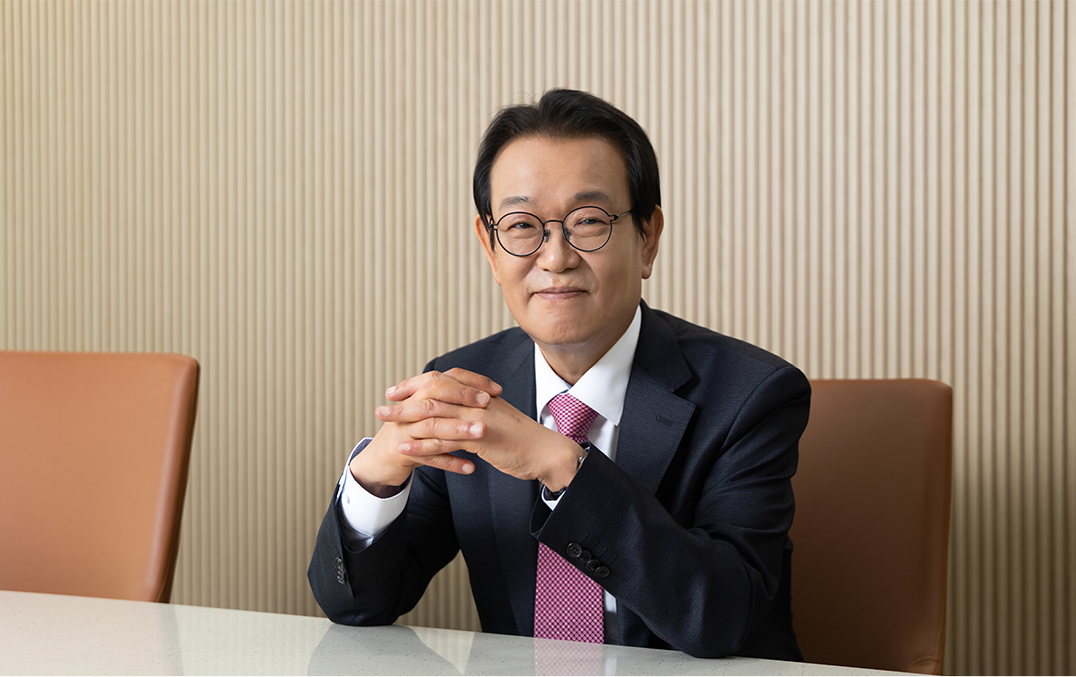
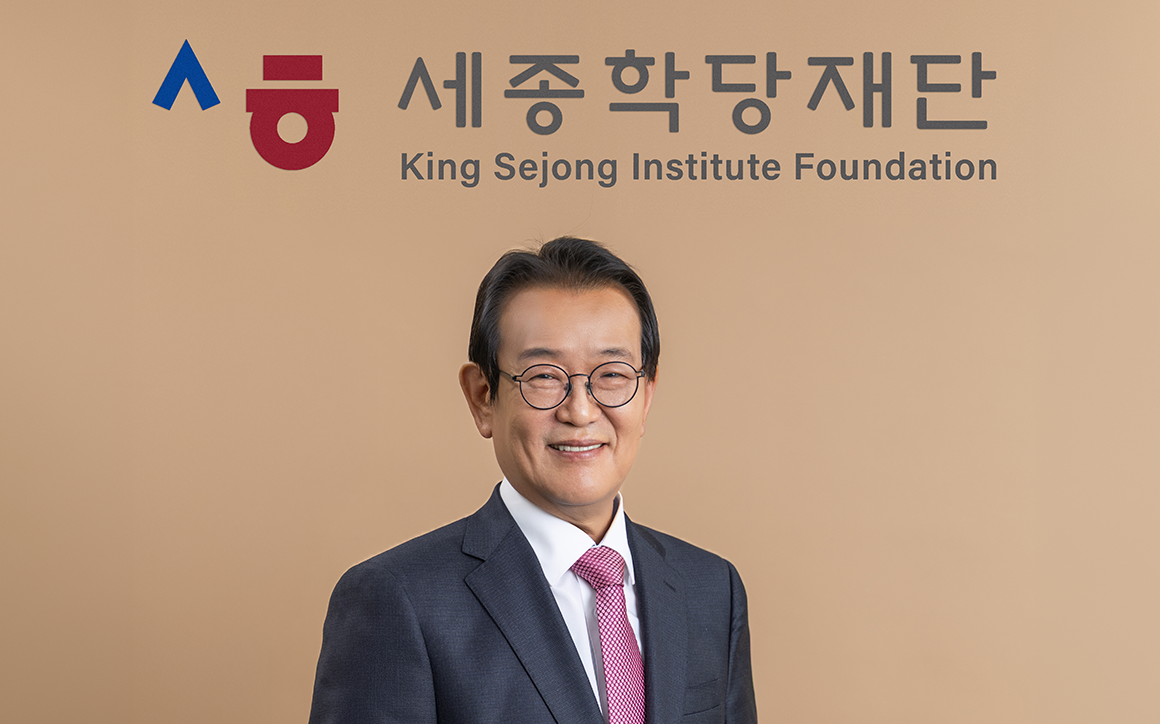
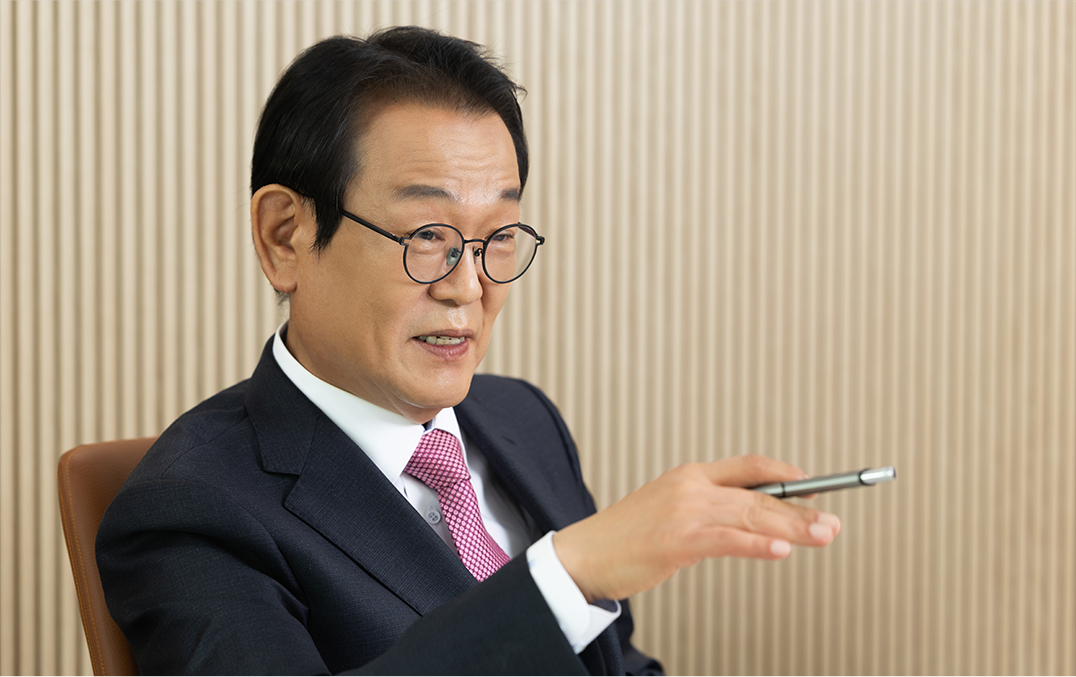
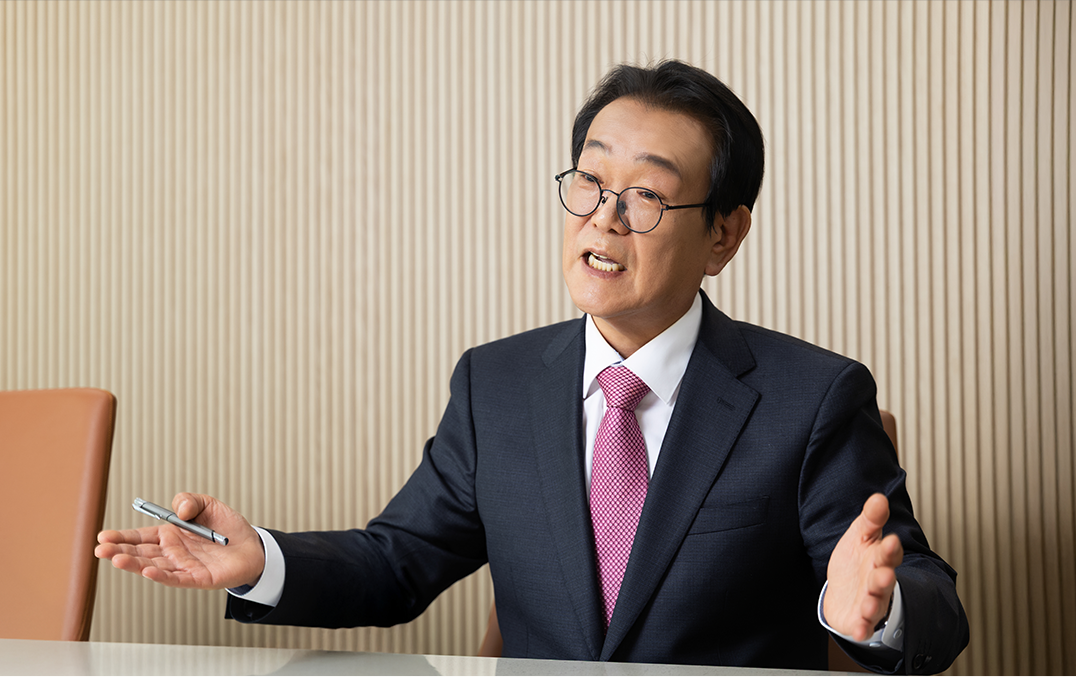
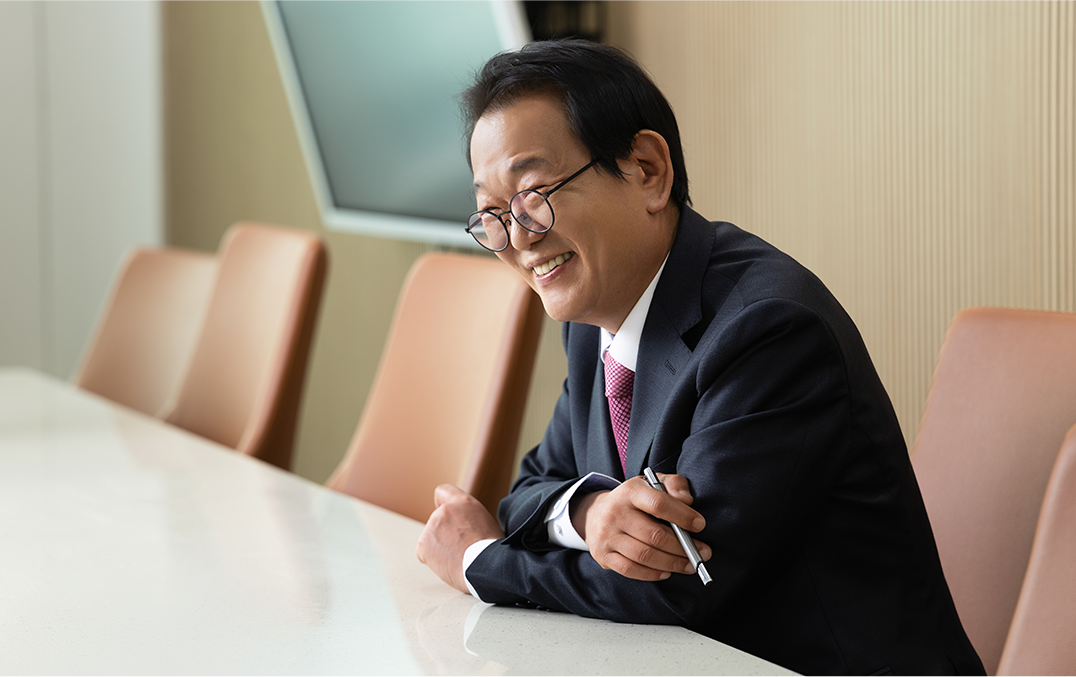
Jeon Woo‑yong officially took office as President of the King Sejong Institute Foundation (KSIF) on April 9. Having devoted his life to studying history and communicating openly with the public, he’s had many titles before his name. Yet aside from his public reputation, the word that has long occupied the deepest place in his heart is “Hangeul.” Ten years ago, while visiting an exhibition of treasures from the Kansong Art Museum, he became overcome with emotion and shed tears before the Hunminjeongeum Haerye manuscript, the original commentary on the Korean alphabet. In his inaugural address, rather than presenting grand ambitions, he emphasized his commitment to wholeheartedly supporting the KSIF staff, who have been at the forefront of promoting the Korean language and Korean culture worldwide. Since assuming office, Jeon has worked tirelessly to address pressing institutional matters. At first, I was worried that the interview might feel somewhat formal and restrained, but those concerns quickly proved unnecessary. On April 15, he sat down with us in his office at the KSIF headquarters in Seocho-gu, Seoul, to share his thoughts and vision.
Q. On the day of your inauguration, you introduced yourself to staff as “Jeon Woo-yong, the newest member of the KSIF.”
A. It was my way of asking people to accept me as a new member of the team. Newbies and youngest members are inexperienced. What I meant to convey was that I’d like for us to learn from each other, teach each other, and get along well together.
Q. What values do you hope to uphold, not only within the organization, but in KSI classrooms?
A. People all over the globe are forming ties with KSIs. Regardless of their backgrounds, we should strive to share with them the universal dreams of humanity. Modern history, shaped in the aftermath of the First and Second World Wars, has been marked by humanity’s ongoing efforts to realize the principles of sovereign equality among nations and equality in human rights among individuals. The Universal Declaration of Human Rights clearly states that no one should face discrimination based on race, religion, gender, wealth, political beliefs, or social background. In many ways, Korea’s independence movement was also a rejection of the discriminatory ideologies that fueled imperialist wars of aggression and mass violence. I believe that contemporary Korean culture, which is rooted in anti-imperialism and anti-hegemony, is well positioned to help advance humanity’s shared aspiration for a peaceful world. For that reason, KSI classrooms around the world should serve as exemplary spaces of cultural harmony and sharing.
◇ The Reason There Are No Superheroes Like Superman or Ironman in Korea
Q. With the recent emergence of AI, human history has reached a major turning point. How do you view this phenomenon?
A. These days, when people are traveling or shopping, they can communicate in almost any language simply by using AI translation apps on their phones. So why do so many foreigners want to learn Korean? I believe we must recognize that those who choose to learn the language are seeking not only to communicate, but to engage more deeply with Korean culture as a whole. Of course, this engagement should not be one-sided. The globalization of the Korean language must progress simultaneously with the localization of universal global concepts in Korean society, in a two-way process. For example, how would AI translate “즈려밟고” in the poetic phrase “사뿐히 즈려밟고 가시옵소서 (Please tread lightly as you pass)”? AI will continue to evolve through mutual and interactive cultural exchanges, and perhaps even create entirely new words. KSIs must continue expanding these points of contact to help elevate both Korean culture and the broader culture of humanity.
Q. From a civilizational perspective, what do you see as the defining characteristics of the Korean language?
A. Almost all mammals are capable of producing sounds with their mouths, but bilabial sounds formed by bringing the lips together, such as ㅁ (m), ㅂ (b), ㅃ (pp), and ㅍ (p), are thought to be uniquely human. We usually say a baby has truly begun “speaking” when it first says words like eomma (mom) or mamma (food). Everything before that is merely babbling. In many cultures, appa, or papa, often follows mamWhat is especially striking about Korean is that many of the most fundamental words are built around these bilabial sounds: maeum (mind or heart), mom (body), mal (speech or language), mul (water), bul (fire), bit (light), byeol (star), and baram (wind). Simply learning these words offers insight into what Korean culture has long valued most deeply. In that sense, I believe the essence of the Korean language lies in life and humanity.
Another defining characteristic of Korean is that it is centered around relationships. Foreign learners who are taught that the second-person pronoun is simply neo (“you”) will soon find themselves in an awkward situation when they start having actual conversations. In Korean, speakers generally identify the other person’s status or relationship before addressing them directly. That is why expressions such as seonsaengnim (teacher, or an honorific title expressing respect and reverence), sajangnim (CEO), samonim (madam), imonim (auntie), or gogaeknim (customer) often function in place of the word “you.” In some ways, this may be seen as a remnant of Korea’s hierarchical society. But from another perspective, it can also be understood as the language being shaped by consideration and respect for others.
Another defining characteristic of Korean is that it is centered around relationships. Foreign learners who are taught that the second-person pronoun is simply neo (“you”) will soon find themselves in an awkward situation when they start having actual conversations. In Korean, speakers generally identify the other person’s status or relationship before addressing them directly. That is why expressions such as seonsaengnim (teacher, or an honorific title expressing respect and reverence), sajangnim (CEO), samonim (madam), imonim (auntie), or gogaeknim (customer) often function in place of the word “you.” In some ways, this may be seen as a remnant of Korea’s hierarchical society. But from another perspective, it can also be understood as the language being shaped by consideration and respect for others.
Q. Learning a language can be seen a process of gradually coming to understand the culture of that country, one piece at a time.
A. Language should never be regarded merely as a tool for communication. We also think through language. Language is the essence of intention”. Human thoughts and emotions are both contained in and expressed through language. This is why teaching and learning language is, inevitably, a process of cultural exchange. For example, when I studied English, I also learned about William Shakespeare, Mark Twain, Abraham Lincoln, John F. Kennedy, and other famous figures. The history, culture, and influential figures of Britain and the United States are inseparable from the English language itself. From this perspective, we can begin to consider what kinds of Korean values and cultural elements should accompany the future global spread of the Korean language.
Q. Interest in Korean culture has recently taken root not just as a passing trend but as a genuine cultural phenomenon. What do you think accounts for this?
A. Not long ago, BTS released a new song titled “Aliens” that included the lyric: “Kim Ku Seonsaengnim, tell me how you feel.” To me, it sounded like a message saying, “Kim Ku Seonsaengnim, your wish has come true.” In My Wish, Kim Ku wrote: “Because my heart ached under foreign invasion, I do not wish for my nation to invade others. I only wish that we may live well in a culture of peace, and that all of humanity may live in harmony and joy.” There is no imperialist code in our culture. Korean cultural content rarely includes narratives in which a hero of a particular nationality determines the fate of all humanity.
Q. Would you say this value system has worked to Korea’s advantage?
A. I believe so. South Korea is the only country that was a colony during the age of imperialism and has since joined the ranks of advanced nations. Decolonization is a universal task for humanity in the modern world. Koreans have taken the lead and carried out this task in the most exemplary way. For a long time, we looked to the United States and Europe as models to emulate. But today, many countries around the world are looking to Korea as a model instead. In that sense, the historical responsibility borne by Koreans has grown considerably. The global spread of the Korean language inevitably involves an exchange of values as well, and from that perspective, I believe the spirit of the Constitution of the Republic of Korea, which embodies the values of the Korean people, will naturally become part of that broader process of exchange and sharing.
Q. Why do you believe the spirit of the Constitution should be part of the conversation?
A. Whenever I try to understand a country, the first thing I look at is its constitution. When there’s a preamble, it often reflects the values and virtues the people of that country collectively aspire to uphold. For example, the principles of liberty, equality, and fraternity in the French Constitution are promises made within the French community. So what appears in the preamble of the Constitution of the Republic of Korea? Justice, humanity, and fraternity. These three principles express the values that the Korean people have agreed to uphold. Independence activists such as Ahn Jung-geun envisioned a world governed not by force, but by justice. During the March 1st Movement, our predecessors formulated the Declaration of Independence. The first pledge of this declared that the movement had arisen from a national demand for “justice, humanity, survival, and dignity.” The preamble to the Constitution of the Republic of Korea explicitly states that the nation seeks to “consolidate national unity through justice, humanity, and fraternity,” so it has inherited the same spirit. In many ways, these values represent a concentrated expression of decolonial ideals, and that is precisely why they are values that can be shared with people around the world.
Q. Some have pointed out that consumption of Korean culture among foreigners is disproportionately focused on pop culture.
A. People around the world are also deeply interested in Korean democracy. As democratization movements are a global phenomenon, Korea’s path to democracy holds significant interest for activists in many countries. However, since information about Korean politics and society is mostly conveyed in English, distortions can sometimes arise. In this context, the work of the KSIF will certainly be of help to foreigners seeking an accurate and comprehensive understanding of Korean history, culture, and social phenomena.
Q. There seems to be a need to understand Korean culture in a broader context.
A. Korean culture, too, has changed throughout history. It is not a “fossilized culture,” unfamiliar even to modern Koreans, but a “living culture” that is continually evolving. I believe we must shift our mindset from distributing or “disseminating” the Korean language and Korean culture to “sharing” them. José Ortega y Gasset, the Spanish philosopher of history, once said, “Man has no nature; what he has… is history.” In other words, what we call national character or ethnic identity is not determined by biological or genetic traits, but is instead shaped through shared historical experiences. By approaching our work with the goal of building a foundation for cultural sharing through the Korean language, we can help create a world where people truly connect with one another.
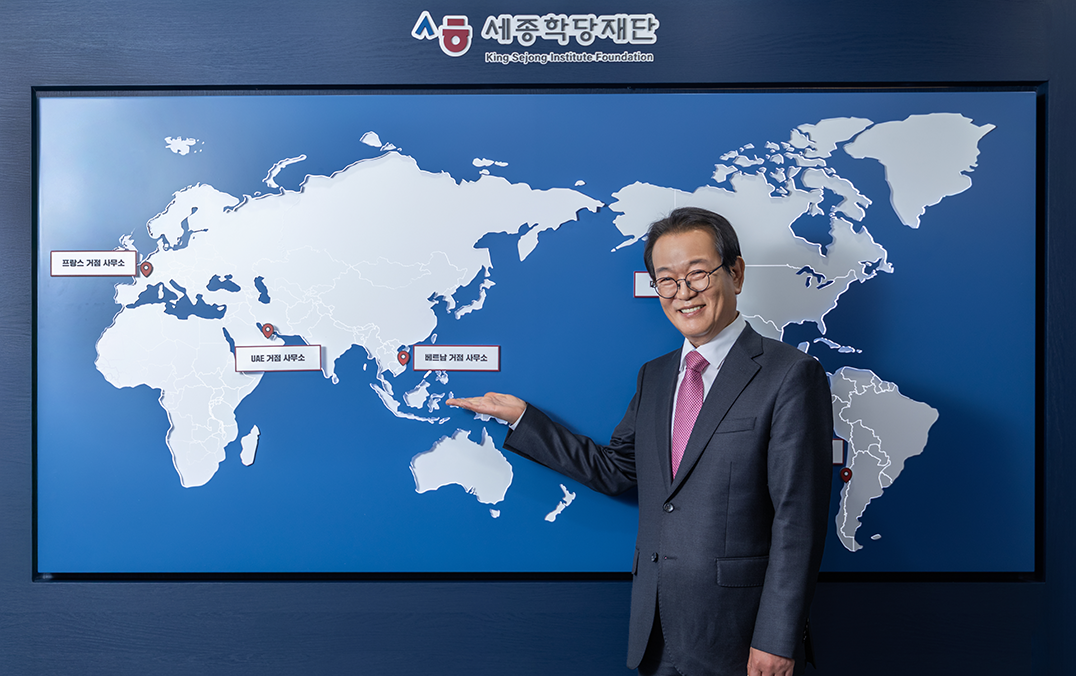
◇ The New Blueprint for the KSIF, Celebrating Its 15th Anniversary Next Year
Q. What direction should the KSIF take as it moves forward?
A. Ultimately, we should aim to share the value of decolonization embedded in the modern Korean language with people around the world. To achieve this, we must first ensure that this value is clearly reflected in our teaching materials. We must also take care to ensure that Korean-language textbooks contain no trace of ethnic superiority or hegemonism.
Q. What steps are necessary for this new leap forward?
A. First, I want our employees to feel genuine fulfillment from their work. I also hope our staff take pride in their work from a civilizational perspective. To achieve this, we must listen closely to our staff and engage in open discussions whenever necessary.
Second, I envision KSIs as places for practicing peace. The true opposite of peace is not war, but discrimination. Pyeong in pyeonghwa (peace) signifies the absence of hierarchy or inequality, while hwa represents harmony so complete that distinctions disappear. I want to foster a culture where KSI teachers, staff, and learners worldwide interact as equals, free from prejudice and discrimination.
Third is connection. I hope to create a platform where the global KSI community can come to share their countless.
Second, I envision KSIs as places for practicing peace. The true opposite of peace is not war, but discrimination. Pyeong in pyeonghwa (peace) signifies the absence of hierarchy or inequality, while hwa represents harmony so complete that distinctions disappear. I want to foster a culture where KSI teachers, staff, and learners worldwide interact as equals, free from prejudice and discrimination.
Third is connection. I hope to create a platform where the global KSI community can come to share their countless.
Q. Lastly, what are you determined to achieve during your term?
A. I believe it is crucial to elevate the brand and reputation of King Sejong Institutes. Many countries operate language institutions worldwide, so people naturally compare them. Of course, KSIs cannot secure a competitive advantage on their own. A nation’s reputation becomes the reputation of its language, which in turn shapes the reputation of its language institutions. If KSI teachers and staff lead by example in practicing consideration and harmony, we will be able to enhance the reputation of both KSIs and the Republic of KoreMy hope is that KSIs will be recognized everywhere as the most approachable and welcoming Korean-language and foreign-language institutions. I also hope that more people around the world will come to associate King Sejong Institutes with Korea itself.