Central America is emerging as the next major Hallyu hotspot and is already the center
of the non-Asian Hallyu community. Can you explain how Hallyu first laid down roots
in Central America and its status today?
Up until the 1990s, when Hallyu started gaining popularity in China, Taiwan, and Vietnam, Central
America had little to no knowledge of Korea. Not only were Central Americans largely unaware of
Korea’s language and culture, there were also very few who knew that Korean products are not
made in the same country as Japanese products.
This state of affairs changed in 1998 and again in 2005, when the dramas Star in My Heart, Jewel
in the Palace, and Stairway to Heaven were broadcast on terrestrial networks, beginning in Mexico
and spreading to several other countries. The hosting of the Korea-Japan World Cup in 2002 also
played a major role in the rapid, wide-reaching acceptance of Korean culture among the Central
American public. Today, we are at a point at which consumption of Hallyu products, including not
only dramas and music but also games and food, is generating demand for Korean classes and
Korean-made consumer goods as well as employment at Korean companies.
One interesting aspect is that Central America is the area of the world with the most active “club
activity-based” enjoyment of Korean culture (as opposed to private, individual encounters with
Hallyu). As of 2018, there were 627 Hallyu clubs in Central America, far more than in Asia/Oceania,
Europe, the Middle East/Africa, and North America.
What do you think is the force behind such popularity [in Central America]
—both of Korean culture and Korea in general? Also, what do you think about
the sustainability of Hallyu?
The 20 countries of Central America, which is part of the Latin American region, share much in
common in terms of history, culture, religion, and language. This has resulted in the formation
of a homogenous foundation that makes it very easy for pop culture to spread quickly. The high
levels of urbanization, Internet accessibility, and social media use make it easy for people to share
their interests and explore foreign cultures. Hallyu products, which embody the socioeconomic
experience of overcoming poverty and forthright expressions of current problems/issues, hold a
very high appeal for Central Americans. The high degree of cultural homogeneity in this region also
enables economies of scale in the production of Hallyu-related products.
Conversely, a dampening of Hallyu would most likely result in immediate and serious damages.
Such dampening could be generated at the government level (politics, diplomacy, or trade) or as a
result of social conflict (treatment of tourists or study-abroad students, crime, public health, etc.).
Therefore, maintaining a positive national image has become immeasurably important
There are 15 KSIs in 11 countries of Central America, and more will be built on
a consistent basis well into the future. Is there anything in particular that you would
like to request or things that should be kept in mind in terms of sharing Korean culture
or the Korean language in Central America?
If we could host a regular regional workshop, based on intra-regional homogeneity, for all KSI staff
and affiliated learners in Central America that is based on sharing information and experiences,
I think it would be of great help in promoting, quantitatively expanding, and enhancing the
reputation of KSI projects and businesses.
That being said, generally, Central America has a very strong instinct of self-protection that was
developed over many years of being under the control of foreign powers. We must therefore
generate local interest/curiosity in and promote a positive reception of Hallyu (independently) in
order to foster greater demand for Korean language and culture. It’s also important to remember
that such efforts may be jeopardized if government agencies are blinded by their desire to “produce
visible outcomes of progress” from increased demand or large corporations are similarly blinded by
the desire to generate profits.
We must take the situation of China’s Confucius Institute, which now finds itself at a crossroads
in Central America, as a lesson. If the Confucius Institute loses ground, China can persevere by
leveraging its financial cooperation with the Central American region. We, however, do not have
such leverage.
Do you have any final words of encouragement and/or advice for the KSIF?
The KSIF is an international cultural exchange institution with a focus on the Korean language
that has carried out, and continues to carry out, a noble task with great dedication. I would like to
stress, however, that the foundation should conduct its activities in a manner that is befitting of
an international cooperative body. The key to success in international cooperative endeavors lies in
respecting systems and principles that are different from our own. The same is probably true for any
other region of the world, but Central America is especially different from Korea in terms of labor
laws, national health care system, financial systems, and accounting procedures. I have no doubt
that the KSIF’s projects will achieve even greater results if the foundation makes an effort to respect
local practices and systems when carrying out activities in Central America.
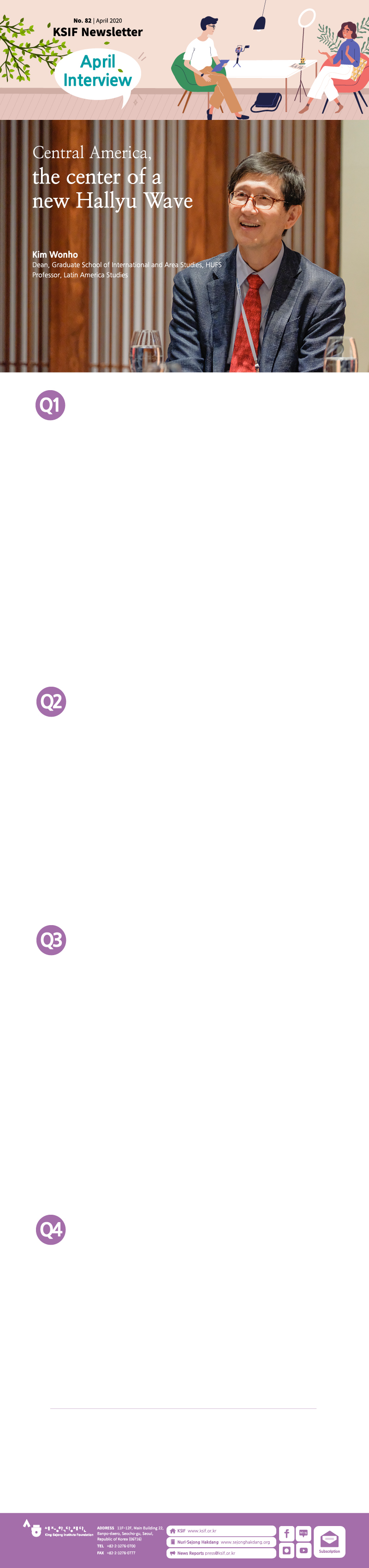
Kim Wonho
Dean, Graduate School of International and Area Studies, HUFS
Professor, Latin America Studies
Kim Wonho received his Ph.D. in Central American studies from the University of Texas at Austin (United
States). He previously served as director of the Korea Institute for International Economic Policy’s Center
for Area Studies, chair of the FEALAC (Forum for East Asia-Latin America Cooperation) Vision Group,
and president of the Latin American Studies Association of Korea. Kim is currently the dean of the
Graduate School of International and Area Studies at Hankuk University of Foreign Studies.