Interview with Kim, Yeong-Soon, the President of the Korean Language & Culture Education Society
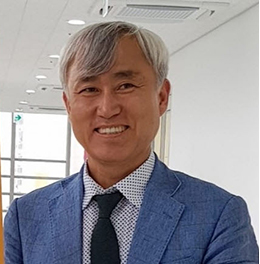
1. Hello, Kim, Yeong-Soon, the President of the Society. Please briefly introduce the Korean Language & Culture Education Society.
The Korean Language & Culture Education Society(http://klaces.or.kr/) has been working in the front line of researches on Korean language education for 17 years since its foundation on November 1st 2003. Especially, our society has contributed to the development of Korean language/culture education focusing on researches of language and culture since its foundation. The identity of our society could be viewed from Article2(Purpose) of society rules. “This society aims for the domestic/foreign academic exchanges and presentation of researches by members aspiring to the education of Korean language/culture. Through this, it aims to contribute to the integrated researches on Korean language/culture, and the Korean language/culture education especially for overseas Koreans and foreigners.”
For this purpose of the foundation, our society is putting efforts to maintain the differentiation from other societies related to Korean language education by equally developing the researches on language and culture. Recently, declaring its global vision to contribute to the globalization of Korean language, our society has established the actual roadmap such as the establishment of networks with the domestic/foreign leading societies related to Korean language education and the expansion of overseas internship for the follow-up generations of Korean language education. Our society is preparing for the conferences of Korean language education including two times of spring/autumn regular conference, one time of overseas conference, and two times of expert colloquium per year. All the readers who love Korean language are invited to the academic feast of our society.
2. In this January, the KSIF and the Korean Language & Culture Education Society concluded the business agreement to expand the research/consultation related to Korean language/culture education overseas. What activities would you like to do with the foundation in the future?
Just as mentioned earlier, compared to other societies, our society is the only Korean language education society of Korea that is performing equal researches on language and culture, and also practicing them in in the actual area of academic performance such as conference and journal. Therefore, based on the plentiful research data focusing on language/culture accumulated in our society, we aim to participate in the globalization project of Korean language/culture that is planned and carried forward by the KSIF.
For this, first, we will encourage our members to participate in diverse academic projects & policy researches performed by the KSIF. Second, on top of cooperating the improvement of curriculum & development of teaching materials reflecting the local culture and training to strengthen the competencies of Korean language teachers of KSIs in the whole world, we will establish the system for supporting the policies of KSIF through academic events such as colloquium by organizing the research group of our society. Third, for the regular conference, we aim to jointly prepare a place for the development of Korean language education such as composition of mid/long-term vision & roadmap of Korean language education policy of KSIF, and evaluation of results of performing diverse policies. Thus, we aim to organize the organic cooperating system between institutes performing the Korean language education policies and the group of researchers/teachers executing them.
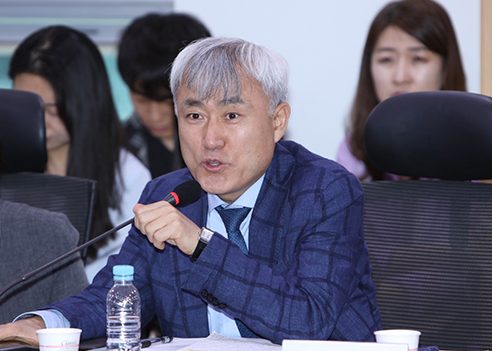
3. In the National Assembly Debate between the foundation and Woo, Sang-Ho’s office held in last June, you delivered a free speech under the theme of ‘Korean culture spread policy based on the interculturalism’. Do you have any advices about what should be careful of in the aspect of disseminating Korean culture?
As the answer to this question reflects my personal philosophy of education as a researcher instead of the common position of the Korean Language & Culture Education Society, this part should be considered. I think that there are three points to be careful of for the foundation to introduce Korean culture overseas.
First, based on the interculturalism, the expression of ‘disseminating’ ‘Korean culture’ should be reconsidered. I am an interculturalist. The core of interculturalism is the ‘understanding of others’, which should be based on individuals’ other-directedness. In the area of practice, it should be changed to the interculturalism. In this context, the ‘interculturalism’ and ‘dissemination’ do not accord with each other. Instead, I think that the expression ‘spread is more proper.
Second, the existing Korean language education was more likely based on the cultural imperialism. The pressure of our style could be working as a violence, instead of the interculturalistic approaches to their culture, system, and daily life. Despite such diverse purposes of learning Korean language, it is needed to compose the teaching materials and curriculum considering the learners’ cultural diversity to open the interesting world of learning at least. For this, it is essential to have the cooperation with Korean language educators, experts in local culture/region, and local Korean language educators.
Third, with the increased learning of Korean language/culture, there are more expectations for the creation of jobs such as posting Korean language teachers. This should not be simply connected to the economic growth and spread of K-Wave. We should remember that the domestic/foreign Korean language education institutes have continuously worked hard for the cultivation of excellent Korean language educators. Now, the market of Korean language education in the world has been expanded great enough to qualitatively cultivate the Korean language educators. There should be more diverse systems such as certification system of Korean language teachers training institutes and overseas internship for cultivating the next-generation Korean language educators in the global society. Moreover, the government should put the diplomatic efforts for the selection of Korean language as a second foreign language.
4. You have worked as an educator of Korean language/culture for decades. What is your characteristic philosophy of education?
I think that a certain philosophy of a researcher or teacher would be originated from his/her training course or academic experiences. After studying European Culture Studies in university, I got a master’s degree in Media Education at Technical University of Berlin. After studying Linguistics, Education, and Ethnology, I got a doctor’s degree in Comparative Cultural Change. Like this, in my school life, I had the experiences in interdisciplinary convergence research. Thus, as a researcher, I can say that my philosophy is the ‘crossing the boundary’ to respect the value of convergence.
Also, while studying abroad in Berlin, Germany, I used to teach Hangeul to the second generation Korean-Germans at a weekend school for Koreans in Berlin. After that, working for Kyungpook National University, I developed a Korean language textbook for foreigners called
Currently, as a researcher who studies and lectures the general multicultural education, I cannot say that I am a major in the core area in the sub-areas of Korean language education. However, in order for the development of Korean language education, it is needed to be expanded to the interdisciplinary convergence studies and also to accept the systematic research methods. In this aspect, I want to see the future of Korean language education as a convergence study combined with social science such as humanities, education, sociology, psychology, and anthropology focusing on literature, history, and philosophy after exceeding researches on the area of Korean language.
5. Recently, you are actively carrying forward the multicultural social integration project like working as the head of the Convergence Institute for Multicultural Studies in Inha University. Our KSIF is operating the curriculum for married immigrants, and also considering the Korean language education for immigrant adolescents. In terms of the multicultural project, do you have any advices on cautions or future direction for our foundation?
The Convergence Institute for Multicultural Studies in Inha University is a research institute affiliated with the university that convergently studies diverse multicultural policies to actively cope with changes in multicultural environment of rapidly-changing Korean society. Currently, our research institute is performing researches on policies & programs about education for understanding cultural diversity and multicultural sensitivity, targeting immigrant women’s acculturation, academic adjustment of students from multicultural families, and ordinary citizens.
We are also operating the BK21 Glocal Multicultural Education-Professional Manpower Cultivation Project Group, the research on the living world & social integration of immigrants as a humanities & social science-based research project by the National Research Foundation of Korea, and the Multicultural Mentoring Project Group for North Korean Defectors by the Korea Student Aid Foundation. Through these series of research project, we are also performing a research on the Korean language education for immigrants. On top of actively supporting the Korean language education support project for immigrants of KSIF, we are ready to share the information about relevant policies & researches, and also to perform joint researches. Especially, we are competent enough to contribute to the development of curriculum and teaching materials of Korean language education reflecting the immigrants’ needs, and also to contribute to the multicultural understanding training for Korean language teachers.
6. Lastly, do you have any comments you like to say?
In order for the KSIF to rationally perform the Korean language education policies, it would be necessary to pay attention to opinions of Korean language education teachers and researchers. Moreover, it would be needed to expansively organize the organizations such as Korean Language Educational Development Institute and Korean Institute of Korean Language Education & Evaluation under the foundation, in order to mainly perform surveys, researches, training, and planning of programs related to Korean language education. Lastly, hoping for the development of KSIF, the Korean Language & Culture Education Society is fully ready to sincerely perform the business agreement with the KSIF anytime. Thank you.