
“It was a time when I truly grew as a person.” Interview with Kil A-jeong, 2025 KSI Prospective Korean Language Teacher at KSI Korean Cultural Center, Brazil
글쓴이홍보협력팀
태그
작성일 2025-10-27
조회수93


“It was a time when I truly grew as a person.” Interview with Kil A-jeong,
2025 KSI Prospective Korean Language Teacher
at KSI Korean Cultural Center, Brazil
KSIF operates the KSI Prospective Korean Language Teacher Overseas Practicum Program to help students majoring in Korean language education at domestic universities and graduate schools gain teaching experience before becoming certified Korean language teachers. Through this initiative, participants can build practical teaching experience at KSIs around the world. In August, we met with Kil A-jeong, who served as a prospective Korean language teacher at the KSI Korean Cultural Center, Brazil, to hear about her four weeks of learning and growth.
Hello, Kil A-jeong! It’s a pleasure to meet you. Please introduce yourself to the readers of Monthly Knock Knock.
Hello! My name is Kil A-jeong, and I am currently studying in the Department of Korean Language and Culture at Sangji University. I participated in the 2025 KSI Prospective Korean Language Teacher Overseas Practicum and completed a four-week practicum at the KSI Korean Cultural Center, Brazil, beginning in August. I’ve always been interested in the Korean language since childhood, and studying Korean Language and Culture at university has allowed me to view Korean from a new perspective. Through my professors’ lectures, I came to understand why foreign learners find Korean pronunciation and grammar challenging, and this gave me a chance to see my native language from an unfamiliar angle. During this process, I discovered the appeal of Korean language education—the art of conveying the language in an understandable and engaging way.
One particularly transformative experience was teaching Korean to Chinese exchange students for seven weeks, three hours a week, through Sangji University’s extracurricular program Global Class. Looking back, there were certainly areas where I lacked experience, but the trust and enthusiasm shown by my students allowed me to feel the joy of teaching Korean. That experience motivated me to set a goal of becoming a more professional Korean language teacher, and I’ve been working hard toward it ever since.
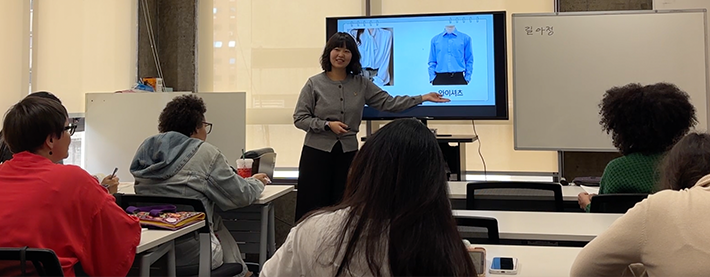 Kil A-jeong conducting a mock Korean language class at the KSI Korean Cultural Center, Brazil,
during her KSI Prospective Korean Language Teacher practicum
What motivated you to apply for the KSI Prospective Korean Language Teacher Overseas Practicum? Among the 13 participating countries, why did you choose Brazil, and how did you prepare before departure?
I decided to apply for the KSI Prospective Korean Language Teacher Overseas Practicum because I wanted to develop the ability to systematically design and conduct Korean language classes. Two years ago, I participated in a student exchange program at EMBA Business School in France, where there happened to be a King Sejong Institute. When my French friends asked me questions about the Korean language at the time, I found it difficult to give clear explanations. That experience made me think seriously about what kind of preparation is necessary to teach Korean effectively to foreign learners. Later, while teaching Korean to Chinese exchange students through my university’s Global Class program, I also spent a lot of time thinking about how to explain concepts in a way that is easier for non-native speakers to understand. Through these experiences, I realized that teaching Korean is not something that can be done with linguistic knowledge alone—it requires the ability to design lessons systematically. I wanted to build that ability through hands-on experience in a real teaching environment, which is why I applied for the KSI Prospective Korean Language Teacher Overseas Practicum.
As for why I chose Brazil among the 13 participating countries, it was because it was the farthest destination. During my exchange in France, I learned how meaningful and valuable it is to meet new people in a completely different linguistic and cultural environment. I also discovered new sides of myself that I hadn’t known before. I was very curious and excited to see what kind of people I would meet in Brazil—on the opposite side of the globe—and what new aspects of myself I might discover through those encounters. When I was finally assigned to Brazil, which had been my first choice, I was absolutely thrilled.
Once my placement was confirmed, I began studying Portuguese, the language used in Brazil. Although I knew full communication would be difficult, I wanted to at least be able to greet and express simple things in the local language. I also reviewed the curriculum of Sejong Korean, the textbook used at the KSI Korean Cultural Center, Brazil. Since I had never taught intermediate-level learners before, I worked hard to reflect the curriculum in my lesson plans and mock classes to ensure effective instruction.
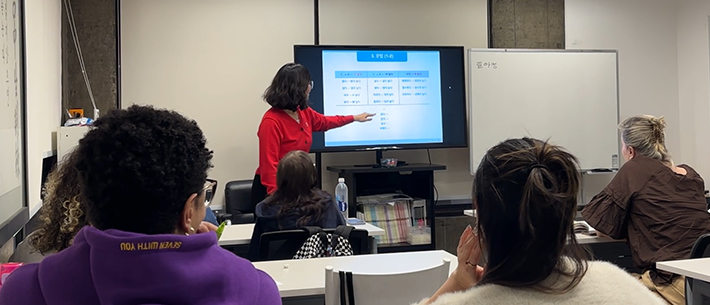 Kil A-jeong teaching a Korean class for Intermediate Level 3B
What kind of activities did you take part in during your one-month practicum at the KSI Korean Cultural Center, Brazil?
During my four-week practicum at the KSI Korean Cultural Center, Brazil, I participated in various activities such as observing Korean language classes, conducting mock teaching sessions, and leading cultural classes. These experiences were extremely helpful in developing my competencies as a Korean language teacher.
First, by observing the classes taught by Teacher Jung Yeon-woo, who guided me throughout the program, I learned how to structure and organize lessons effectively. I was particularly impressed by the way the teacher explained activities so that learners could easily understand them. I also learned how to design lessons that connect learning objectives with student engagement—for example, by using interesting images to present the pragmatic aspects of grammar. Watching these techniques made me realize the importance of using diverse materials to help learners better grasp grammatical concepts.
I conducted six hours of mock Korean classes for Beginner Level 2A and Intermediate Level 3B students. Through the process of preparing lesson plans and receiving feedback, I was able to broaden my perspective on how to approach teaching. My supervising teacher offered detailed guidance, such as distinguishing between vocabulary that can be presented directly and words that require additional explanation—an aspect I had not previously considered. This helped me gain a deeper understanding of what needs to be taken into account when teaching Korean. I also learned that lesson methods should differ between beginner and intermediate levels. For beginners, a step-by-step teaching approach is effective, whereas for intermediate learners, instead of simplifying explanations into the “-아/어요”form, it’s better to use previously learned grammar appropriately when explaining new concepts. Through this feedback, I realized that it’s not enough to merely teach the content of a single textbook lesson—teachers must adapt their explanations according to the learner’s proficiency level. Afterward, by reviewing the curriculum of Sejong Korean, I was able to understand lesson composition more systematically and further enhance my instructional skills.
For the cultural class, I led a norigae (traditional Korean ornamental pendant) making activity. Coincidentally, the recently popular Netflix film ❬KPop Demon Hunters❭ featured main characters wearing norigae, and when I showed this scene to the students, they were delighted—which made the class even more enjoyable for me as well. While making norigae together, I also explained the meanings of traditional patterns such as butterflies and suja (longevity) motifs, which sparked even greater interest among the learners. It was rewarding to share not only a hands-on craft experience but also the deeper cultural significance behind it.
In addition, I created a “Hanbok Dressing Worksheet” for a class themed around traditional clothing and used it as part of the lesson. I also had the opportunity to check students’ homework and provide feedback on their Korean writing. Rather than simply marking correct answers, I reflected on how to guide learners more effectively, and in doing so, I was also able to revisit and strengthen my own understanding of Korean grammar. It was a truly meaningful experience.
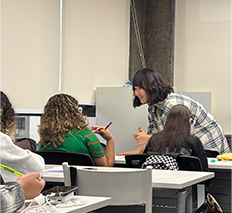
Intermediate Level 3B classes
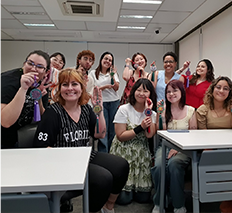 Commemorative photo with KSI
learners after the norigae-making
activity
Please tell us about the most rewarding or memorable moment during your practicum. Were there any unexpected challenges you encountered?
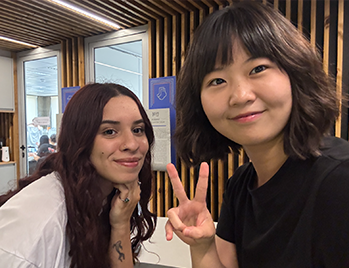
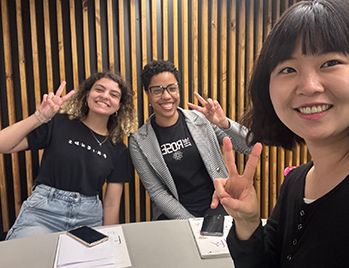
Every moment was rewarding, but the most memorable experience for me was communicating with learners through the mentoring sessions. During mentoring, I reviewed previously learned materials with the learners to help improve their speaking skills and engaged in conversations on various topics. Through these interactions, I was able to learn not only about the learners’ personal interests but also about Brazilian culture as a whole.
What I remember most vividly is having meals with the learners after mentoring sessions, which allowed us to connect naturally outside the classroom. It was a meaningful experience that went beyond the teacher–student relationship and helped us become good friends. Moreover, the mentoring activities helped me develop a learner-centered teaching attitude and made me realize that language education extends beyond the mere delivery of knowledge—it also encompasses cultural understanding and the building of human relationships. I believe these experiences will serve as a valuable foundation for my future growth as a Korean language teacher.
How do you think this experience will influence your future career or plans? Also, do you have any advice or words of encouragement for those who aspire to become KSI Prospective Korean Language Teachers?
At first, I was worried about whether I would be able to adapt to a completely new environment. However, after communicating directly with learners and teachers in Brazil, I gained confidence that I could adjust well. Now, rather than feeling afraid, I feel more excited about the prospect of working as a Korean language teacher overseas. Through this overseas practicum, I was able to identify the key competencies that every Korean language teacher should possess, and I’ve set a new goal to continue developing those skills. Once I obtain my Korean language teaching certification, I hope to apply again for an overseas teaching position at a KSI, regardless of which country it may be.
To those who, like me, dream of becoming a KSI Prospective Korean Language Teacher, I want to say that the rewards you receive from teaching Korean far outweigh what you give. It may feel intimidating to step into an unfamiliar environment, but as you make an effort to communicate with foreign learners, you will experience a genuine sense of mutual understanding. Even though my time in Brazil was short, interacting with learners there allowed me to grow not only as a prospective Korean language teacher but also as an individual. Opportunities to meet and understand people who are different from yourself are rare—so don’t be afraid, and I truly encourage you to take on this meaningful challenge!