
“It strengthened my confidence in my career path.” Interview with Cho Yea-weon, 2025 KSI Prospective Korean Language Teacher at KSI Center Vietnam
글쓴이홍보협력팀
태그
작성일 2025-10-27
조회수104


“It strengthened my confidence in my career path.” Interview with Cho Yea-weon,
2025 KSI Prospective Korean Language Teacher
at KSI Center Vietnam
KSIF operates the KSI Prospective Korean Language Teacher Overseas Practicum Program to help students majoring in Korean language education at domestic universities and graduate schools gain teaching experience before becoming certified Korean language teachers. Through this program, participants can build practical teaching experience by conducting Korean language classes at KSIs around the world. In August, we met with Cho Yea-weon, who served as a prospective Korean language teacher at the KSI Center Vietnam, to hear about her four weeks of learning and growth.
Hello, Cho Yea-weon! It’s a pleasure to meet you. Please introduce yourself to the readers of Monthly Knock Knock.
Hello! My name is Cho Yea-weon, and I am currently studying in the Graduate School of Education at Anyang University, majoring in Teaching Korean as a Foreign Language. I participated in the 2025 KSI Prospective Korean Language Teacher Overseas Practicum and completed a four-week practicum at the KSI Center Vietnam in August. Although I majored in Chinese Language and Literature as an undergraduate, my interest in Korean language education actually began in high school. At that time, I attended the Korean International School of Hong Kong and took part in a volunteer program where I interacted with students from the Chinese University of Hong Kong who were learning Korean. It was then that I first discovered the joy of communicating and teaching in Korean.
During my university years, I created my own curriculum and led students through volunteer teaching activities. That experience has been a great foundation for preparing lesson plans and organizing classes today. I also taught basic Korean alphabet (Hangul) classes for foreigners abroad and conducted online Korean lessons for Paraguayan students through a graduate school–linked program. Through these experiences, I came to realize that teaching Korean is more than just an academic pursuit—it is a meaningful way of connecting people to one another, and I continue to explore it with great interest.
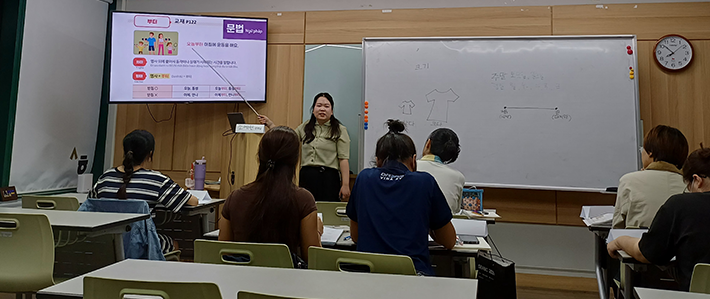 Cho Yea-weon teaching a Korean language class at KSI Center Vietnam during her KSI Prospective
Korean Language Teacher Practicum
What motivated you to apply for the KSI Prospective Korean Language Teacher Overseas Practicum Program? After being selected, how did you prepare before departure?
The main reason I decided to apply for this program was because I wanted to experience the actual teaching field before graduating. Even while studying in my major, I often wondered, “Is this really the right path for me?” Since I had a goal of working overseas after graduation, I wanted to see firsthand what Korean language education was like in an international setting. I had also heard that in Vietnam, it can be quite difficult to gain teaching experience even with a degree, so I thought this would be a rare and valuable opportunity that I shouldn’t miss.
Before the practicum, I was quite anxious because I had no prior teaching experience. However, through the preliminary training, I was able to learn practical aspects intensively in a short period of time, such as writing observation journals, preparing lesson plans, and managing classes. The dedicated guidance from my professors was also a great source of strength. In addition, I read grammar reference books, reviewed sample lesson plans to supplement my weak areas, and held a pre-meeting with my local supervising teacher to ask detailed questions about the institute’s operation, learner characteristics, and living environment. This allowed me to prepare thoroughly for the practicum.
 Cho Yea-weon visiting the Independence Palace in Ho Chi Minh City during her KSI Prospective Korean Language Teacher Practicum
 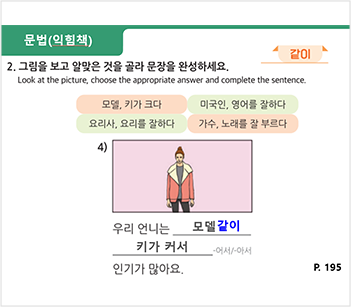 Teaching materials prepared by Cho Yea-weon for her KSI Prospective Korean Language Teacher Practicum classes
 What kind of activities did you take part in during your one-month practicum at the KSI Center Vietnam? It is said that Vietnamese learners show unique enthusiasm and characteristics in learning Korean—what impressed you most from your firsthand experience?
During my one-month practicum at the KSI Center Vietnam, I observed a total of 16 hours of regular classes and wrote observation journals. By experiencing different class levels, I was able to learn various approaches to class management. I also conducted three mock teaching sessions—twice for Level 3A and once for Level 1A—where I prepared lesson plans, rehearsed, received feedback, and then taught actual classes. Experiencing the full process of teaching—from lesson planning to execution, feedback, and revision—was an invaluable learning experience for me.
In addition to Korean language classes, I took part in a Korean culture class titled “Making Dancheong Norigae (Traditional Ornaments)”, where I alternated between the roles of lead teacher and assistant teacher to introduce Korean culture to local learners. I also observed Korean cooking classes designed for multicultural families and participated in Saturday Korean School sessions as well as a meeting with the school principal, which gave me the opportunity to experience a wide range of educational environments.
The Vietnamese learners I met were extremely passionate about learning Korean. The morning class learners had clear academic or professional goals, so they actively participated in every part of the learning process. The afternoon class learners, many of whom were working adults, preferred focusing on in-class learning rather than homework. Therefore, when planning lessons, I tried to reduce the burden of assignments and instead designed more engaging in-class activities to help them learn as much as possible during class time. For pronunciation correction, I focused on simplifying explanations and addressing areas that beginner learners often find confusing—for example, the pronunciation of “시월 (October)”. This helped ease learners’ anxiety and made the learning process more accessible.
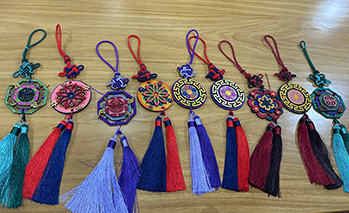 Norigae made by learners during the Dancheong craft activity
 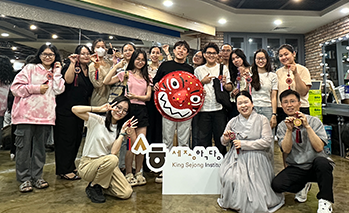 Commemorative photo taken after completing the norigae-making class
 Was there a particularly rewarding or meaningful moment during your practicum? Also, did you face any unexpected challenges while teaching or engaging in cultural exchanges with Vietnamese learners?
The most rewarding moments were when the learners actively participated in class. Whenever they responded enthusiastically to the activities or even the small jokes I had prepared, I felt that all my preparation had paid off. On the other hand, there were also challenges. After a long holiday break, during a class I was in charge of, I reviewed the vocabulary and grammar from the previous lesson before starting a listening activity—but to my surprise, most learners could not recall what they had learned. Caught off guard, I decided to spend much more time on review instead of proceeding with the planned listening activity. However, since I had only prepared that section lightly, I felt uneasy continuing the class. Fortunately, the lesson ended smoothly, but through that experience, I learned an important lesson: “There is no such thing as a light review. You must always be thoroughly prepared for every possible situation.” I was grateful that I could have this experience in a safe learning environment as part of a practicum. What initially felt like a difficulty became a valuable turning point that helped me grow stronger and more resilient as a teacher.
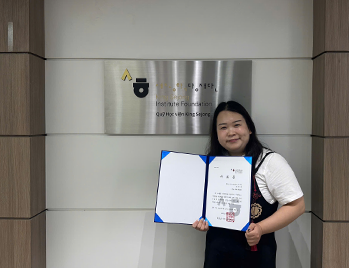 Completion ceremony for the 2025 KSI Prospective Korean Language Teacher Overseas Practicum after four weeks of training
 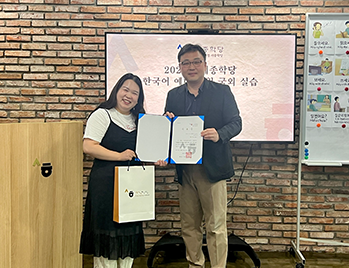 Commemorative photo with Director Park Sung-min of KSI Center Vietnam at the completion ceremony
 How do you think your experience as a KSI Prospective Korean Language Teacher will influence your future career or plans? Do you have any advice for those who aspire to become KSI Prospective Korean Language Teachers?
Through this practicum at KSI, I learned that a Korean language teacher is not simply someone who imparts knowledge of the Korean language, but someone who understands what learners need and helps fulfill those needs. In the past, I only thought vaguely about “becoming a teacher,” but now I am convinced that the true essence of teaching lies in preparing lessons centered on the learner’s growth and learning experience. Going forward, I hope to become a Korean language teacher who designs learner-centered classes. This experience has strengthened my confidence in my career path, and I plan to continue my research in graduate school while expanding my hands-on teaching experience in the field.
There is something I would like to share with those who dream of becoming KSI Prospective Korean Language Teachers. A plant can grow safely inside a greenhouse, but it cannot withstand the real world in that state. Likewise, field training at a local KSI is like a “pre-heating process” or a “safari experience”—a chance to experience the real teaching environment within a safe and supportive setting. In preparing to become a Korean language teacher, it is essential to have opportunities like this to face challenges, feel uncertain at times, and build resilience. Any shortcomings can be learned and filled through field experience, and that very process becomes an invaluable opportunity for growth. So, I truly encourage you to take on the challenge.